
BUTYRALDEHYDE
Butanal
BUTYRALDEHYDE is listed in the EU CosIng inventory, but no direct annex records are linked on this page yet.
Regulatory evidence by market
No rule for this ingredient has been imported for any of the 13 markets tracked here.
That describes this inventory, not the law. No imported rule is not evidence that an ingredient is permitted: a rule may exist under another name or identifier, or in a dataset not yet imported here.
Chemical identity and properties
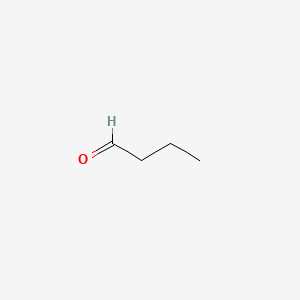
Butanal
Butanal is a member of the class of butanals that consists of propane bearing a formyl substituent at the 1-position. The parent of the class of butanals. It has a role as a biomarker, a mouse metabolite and an Escherichia coli metabolite. — ChEBI
- IUPAC name
- butanal
- Molecular formula
- C4H8O
- Molecular weight
- 72.11 g/mol
- Exact mass
- 72.057514874 Da
- XLogP3
- 0.9
- Topological polar surface area
- 17.1 Ų
- Hydrogen-bond donors
- 0
- Hydrogen-bond acceptors
- 1
- Covalent units
- 1
- Defined stereocentres
- 0
Also known as
16 more reported names
External database identifiers
- ChEBI:CHEBI:15743
- ChEMBL:CHEMBL1478334
- EPA DTXSID:DTXSID8021513
- PubMed:33358762
- PubMed:30002397
- PubMed:26079696
- PubMed:25014914
- PubMed:23065996
- PubMed:23009998
- PubMed:22979866
- PubMed:22959517
- PubMed:22831401
- PubMed:22824331
- PubMed:22803344
- PubMed:22776992
Evidence from additional scientific databases
NIH PubChem PUG-View
Attributed physical-property, hazard, environmental and use annotations.
- Autoignition Temperature: 446 °F (USCG, 1999) Source: CAMEO Chemicals
- Autoignition Temperature: 425 °F 218 °C Source: Hazardous Substances Data Bank (HSDB)
- Autoignition Temperature: 230 °C Source: ILO-WHO International Chemical Safety Cards (ICSCs)
- Boiling Point: 167 °F at 760 mmHg (NTP, 1992) Source: CAMEO Chemicals
- Boiling Point: 74.8 °C Source: Hazardous Substances Data Bank (HSDB)
- Boiling Point: 74.00 to 75.00 °C. @ 760.00 mm Hg Source: Human Metabolome Database (HMDB)
- Boiling Point: 74.8 °C Source: ILO-WHO International Chemical Safety Cards (ICSCs)
- Boiling Point: 74.8 °C Source: Joint FAO/WHO Expert Committee on Food Additives (JECFA)
- Boiling Point: 74.7 °C @760 [mm Hg] Source: PAC Chemical Database, U.S. Department of Energy
- Color/Form: Liquid Source: Hazardous Substances Data Bank (HSDB)
- Color/Form: Water-white liquid Source: Hazardous Substances Data Bank (HSDB)
- Density: 0.803 at 68 °F (USCG, 1999) - Less dense than water; will float Source: CAMEO Chemicals
- Density: 0.8016 g/cu cm 20 °C Source: Hazardous Substances Data Bank (HSDB)
- Density: 0.8 g/cm³ Source: ILO-WHO International Chemical Safety Cards (ICSCs)
- Density: 0.797-0.802 Source: Joint FAO/WHO Expert Committee on Food Additives (JECFA)
- Density: .802 @ 20°C Source: PAC Chemical Database, U.S. Department of Energy
- Flash Point: 20 °F (NTP, 1992) Source: CAMEO Chemicals
- Flash Point: 20 °F Source: Haz-Map, Information on Hazardous Chemicals and Occupational Diseases
- Flash Point: -8 °F (-22 °C) (CLOSED CUP) Source: Hazardous Substances Data Bank (HSDB)
- Flash Point: -12 °C c.c. Source: ILO-WHO International Chemical Safety Cards (ICSCs)
- LogP: log Kow = 0.88 Source: Hazardous Substances Data Bank (HSDB)
- LogP: 0.88 Source: Human Metabolome Database (HMDB)
- LogP: 0.88 Source: ILO-WHO International Chemical Safety Cards (ICSCs)
- Melting Point: -146 °F (NTP, 1992) Source: CAMEO Chemicals
- Melting Point: -96.86 °C Source: Hazardous Substances Data Bank (HSDB)
- Melting Point: -99 °C Source: Human Metabolome Database (HMDB)
- Melting Point: -99 °C Source: ILO-WHO International Chemical Safety Cards (ICSCs)
- Melting Point: -96.86 °C Source: PAC Chemical Database, U.S. Department of Energy
- Odor: Characteristic, pungent, aldehyde odor Source: Hazardous Substances Data Bank (HSDB)
- Physical Description: Butyraldehyde appears as a clear liquid with a pungent odor. Less dense than water and insoluble in water. Vapors heavier than air. Source: CAMEO Chemicals
- Physical Description: Liquid Source: EPA Chemical Data Reporting (CDR)
- Physical Description: A clear liquid with a pungent odor; [AIHA] Colorless liquid; [ICSC] Unpleasant rancid/sweet odor; [OECD SIDS] Source: Haz-Map, Information on Hazardous Chemicals and Occupational Diseases
- Physical Description: Liquid Source: Human Metabolome Database (HMDB)
- Physical Description: COLOURLESS LIQUID WITH PUNGENT ODOUR. Source: ILO-WHO International Chemical Safety Cards (ICSCs)
- Physical Description: colourless, mobile liquid/pungent, nutty odour Source: Joint FAO/WHO Expert Committee on Food Additives (JECFA)
- Refractive Index: Index of refraction: 1.3843 at 20 °C Source: Hazardous Substances Data Bank (HSDB)
- Refractive Index: 1.377-1.387 Source: Joint FAO/WHO Expert Committee on Food Additives (JECFA)
- Solubility: less than 1 mg/mL at 66 °F (NTP, 1992) Source: CAMEO Chemicals
- Solubility: Miscible with ethanol, ether, ethyl acetate, acetone, toluene, many other organic solvents andoils Source: Hazardous Substances Data Bank (HSDB)
- Solubility: Soluble in water; miscible with ethanol; very olubl ein acetone, benzene; slightly soluble in chloroform Source: Hazardous Substances Data Bank (HSDB)
- Solubility: In water, 7.10X10+4 mg/L at 25 °C Source: Hazardous Substances Data Bank (HSDB)
- Solubility: 71 mg/mL at 25 °C Source: Human Metabolome Database (HMDB)
- Solubility: Solubility in water, g/100ml: 7 Source: ILO-WHO International Chemical Safety Cards (ICSCs)
- Solubility: soluble in 1 ml in 15 ml water; miscible with alcohol, ether Source: Joint FAO/WHO Expert Committee on Food Additives (JECFA)
- Solubility: (in ethanol) Source: Joint FAO/WHO Expert Committee on Food Additives (JECFA)
- Vapor Pressure: 91.5 mmHg at 68 °F (NTP, 1992) Source: CAMEO Chemicals
- Vapor Pressure: 111.0 [mmHg] Source: Haz-Map, Information on Hazardous Chemicals and Occupational Diseases
- Vapor Pressure: 111 mm Hg at 25 °C Source: Hazardous Substances Data Bank (HSDB)
- Vapor Pressure: Vapor pressure, kPa at 20 °C: 12.2 Source: ILO-WHO International Chemical Safety Cards (ICSCs)
- Vapor Pressure: 111 [mm Hg] @25 °C Source: PAC Chemical Database, U.S. Department of Energy
- Viscosity: 0.45 cP at 20 °C Source: Hazardous Substances Data Bank (HSDB)
- IARC Carcinogenic Agent: Butyraldehyde Source: International Agency for Research on Cancer (IARC)
- IARC Carcinogenic Classes: Group 2B: Possibly carcinogenic to humans Source: International Agency for Research on Cancer (IARC)
- IARC Monographs: Volume 141 Source: International Agency for Research on Cancer (IARC)
- Publication Year: In prep. Source: International Agency for Research on Cancer (IARC)
- Evaluation Year: 2026 Source: International Agency for Research on Cancer (IARC)
- Exposure Routes: The substance can be absorbed into the body by inhalation of its vapour and by ingestion. Source: ILO-WHO International Chemical Safety Cards (ICSCs)
- First Aid: EYES: First check the victim for contact lenses and remove if present. Flush victim's eyes with water or normal saline solution for 20 to 30 minutes while simultaneously calling a hospital or poison control center. Do not put any ointments, oils, or medication in the victim's eyes without specific instructions from a physician. IMMEDIATELY transport the victim after flushing eyes to a hospital even if no symptoms (such as redness or irritation) develop.; SKIN: IMMEDIATELY flood affected skin with water while removing and isolating all contaminated clothing. Gently wash all affected skin areas thoroughly with soap and water. IMMEDIATELY call a hospital or poison control center even if no symptoms (such as redness or irritation) develop. IMMEDIATELY transport the victim to a hospital for treatment after washing the affected areas.; INHALATION: IMMEDIATELY leave the contaminated area; take deep breaths of fresh air. If symptoms (such as wheezing, coughing, shortness of breath, or burning in the mouth, throat, or chest) develop, call a physician and be prepared to transport the victim to a hospital. Provide proper respiratory protection to rescuers entering an unknown atmosphere. Whene Source: CAMEO Chemicals
- ERG2024, Guide 129P (Butyraldehyde): General First Aid:; · Call 911 or emergency medical service.; · Ensure that medical personnel are aware of the material(s) involved, take precautions to protect themselves and avoid contamination.; · Move victim to fresh air if it can be done safely.; · Administer oxygen if breathing is difficult.; · If victim is not breathing:; -- DO NOT perform mouth-to-mouth resuscitation; the victim may have ingested or inhaled the substance.; -- If equipped and pulse detected, wash face and mouth, then give artificial respiration using a proper respiratory medical device (bag-valve mask, pocket mask equipped with a one-way valve or other device).; -- If no pulse detected or no respiratory medical device available, provide continuous compressions. Conduct a pulse check every two minutes or monitor for any signs of spontaneous respirations.; · Remove and isolate contaminated clothing and shoes.; · For minor skin contact, avoid spreading material on unaffected skin.; · In case of contact with substance, remove immediately by flushing skin or eyes with running water for at least 20 minutes.; · For severe burns, immediate medical attention is required.; · Effects of exposure (inhalation, ingestion, Source: Emergency Response Guidebook (ERG)
- Signal: Danger Source: Regulation (EC) No 1272/2008 of the European Parliament and of the Council
- GHS Hazard Statements: H225: Highly Flammable liquid and vapor [Danger Flammable liquids] Source: Regulation (EC) No 1272/2008 of the European Parliament and of the Council
- Precautionary Statement Codes: P210, P233, P240, P241, P242, P243, P280, P303+P361+P353, P370+P378, P403+P235, and P501 (click each P-code to see the statement) Source: Regulation (EC) No 1272/2008 of the European Parliament and of the Council
- Signal: Danger Source: European Chemicals Agency (ECHA)
- GHS Hazard Statements: H225 (100%): Highly Flammable liquid and vapor [Danger Flammable liquids]; H319 (16.4%): Causes serious eye irritation [Warning Serious eye damage/eye irritation] Source: European Chemicals Agency (ECHA)
- Precautionary Statement Codes: P210, P233, P240, P241, P242, P243, P264+P265, P280, P303+P361+P353, P305+P351+P338, P337+P317, P370+P378, P403+P235, and P501 (click each P-code to see the statement) Source: European Chemicals Agency (ECHA)
- ECHA C&L Notifications Summary: Aggregated GHS information provided per 2152 reports by companies from 10 notifications to the ECHA C&L Inventory. Each notification may be associated with multiple companies.; Information may vary between notifications depending on impurities, additives, and other factors. The percentage value in parenthesis indicates the notified classification ratio from companies that provide hazard codes. Only hazard codes with percentage values above 10% are shown. For more detailed information, please visit ECHA C&L website. Source: European Chemicals Agency (ECHA)
- Signal: Danger Source: NITE-CMC
- GHS Hazard Statements: H350: May cause cancer [Danger Carcinogenicity]; H401: Toxic to aquatic life [Hazardous to the aquatic environment, acute hazard]; H412: Harmful to aquatic life with long lasting effects [Hazardous to the aquatic environment, long-term hazard] Source: NITE-CMC
- Precautionary Statement Codes: P203, P273, P280, P318, P405, and P501 (click each P-code to see the statement) Source: NITE-CMC
- GHS Hazard Statements: H225: Highly Flammable liquid and vapor [Danger Flammable liquids]; H319: Causes serious eye irritation [Warning Serious eye damage/eye irritation]; H370: Causes damage to organs [Danger Specific target organ toxicity, single exposure] Source: NITE-CMC
- Precautionary Statement Codes: P210, P233, P240, P241, P242, P243, P260, P264, P264+P265, P270, P280, P303+P361+P353, P305+P351+P338, P308+P316, P321, P337+P317, P370+P378, P403+P235, P405, and P501 (click each P-code to see the statement) Source: NITE-CMC
- NFPA Health Rating: 3 - Materials that, under emergency conditions, can cause serious or permanent injury. Source: Hazardous Substances Data Bank (HSDB)
- NFPA Fire Rating: 3 - Liquids and solids that can be ignited under almost all ambient temperature conditions. Materials produce hazardous atmospheres with air under almost all ambient temperatures or, though unaffected by ambient temperatures, are readily ignited under almost all conditions. Source: Hazardous Substances Data Bank (HSDB)
- NFPA Instability Rating: 0 - Materials that in themselves are normally stable, even under fire conditions. Source: Hazardous Substances Data Bank (HSDB)
- Environmental Bioconcentration: An estimated BCF of 3 was calculated in fish for butyraldehyde(SRC), using a log Kow of 0.88(1) and a regression-derived equation(2). According to a classification scheme(3), this BCF suggests the potential for bioconcentration in aquatic organisms is low(SRC). Source: Hazardous Substances Data Bank (HSDB)
- Environmental Fate: TERRESTRIAL FATE: Based on a classification scheme(1), an estimated Koc value of 72(SRC), determined from a log Kow of 0.88(2) and a regression-derived equation(3), indicates that butyraldehyde is expected to have high mobility in soil(SRC). Volatilization of butyraldehyde from moist soil surfaces is expected to be an important fate process(SRC) given a Henry's Law constant of 1.15X10⁻⁴ atm-cu m/mole(4). Butyraldehyde is expected to volatilize from dry soil surfaces(SRC) based upon a vapor pressure of 111 mm Hg(5). A theoretical BOD of 100% in 2 weeks using an activated sludge in the Japanese MITI test(6), suggests that biodegradation is an important environmental fate process in soil(SRC). Under anaerobic conditions, butanal underwent 99% degradation (7 day lag period) using the Hungate serum bottle technique(7). Source: Hazardous Substances Data Bank (HSDB)
- Environmental Fate: AQUATIC FATE: Based on a classification scheme(1), an estimated Koc value of 72(SRC), determined from a log Kow of 0.88(2) and a regression-derived equation(3), indicates that butyraldehyde is not expected to adsorb to suspended solids and sediment(SRC). Volatilization from water surfaces is expected(3) based upon a Henry's Law constant of 1.15X10⁻⁴ atm-cu m/mole(4). Using this Henry's Law constant and an estimation method(3), volatilization half-lives for a model river and model lake are 9 hrs and 5 days, respectively(SRC). The rate constant for the reaction between photochemically produced hydroxyl radicals in water and butyraldehyde is 3.9X10+9 L/mole-sec(5); at an aquatic concentration of 1X10-17 mole/L of hydroxyl radicals(6), the half-life would be about 206 days(SRC). According to a classification scheme(7), an estimated BCF of 3(SRC), from its log Kow(2) and a regression-derived equation(8), suggests the potential for bioconcentration in aquatic organisms is low(SRC). A theoretical BOD of 100% in 2 weeks using an activated sludge in the Japanese MITI test(9), suggests that biodegradation is an important environmental fate process in water(SRC).Under anaerobic conditions, bu Source: Hazardous Substances Data Bank (HSDB)
- Environmental Fate: ATMOSPHERIC FATE: According to a model of gas/particle partitioning of semivolatile organic compounds in the atmosphere(1), butyraldehyde, which has a vapor pressure of 111 mm Hg at 25 °C(2), is expected to exist solely as a vapor in the ambient atmosphere. Vapor-phase butyraldehyde is degraded in the atmosphere by reaction with photochemically-produced hydroxyl radicals(SRC); the half-life for this reaction in air is estimated to be 16 hrs(SRC), calculated from its rate constant of 2.35X10⁻¹¹ cu cm/molecule-sec at 25 °C(3). The rate constant for the vapor-phase reaction of butyraldehyde with nitrate radical has been experimentally determined to be 1.15X10⁻¹⁴ cu cm/sec(4), which corresponds to an atmospheric half-life of about 2.9 days(SRC). Butyraldehyde absorbs solar radiation (> 290 nm); direct photooxidation products include carbon monoxide, ethene, ethanal and carbon dioxide(5). Source: Hazardous Substances Data Bank (HSDB)
- Consumer Uses: Not Known or Reasonably Ascertainable Source: EPA Chemical Data Reporting (CDR)
- Industry Uses: Monomers; Intermediate; Not Known or Reasonably Ascertainable Source: EPA Chemical Data Reporting (CDR)
- Sources/Uses: Used to make rubber accelerators, solvents, synthetic resins, high polymers, plasticizers, and other chemicals; [HSDB] Used as a flavoring agent and generally recognized as safe by the FDA; [AIHA] Nearly all manufacturing, processing, and use confined to enclosed processes, with more than 90% being used as on-site reactant (making butanol, butyric acid, and 2-ethylhexanol); [OECD SIDS] Source: Haz-Map, Information on Hazardous Chemicals and Occupational Diseases
- Industrial Processes with risk of exposure: Welding Over Coatings [Category: Weld] Source: Haz-Map, Information on Hazardous Chemicals and Occupational Diseases
- Uses: For Butyraldehyde (USEPA/OPP Pesticide Code: 202500) there are 0 labels match. /SRP: Not registered for current use in the U.S., but approved pesticide uses may change periodically and so federal, state and local authorities must be consulted for currently approved uses./ Source: Hazardous Substances Data Bank (HSDB)
- Uses: Chiefly in manufacturing of rubber accelerators, synthetic resins, solvents, plasticizers. Source: Hazardous Substances Data Bank (HSDB)
- Uses: Reported uses (ppm): (FEMA, 2005); Table: Reported uses (ppm): (FEMA, 2005) [Table#4173] Source: Hazardous Substances Data Bank (HSDB)
- Uses: Use to manufacture 1-butanol, 2-ethylhexanol, poly(vinyl butyral), 2-ethylhexanal, trimethylolpropane, methyl amyl ketone, and butyric acid. Source: Hazardous Substances Data Bank (HSDB)
- Uses: Plasticizers, rubber accelerators, solvents, high polymers Source: Hazardous Substances Data Bank (HSDB)
Mapped by: Existing checksum-valid CAS to unique PubChem CID match. Retrieved: 2026-08-31. Open source record
Scientific classifications and hazard annotations provide context and do not replace the market-specific regulatory decision shown above.
Additional source coverage and match status
| Source | Result | Checked |
|---|---|---|
| NIH PubChem PUG-View | Exact match | 2026-08-31 |
A recorded no-match is useful evidence that the source was checked; it is not a claim that the substance does not exist elsewhere.
Retrieved from NIH PubChem on 2026-08-31 by checksum-valid CAS matching. Chemical properties do not replace the regulatory decision on this page.
Inventory details for BUTYRALDEHYDE
INCI name
BUTYRALDEHYDE
Description
Butanal
Record provenance
- Inventory reference
- 39175
- Imported identity
- BUTYRALDEHYDE
- Source update
- 02/03/2011
Annex records for BUTYRALDEHYDE
Key data
Related inventory evidence
Ingredients with overlapping formulation functions
Additional official and scientific sources
11 external databases to check this identity in
Each link searches that source for this identity. What each source is, and its legal weight
How BUTYRALDEHYDE appears in the CosIng inventory
The CosIng inventory lists BUTYRALDEHYDE as a cosmetic ingredient and this page links it to 0 annex records. The inventory entry captures names and identifiers, while the annex records show where the substance is prohibited, restricted or positively listed in EU cosmetics law.
BUTYRALDEHYDE is also tagged with 1 cosmetic function in the official data. Function labels describe intended use, but they do not replace regulatory review of linked annex records before formulation or labelling work.
Frequently asked questions
Source note for BUTYRALDEHYDE
This page reproduces the CosIng inventory entry for BUTYRALDEHYDE from public European Commission cosmetic ingredient materials and shows linked identifiers even when no direct annex match is currently attached.
Use this inventory page to research BUTYRALDEHYDE and compare linked records, but verify restrictions and legal status against the current official source text and law before making regulatory decisions.
Tools & next steps
Check your formula
Scan a full INCI list to detect BUTYRALDEHYDE and any linked EU annex restrictions or allergen flags.
INCI CheckerSearch similar ingredients
Find other inventory ingredients and annex entries related to BUTYRALDEHYDE, its identifiers or nearby name variants.
Search