
STEARALKONIUM CHLORIDE
Benzyldimethyl(octadecyl)ammonium chloride
STEARALKONIUM CHLORIDE is linked to 2 EU annex records on this page. Inventory note: III/65 V/54.
Regulatory evidence by market
This matrix separates verified ingredient rules from sources that are mapped but not yet imported. No imported rule does not mean the ingredient is permitted.
Swipe or scroll horizontally to see every column.
| Market | Evidence status | Records | Source language |
|---|---|---|---|
| European Union | Evidence linked Restricted entry found Open this evidence | 2 | English and EU languages |
| Great Britain | Source mapped Official source mapped; ingredient rule not imported | 0 | English |
| Canada | Source mapped Official source mapped; ingredient rule not imported | 0 | English and French |
| New Zealand | Source mapped Official source mapped; ingredient rule not imported | 0 | English |
| ASEAN | Source mapped Official source mapped; ingredient rule not imported | 0 | English and national languages |
| China | Source mapped Official source mapped; ingredient rule not imported | 0 | Chinese with selected English material |
| Japan | Source mapped Official source mapped; ingredient rule not imported | 0 | Japanese; official English translation available |
| South Korea | Source mapped Official source mapped; ingredient rule not imported | 0 | Korean with some English names |
| United States | Source mapped Official source mapped; ingredient rule not imported | 0 | English |
| Australia | Source mapped Official source mapped; ingredient rule not imported | 0 | English |
| Brazil | Source mapped Official source mapped; ingredient rule not imported | 0 | Portuguese with INCI crosswalks |
| India | Source mapped Official source mapped; ingredient rule not imported | 0 | English and Hindi |
| Saudi Arabia | Source mapped Official source mapped; ingredient rule not imported | 0 | Arabic and English |
Chemical identity and properties
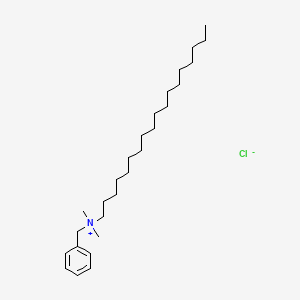
Benzyldimethylstearylammonium chloride
Benzyldimethyloctadecylammonium chloride appears as white solid or thick liquid with a mild odor. (USCG, 1999) — CAMEO Chemicals
- IUPAC name
- benzyl-dimethyl-octadecylazanium chloride
- Molecular formula
- C27H50ClN
- Molecular weight
- 424.1 g/mol
- Exact mass
- 423.3631783 Da
- Topological polar surface area
- 0.0 Ų
- Hydrogen-bond donors
- 0
- Hydrogen-bond acceptors
- 1
- Covalent units
- 2
- Defined stereocentres
- 0
Also known as
16 more reported names
External database identifiers
- ChEMBL:CHEMBL118663
- EPA DTXSID:DTXSID2025139
Evidence from additional scientific databases
NIH PubChem PUG-View
Attributed physical-property, hazard, environmental and use annotations.
- Boiling Point: DECOMP @ 120 °C Source: Hazardous Substances Data Bank (HSDB)
- Color/Form: WHITE, CRYSTALLINE POWDER Source: Hazardous Substances Data Bank (HSDB)
- Color/Form: SOLID OR VISCOUS LIQ, WHITE Source: Hazardous Substances Data Bank (HSDB)
- Density: greater than 1.1 at 68 °F (USCG, 1999) Source: CAMEO Chemicals
- Density: GREATER THAN 1.1 @ 20 °C (SOLID) Source: Hazardous Substances Data Bank (HSDB)
- LogP: log Kow= 3.23 Source: Hazardous Substances Data Bank (HSDB)
- Physical Description: Benzyldimethyloctadecylammonium chloride appears as white solid or thick liquid with a mild odor. (USCG, 1999) Source: CAMEO Chemicals
- Physical Description: Other Solid; CBI Source: EPA Chemical Data Reporting (CDR)
- Physical Description: White solid or viscous liquid; [HSDB] White crystalline powder; [MSDSonline] Source: Haz-Map, Information on Hazardous Chemicals and Occupational Diseases
- Solubility: less than 1 mg/mL at 70 °F (NTP, 1992) Source: CAMEO Chemicals
- Solubility: SOL IN WATER, CHLOROFORM, BENZENE, ACETONE, XYLENE Source: Hazardous Substances Data Bank (HSDB)
- First Aid: EYES: First check the victim for contact lenses and remove if present. Flush victim's eyes with water or normal saline solution for 20 to 30 minutes while simultaneously calling a hospital or poison control center. Do not put any ointments, oils, or medication in the victim's eyes without specific instructions from a physician. IMMEDIATELY transport the victim after flushing eyes to a hospital even if no symptoms (such as redness or irritation) develop.; SKIN: IMMEDIATELY flood affected skin with water while removing and isolating all contaminated clothing. Gently wash all affected skin areas thoroughly with soap and water. If symptoms such as redness or irritation develop, IMMEDIATELY call a physician and be prepared to transport the victim to a hospital for treatment.; INHALATION: IMMEDIATELY leave the contaminated area; take deep breaths of fresh air. If symptoms (such as wheezing, coughing, shortness of breath, or burning in the mouth, throat, or chest) develop, call a physician and be prepared to transport the victim to a hospital. Provide proper respiratory protection to rescuers entering an unknown atmosphere. Whenever possible, Self-Contained Breathing Apparatus (SCBA) shou Source: CAMEO Chemicals
- Note: This chemical does not meet GHS hazard criteria for 5.4% (32 of 591) of reports. Source: European Chemicals Agency (ECHA)
- Signal: Danger Source: European Chemicals Agency (ECHA)
- GHS Hazard Statements: H302 (86.5%): Harmful if swallowed [Warning Acute toxicity, oral]; H314 (84.3%): Causes severe skin burns and eye damage [Danger Skin corrosion/irritation]; H318 (83.9%): Causes serious eye damage [Danger Serious eye damage/eye irritation] Source: European Chemicals Agency (ECHA)
- Precautionary Statement Codes: P260, P264, P264+P265, P270, P280, P301+P317, P301+P330+P331, P302+P361+P354, P304+P340, P305+P354+P338, P316, P317, P321, P330, P363, P405, and P501 (click each P-code to see the statement) Source: European Chemicals Agency (ECHA)
- ECHA C&L Notifications Summary: Aggregated GHS information provided per 591 reports by companies from 21 notifications to the ECHA C&L Inventory. Each notification may be associated with multiple companies.; Reported as not meeting GHS hazard criteria per 32 of 591 reports by companies.; There are 20 notifications provided by 559 of 591 reports by companies with hazard statement code(s).; Information may vary between notifications depending on impurities, additives, and other factors. The percentage value in parenthesis indicates the notified classification ratio from companies that provide hazard codes. Only hazard codes with percentage values above 10% are shown. For more detailed information, please visit ECHA C&L website. Source: European Chemicals Agency (ECHA)
- Signal: Danger Source: NITE-CMC
- GHS Hazard Statements: H302: Harmful if swallowed [Warning Acute toxicity, oral]; H314: Causes severe skin burns and eye damage [Danger Skin corrosion/irritation]; H318: Causes serious eye damage [Danger Serious eye damage/eye irritation] Source: NITE-CMC
- Precautionary Statement Codes: P260, P264, P264+P265, P270, P280, P301+P317, P301+P330+P331, P302+P361+P354, P304+P340, P305+P354+P338, P316, P317, P321, P330, P363, P405, and P501 (click each P-code to see the statement) Source: NITE-CMC
- Signal: Danger Source: Hazardous Chemical Information System (HCIS), Safe Work Australia
- GHS Hazard Statements: H302: Harmful if swallowed [Warning Acute toxicity, oral]; H312: Harmful in contact with skin [Warning Acute toxicity, dermal]; H314: Causes severe skin burns and eye damage [Danger Skin corrosion/irritation]; H330: Fatal if inhaled [Danger Acute toxicity, inhalation] Source: Hazardous Chemical Information System (HCIS), Safe Work Australia
- Precautionary Statement Codes: P260, P264, P270, P271, P280, P284, P301+P317, P301+P330+P331, P302+P352, P302+P361+P354, P304+P340, P305+P354+P338, P316, P317, P320, P321, P330, P362+P364, P363, P403+P233, P405, and P501 (click each P-code to see the statement) Source: Hazardous Chemical Information System (HCIS), Safe Work Australia
- Cosmetic Ingredient Review Finding(s): Safe in the present practices of use and concentration. Ingredient, concentration, and use information are available in documents discoverable at https://cir-reports.cir-safety.org Source: Cosmetic Ingredient Review (CIR)
- Environmental Bioconcentration: An estimated BCF of 71 was calculated for benzyldimethylstearylammonium chloride(SRC), using a log Kow of 3.23(1) and a regression-derived equation(2). According to a classification scheme(3), this BCF suggests the potential for bioconcentration in aquatic organisms is moderate. Source: Hazardous Substances Data Bank (HSDB)
- Environmental Fate: TERRESTRIAL FATE: Based on a classification scheme(1), an estimated Koc value of 3X10+7(SRC), determined from a structure estimation method(2), indicates that benzyldimethylstearylammonium chloride is expected to be immobile in soil(SRC). Volatilization of benzyldimethylstearylammonium chloride from moist soil surfaces is not expected to be an important fate process(SRC) given an estimated Henry's Law constant of 4.2X10⁻¹¹ atm-cu m/mole(SRC), using a fragment constant estimation method(3). Benzyldimethylstearylammonium chloride is not expected to volatilize from dry soil surfaces(SRC) based upon an estimated vapor pressure of 1.2X10⁻¹³ mm Hg(SRC), determined from a fragment constant method(4). Source: Hazardous Substances Data Bank (HSDB)
- Environmental Fate: AQUATIC FATE: Based on a classification scheme(1), an estimated Koc value of 3X10+7(SRC), determined from an estimation method(2), indicates that benzyldimethylstearylammonium chloride is expected to adsorb to suspended solids and sediment in water(SRC). Volatilization from water surfaces is not expected(3) based upon an estimated Henry's Law constant of 4.2X10⁻¹¹ atm-cu m/mole(SRC), developed using a fragment constant estimation method(4). According to a classification scheme(5), an estimated BCF of 71(SRC), from its log Kow of 3.23(2) and a regression-derived equation(6), suggests the potential for bioconcentration in aquatic organisms is moderate. Using the SCAS method and the OECD Confirmatory test, 94 and 95% benzyldimethylstearylammonium chloride was degraded, respectively(8), suggesting that biodegradability in water is likely to be important(SRC). Source: Hazardous Substances Data Bank (HSDB)
- Environmental Fate: ATMOSPHERIC FATE: According to a model of gas/particle partitioning of semivolatile organic compounds in the atmosphere(1), benzyldimethylstearylammonium chloride, which has an estimated vapor pressure of 1.2X10⁻¹³ mm Hg at 25 °C(SRC), using a fragment constant estimation method(2), is expected to exist in the particulate phase in the ambient atmosphere. Particulate-phase benzyldimethylstearylammonium chloride may be removed from the air by wet and dry deposition(SRC). Source: Hazardous Substances Data Bank (HSDB)
- Consumer Uses: Surfactant (surface active agent) Source: EPA Chemical Data Reporting (CDR)
- Industry Uses: Surfactant (surface active agent); Other Source: EPA Chemical Data Reporting (CDR)
- Cosmetic Ingredient Review Link: CIR ingredient: Stearalkonium Chloride Source: Cosmetic Ingredient Review (CIR)
- Sources/Uses: Used as a cationic surfactant, wetting agent, emulsifier, germicide, fungicide, disinfectant, and slimicide; Used in industrial cleaners, emulsion polymerization processes, paper and textile processing, hair colors and conditioners (softener), lipsticks and lotions (emollient), textiles (softener), hair sprays (antistatic agent), and contraceptive formulations; [HSDB] Quaternary ammonium compounds are also used as algaecides/slimicides (swimming pools, industrial water reservoirs, and farm ponds), antiseptics for cleaning wounds, antistatic agents for textiles, softeners for paper products, and pigment dispersers; [IPCS-PIMs] Source: Haz-Map, Information on Hazardous Chemicals and Occupational Diseases
- Industrial Processes with risk of exposure: Pulp and Paper Processing [Category: Industry]; Textiles (Fiber & Fabric Manufacturing) [Category: Industry]; Using Disinfectants or Biocides [Category: Clean]; Dressing Hair [Category: Other] Source: Haz-Map, Information on Hazardous Chemicals and Occupational Diseases
- Uses: CATIONIC SURFACTANT Source: Hazardous Substances Data Bank (HSDB)
- Uses: SOFTENERS; WETTING AGENTS; EMULSIFIERS; SOME GRADES ARE GERMICIDES, FUNGICIDES, DISINFECTANTS, & SLIMICIDES. /AMMONYX/ Source: Hazardous Substances Data Bank (HSDB)
- Uses: Industrial and institutional cleaners, various detergents, emulsion polymerization processes, paper and textile processing. Source: Hazardous Substances Data Bank (HSDB)
- Uses: SOFTENER IN COSMETICS, EG, HAIR COLORS & CONDITIONERS; EMOLLIENT, EG, FOR LIPSTICKS, LOTIONS & TOILETRIES; TEXTILE SOFTENER; ANTISTATIC AGENT, EG, FOR AEROSOL HAIR SPRAYS; CHEM INT FOR SURFACE-MODIFIED CLAYS Source: Hazardous Substances Data Bank (HSDB)
- Uses: Contraceptive formulations Source: Hazardous Substances Data Bank (HSDB)
Mapped by: Existing checksum-valid CAS to unique PubChem CID match. Retrieved: 2026-08-31. Open source record
Scientific classifications and hazard annotations provide context and do not replace the market-specific regulatory decision shown above.
Additional source coverage and match status
| Source | Result | Checked |
|---|---|---|
| NIH PubChem PUG-View | Exact match | 2026-08-31 |
A recorded no-match is useful evidence that the source was checked; it is not a claim that the substance does not exist elsewhere.
Retrieved from NIH PubChem on 2026-08-31 by checksum-valid CAS matching. Chemical properties do not replace the regulatory decision on this page.
Inventory details for STEARALKONIUM CHLORIDE
INCI name
STEARALKONIUM CHLORIDE
Description
Benzyldimethyl(octadecyl)ammonium chloride
Record provenance
- Inventory reference
- 38237
- Imported identity
- STEARALKONIUM CHLORIDE
- Source update
- 21/11/2016
Annex records for STEARALKONIUM CHLORIDE
BENZALKONIUM CHLORIDE / BENZALKONIUM BROMIDE / BENZALKONIUM SACCHARINATE
BENZALKONIUM CHLORIDE / BENZALKONIUM BROMIDE / BENZALKONIUM SACCHARINATE
Key data
- ANTISTATIC
- Preventing and/or reducing static electricity by neutralising electrical charge on surfaces.
- PRESERVATIVE
- Exclusively or mainly intended to inhibit the development of micro-organisms in the cosmetic product. All authorised preservatives are substances in the positive list of Annex V to the Cosmetics Regulation 1223/2009.
- SURFACTANT - CLEANSING
- Wetting body surfaces, emulsifying or solubilizing oils, and suspending soil (generally, such ingredients contribute to the foaming and lathering properties of cleansing products).
Official EU ingredient-name evidence
The ingredient name exactly matches the official 2025 EU glossary of common ingredient names.
Related inventory evidence
Ingredients with overlapping formulation functions
Additional official and scientific sources
11 external databases to check this identity in
Each link searches that source for this identity. What each source is, and its legal weight
How STEARALKONIUM CHLORIDE appears in the CosIng inventory
The CosIng inventory lists STEARALKONIUM CHLORIDE as a cosmetic ingredient and this page links it to 2 annex records. The inventory entry captures names and identifiers, while the annex records show where the substance is prohibited, restricted or positively listed in EU cosmetics law.
STEARALKONIUM CHLORIDE is also tagged with 3 cosmetic functions in the official data. Function labels describe intended use, but they do not replace regulatory review of linked annex records before formulation or labelling work.
Frequently asked questions
Source note for STEARALKONIUM CHLORIDE
This page combines the CosIng inventory entry for STEARALKONIUM CHLORIDE with 2 linked Annex II–VI records from the local dataset built from public European Commission cosmetic ingredient materials.
Use this inventory page to research STEARALKONIUM CHLORIDE and compare linked records, but verify restrictions and legal status against the current official source text and law before making regulatory decisions.
Tools & next steps
Check your formula
Scan a full INCI list to detect STEARALKONIUM CHLORIDE and any linked EU annex restrictions or allergen flags.
INCI CheckerSearch similar ingredients
Find other inventory ingredients and annex entries related to STEARALKONIUM CHLORIDE, its identifiers or nearby name variants.
Search