
SODIUM SULFIDE
Disodium sulphide
SODIUM SULFIDE is linked to 1 EU annex record on this page. Inventory note: III/23.
Regulatory evidence by market
This matrix separates verified ingredient rules from sources that are mapped but not yet imported. No imported rule does not mean the ingredient is permitted.
Swipe or scroll horizontally to see every column.
| Market | Evidence status | Records | Source language |
|---|---|---|---|
| European Union | Evidence linked Restricted entry found Open this evidence | 1 | English and EU languages |
| Great Britain | Source mapped Official source mapped; ingredient rule not imported | 0 | English |
| Canada | Source mapped Official source mapped; ingredient rule not imported | 0 | English and French |
| New Zealand | Source mapped Official source mapped; ingredient rule not imported | 0 | English |
| ASEAN | Source mapped Official source mapped; ingredient rule not imported | 0 | English and national languages |
| China | Source mapped Official source mapped; ingredient rule not imported | 0 | Chinese with selected English material |
| Japan | Source mapped Official source mapped; ingredient rule not imported | 0 | Japanese; official English translation available |
| South Korea | Source mapped Official source mapped; ingredient rule not imported | 0 | Korean with some English names |
| United States | Source mapped Official source mapped; ingredient rule not imported | 0 | English |
| Australia | Source mapped Official source mapped; ingredient rule not imported | 0 | English |
| Brazil | Source mapped Official source mapped; ingredient rule not imported | 0 | Portuguese with INCI crosswalks |
| India | Source mapped Official source mapped; ingredient rule not imported | 0 | English and Hindi |
| Saudi Arabia | Source mapped Official source mapped; ingredient rule not imported | 0 | Arabic and English |
Chemical identity and properties
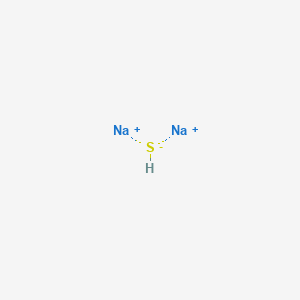
Sodium sulfide, hydrated, with not less than 30% water
Sodium sulfide, hydrated, with not less than 30% water appears as yellow-pink or white deliquescent crystals, flakes or lumps. Contains at least 30% water. Alkaline. Burns skin, eyes and mucous membranes. Mildly corrosive to most metals. May be toxic by skin absorption. Releases toxic hydrogen sulfide gas when mixed with an acid. — CAMEO Chemicals
- IUPAC name
- disodium;sulfanide
- Molecular formula
- HNa2S+
- Molecular weight
- 79.06 g/mol
- Exact mass
- 78.95943477 Da
- Topological polar surface area
- 1.0 Ų
- Hydrogen-bond donors
- 1
- Hydrogen-bond acceptors
- 1
- Covalent units
- 3
- Defined stereocentres
- 0
Also known as
14 more reported names
External database identifiers
- PubMed:15790858
Evidence from additional scientific databases
NIH PubChem PUG-View
Attributed physical-property, hazard, environmental and use annotations.
- Physical Description: Sodium sulfide, hydrated, with not less than 30% water appears as yellow-pink or white deliquescent crystals, flakes or lumps. Contains at least 30% water. Alkaline. Burns skin, eyes and mucous membranes. Mildly corrosive to most metals. May be toxic by skin absorption. Releases toxic hydrogen sulfide gas when mixed with an acid. Source: CAMEO Chemicals
- Physical Description: Wet Solid; Other Solid; Dry Powder; CBI; Large Crystals; Liquid Source: EPA Chemical Data Reporting (CDR)
- First Aid: Excerpt from ERG Guide 153 [Substances - Toxic and/or Corrosive (Combustible)]:; Refer to the "General First Aid" section. Specific First Aid: For corrosives, in case of contact, immediately flush skin or eyes with running water for at least 30 minutes. Additional flushing may be required. Removal of solidified molten material from skin requires medical assistance. (ERG, 2024) Source: CAMEO Chemicals
- Signal: Danger Source: European Chemicals Agency (ECHA)
- GHS Hazard Statements: H290 (14.7%): May be corrosive to metals [Warning Corrosive to Metals]; H301+H311 (15.7%): Toxic if swallowed or in contact with skin [Danger Acute toxicity, oral; acute toxicity, dermal]; H301 (65.3%): Toxic if swallowed [Danger Acute toxicity, oral]; H302 (34.8%): Harmful if swallowed [Warning Acute toxicity, oral]; H311 (96.2%): Toxic in contact with skin [Danger Acute toxicity, dermal]; H314 (100%): Causes severe skin burns and eye damage [Danger Skin corrosion/irritation]; H318 (62.9%): Causes serious eye damage [Danger Serious eye damage/eye irritation]; H400 (100%): Very toxic to aquatic life [Warning Hazardous to the aquatic environment, acute hazard] Source: European Chemicals Agency (ECHA)
- Precautionary Statement Codes: P234, P260, P262, P264, P264+P265, P270, P273, P280, P301+P316, P301+P317, P301+P330+P331, P302+P352, P302+P361+P354, P304+P340, P305+P354+P338, P316, P317, P321, P330, P361+P364, P363, P390, P391, P405, P406, and P501 (click each P-code to see the statement) Source: European Chemicals Agency (ECHA)
- ECHA C&L Notifications Summary: Aggregated GHS information provided per 1100 reports by companies from 24 notifications to the ECHA C&L Inventory. Each notification may be associated with multiple companies.; Information may vary between notifications depending on impurities, additives, and other factors. The percentage value in parenthesis indicates the notified classification ratio from companies that provide hazard codes. Only hazard codes with percentage values above 10% are shown. For more detailed information, please visit ECHA C&L website. Source: European Chemicals Agency (ECHA)
- Signal: Danger Source: NITE-CMC
- GHS Hazard Statements: H251: Self-heating; may catch fire [Danger Self-heating substances and mixtures]; H301: Toxic if swallowed [Danger Acute toxicity, oral]; H314: Causes severe skin burns and eye damage [Danger Skin corrosion/irritation]; H318: Causes serious eye damage [Danger Serious eye damage/eye irritation]; H335: May cause respiratory irritation [Warning Specific target organ toxicity, single exposure; Respiratory tract irritation]; H400: Very toxic to aquatic life [Warning Hazardous to the aquatic environment, acute hazard] Source: NITE-CMC
- Precautionary Statement Codes: P235, P260, P261, P264, P264+P265, P270, P271, P273, P280, P301+P316, P301+P330+P331, P302+P361+P354, P304+P340, P305+P354+P338, P316, P317, P319, P321, P330, P363, P391, P403+P233, P405, P407, P410, P413, P420, and P501 (click each P-code to see the statement) Source: NITE-CMC
- GHS Hazard Statements: H251: Self-heating; may catch fire [Danger Self-heating substances and mixtures]; H301: Toxic if swallowed [Danger Acute toxicity, oral]; H314: Causes severe skin burns and eye damage [Danger Skin corrosion/irritation]; H318: Causes serious eye damage [Danger Serious eye damage/eye irritation]; H371: May cause damage to organs [Warning Specific target organ toxicity, single exposure] Source: NITE-CMC
- Precautionary Statement Codes: P235, P260, P264, P264+P265, P270, P280, P301+P316, P301+P330+P331, P302+P361+P354, P304+P340, P305+P354+P338, P308+P316, P316, P317, P321, P330, P363, P405, P407, P410, P413, P420, and P501 (click each P-code to see the statement) Source: NITE-CMC
- Signal: Danger Source: Hazardous Chemical Information System (HCIS), Safe Work Australia
- GHS Hazard Statements: H301: Toxic if swallowed [Danger Acute toxicity, oral]; H312: Harmful in contact with skin [Warning Acute toxicity, dermal]; H314: Causes severe skin burns and eye damage [Danger Skin corrosion/irritation]; H400: Very toxic to aquatic life [Warning Hazardous to the aquatic environment, acute hazard] Source: Hazardous Chemical Information System (HCIS), Safe Work Australia
- Precautionary Statement Codes: P260, P264, P270, P273, P280, P301+P316, P301+P330+P331, P302+P352, P302+P361+P354, P304+P340, P305+P354+P338, P316, P317, P321, P330, P362+P364, P363, P391, P405, and P501 (click each P-code to see the statement) Source: Hazardous Chemical Information System (HCIS), Safe Work Australia
- Consumer Uses: Not Known or Reasonably Ascertainable Source: EPA Chemical Data Reporting (CDR)
- Industry Uses: Intermediate; Processing aids, specific to petroleum production; Solids separation (precipitating) agent, not otherwise specified; Not Known or Reasonably Ascertainable; pH regulating agent; Tanning agents not otherwise specified; Processing aids not otherwise specified; Lubricating agent; Other Source: EPA Chemical Data Reporting (CDR)
Mapped by: Existing checksum-valid CAS to unique PubChem CID match. Retrieved: 2026-08-31. Open source record
Scientific classifications and hazard annotations provide context and do not replace the market-specific regulatory decision shown above.
Additional source coverage and match status
| Source | Result | Checked |
|---|---|---|
| NIH PubChem PUG-View | Exact match | 2026-08-31 |
A recorded no-match is useful evidence that the source was checked; it is not a claim that the substance does not exist elsewhere.
Retrieved from NIH PubChem on 2026-09-02 by checksum-valid CAS matching. Chemical properties do not replace the regulatory decision on this page.
Inventory details for SODIUM SULFIDE
INCI name
SODIUM SULFIDE
Description
Disodium sulphide
Record provenance
- Inventory reference
- 38094
- Imported identity
- SODIUM SULFIDE
- Source update
- 15/10/2010
Annex records for SODIUM SULFIDE
Key data
- DEPILATORY
- Breaking down the mechanical strength of hair fibers so that they can be removed by mild scraping/rubbing.
Official EU ingredient-name evidence
The ingredient name exactly matches the official 2025 EU glossary of common ingredient names.
Related inventory evidence
Ingredients with overlapping formulation functions
Additional official and scientific sources
11 external databases to check this identity in
Each link searches that source for this identity. What each source is, and its legal weight
How SODIUM SULFIDE appears in the CosIng inventory
The CosIng inventory lists SODIUM SULFIDE as a cosmetic ingredient and this page links it to 1 annex record. The inventory entry captures names and identifiers, while the annex record shows where the substance is prohibited, restricted or positively listed in EU cosmetics law.
SODIUM SULFIDE is also tagged with 1 cosmetic function in the official data. Function labels describe intended use, but they do not replace regulatory review of linked annex records before formulation or labelling work.
Frequently asked questions
Source note for SODIUM SULFIDE
This page combines the CosIng inventory entry for SODIUM SULFIDE with 1 linked Annex II–VI record from the local dataset built from public European Commission cosmetic ingredient materials.
Use this inventory page to research SODIUM SULFIDE and compare linked records, but verify restrictions and legal status against the current official source text and law before making regulatory decisions.
Tools & next steps
Check your formula
Scan a full INCI list to detect SODIUM SULFIDE and any linked EU annex restrictions or allergen flags.
INCI CheckerSearch similar ingredients
Find other inventory ingredients and annex entries related to SODIUM SULFIDE, its identifiers or nearby name variants.
Search