
PIGMENT VIOLET 19
5,12-Dihydroquino[2,3-b]acridine-7,14-dione (CI 73900)
PIGMENT VIOLET 19 is linked to 2 EU annex records on this page. Inventory note: II/1366.
Regulatory evidence by market
This matrix separates verified ingredient rules from sources that are mapped but not yet imported. No imported rule does not mean the ingredient is permitted.
Swipe or scroll horizontally to see every column.
| Market | Evidence status | Records | Source language |
|---|---|---|---|
| European Union | Evidence linked Prohibited entry found Open this evidence | 2 | English and EU languages |
| Great Britain | Source mapped Official source mapped; ingredient rule not imported | 0 | English |
| Canada | Source mapped Official source mapped; ingredient rule not imported | 0 | English and French |
| New Zealand | Source mapped Official source mapped; ingredient rule not imported | 0 | English |
| ASEAN | Source mapped Official source mapped; ingredient rule not imported | 0 | English and national languages |
| China | Source mapped Official source mapped; ingredient rule not imported | 0 | Chinese with selected English material |
| Japan | Source mapped Official source mapped; ingredient rule not imported | 0 | Japanese; official English translation available |
| South Korea | Source mapped Official source mapped; ingredient rule not imported | 0 | Korean with some English names |
| United States | Source mapped Official source mapped; ingredient rule not imported | 0 | English |
| Australia | Source mapped Official source mapped; ingredient rule not imported | 0 | English |
| Brazil | Source mapped Official source mapped; ingredient rule not imported | 0 | Portuguese with INCI crosswalks |
| India | Source mapped Official source mapped; ingredient rule not imported | 0 | English and Hindi |
| Saudi Arabia | Source mapped Official source mapped; ingredient rule not imported | 0 | Arabic and English |
Chemical identity and properties
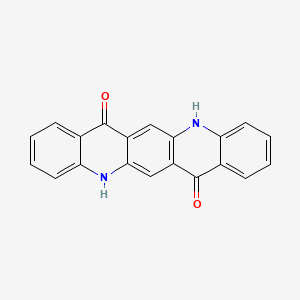
Quinacridone
Quinacridone is an organonitrogen heterocyclic compound and an organic heterotetracyclic compound. — ChEBI
- IUPAC name
- 5,12-dihydroquinolino[2,3-b]acridine-7,14-dione
- Molecular formula
- C20H12N2O2
- Molecular weight
- 312.3 g/mol
- Exact mass
- 312.089877630 Da
- XLogP3
- 4.0
- Topological polar surface area
- 58.2 Ų
- Hydrogen-bond donors
- 2
- Hydrogen-bond acceptors
- 4
- Covalent units
- 1
- Defined stereocentres
- 0
Also known as
16 more reported names
External database identifiers
Evidence from additional scientific databases
EMBL-EBI ChEBI
Quinacridone
- Formula
- C20H12N2O2
- Average mass
- 312.328 g/mol
- Monoisotopic mass
- 312.08988 Da
- Formal charge
- 0
- organonitrogen heterocyclic compound — is a (CHEBI:38101)
- organic heterotetracyclic compound — is a (CHEBI:38163)
- organonitrogen heterocyclic compound — is a (CHEBI:38101)
- organic heterotetracyclic compound — is a (CHEBI:38163)
Additional curated names
Cross-references from this source
- CAS: 1047-16-1 — ChemIDplus
- MANUAL_X_REF: 13369 — ChemSpider
- MANUAL_X_REF: HMDB0034058 — HMDB
Mapped by: Exact CAS cross-reference in the ChEBI compound record. Retrieved: 2026-08-31. Open source record
NIH PubChem PUG-View
Attributed physical-property, hazard, environmental and use annotations.
- Color/Form: Red to violet solid with blueish or yellowish tint depending upon crystalline form. Source: Hazardous Substances Data Bank (HSDB)
- Color/Form: particle characteristics: thin plates Source: Hazardous Substances Data Bank (HSDB)
- Density: 1.5 Source: Hazardous Substances Data Bank (HSDB)
- LogP: 1.9 (estimated) Source: Hazardous Substances Data Bank (HSDB)
- Melting Point: 390 °C Source: Human Metabolome Database (HMDB)
- Physical Description: Liquid; Other Solid; Dry Powder; Other Solid; CBI Source: EPA Chemical Data Reporting (CDR)
- Physical Description: Red to violet solid; Bluish or yellowish tint depending of form; [HSDB] Red odorless powder; [MSDSonline] Source: Haz-Map, Information on Hazardous Chemicals and Occupational Diseases
- Physical Description: Solid Source: Human Metabolome Database (HMDB)
- Refractive Index: Refractive index: quinacridine red (gamma), n(Na) Av. 2.04; quinacridine red (beta), Av. 2.02 Source: Hazardous Substances Data Bank (HSDB)
- Solubility: Insoluble in water Source: Hazardous Substances Data Bank (HSDB)
- Solubility: Insoluble in organic solvents and dispersion media. Source: Hazardous Substances Data Bank (HSDB)
- Note: This chemical does not meet GHS hazard criteria for 99.6% (760 of 763) of all reports. Source: European Chemicals Agency (ECHA)
- GHS Hazard Statements: Not Classified; Reported as not meeting GHS hazard criteria by 760 of 763 companies (only 0.4% companies provided GHS information). For more detailed information, please visit ECHA C&L website. Source: European Chemicals Agency (ECHA)
- ECHA C&L Notifications Summary: Aggregated GHS information provided per 763 reports by companies from 4 notifications to the ECHA C&L Inventory.; Reported as not meeting GHS hazard criteria per 760 of 763 reports by companies.; There are 2 notifications provided by 3 of 763 reports by companies with hazard statement code(s).; Information may vary between notifications depending on impurities, additives, and other factors. The percentage value in parenthesis indicates the notified classification ratio from companies that provide hazard codes. Only hazard codes with percentage values above 10% are shown. For more detailed information, please visit ECHA C&L website. Source: European Chemicals Agency (ECHA)
- Environmental Bioconcentration: Cinquasia red should not bioconcentrate, since it is insoluble, and therefore, will not be taken up into the body. Source: Hazardous Substances Data Bank (HSDB)
- Environmental Fate: Much of cinquasia red will be bound up in the components of landfills, junkyards, and general dump sites. Source: Hazardous Substances Data Bank (HSDB)
- Environmental Fate: Terrestrial: The insolubility of cinquasia red will cause it to collect in soils and sediments. Source: Hazardous Substances Data Bank (HSDB)
- Environmental Fate: Aquatic: Due to its insolubility, cinquasia red may reside in the water column for a substantial period, long enough to become part of deep sea sediments. Source: Hazardous Substances Data Bank (HSDB)
- Consumer Uses: Pigment Source: EPA Chemical Data Reporting (CDR)
- Industry Uses: Pigment Source: EPA Chemical Data Reporting (CDR)
- Sources/Uses: Used as pigment (paints, printing inks, plastics, rubber, alkyd resin enamels, textile emulsion inks, textiles, nitrocellulose, vinyl, and acrylic lacquers) and sensitizing dye in color photo electrophoresis; Used to tone and make other pigments; [HSDB] Source: Haz-Map, Information on Hazardous Chemicals and Occupational Diseases
- Industrial Processes with risk of exposure: Painting (Pigments, Binders, and Biocides) [Category: Paint]; Textiles (Printing, Dyeing, or Finishing) [Category: Industry] Source: Haz-Map, Information on Hazardous Chemicals and Occupational Diseases
- Uses: PAINTS, PRINTING INKS, PLASTICS, RUBBER Source: Hazardous Substances Data Bank (HSDB)
- Uses: Cinquasia red is used a sensitizing dye in color photoelectrophoresis. Source: Hazardous Substances Data Bank (HSDB)
- Uses: Pigment in textiles Source: Hazardous Substances Data Bank (HSDB)
- Uses: As colorants for plastics, quinacridone pigments may be used in all resins except nylon-66 and polystyrene./Quinacridone Pigments/ Source: Hazardous Substances Data Bank (HSDB)
- Uses: For more Uses (Complete) data for CINQUASIA RED (9 total), please visit the HSDB record page. Source: Hazardous Substances Data Bank (HSDB)
- Uses: Plastics -> Typical concentration range in plastic materials -> 2% Source: NORMAN Suspect List Exchange
Mapped by: Existing checksum-valid CAS to unique PubChem CID match. Retrieved: 2026-08-31. Open source record
Scientific classifications and hazard annotations provide context and do not replace the market-specific regulatory decision shown above.
Additional source coverage and match status
| Source | Result | Checked |
|---|---|---|
| EMBL-EBI ChEBI | Exact match | 2026-08-31 |
| NIH PubChem PUG-View | Exact match | 2026-08-31 |
A recorded no-match is useful evidence that the source was checked; it is not a claim that the substance does not exist elsewhere.
Retrieved from NIH PubChem on 2026-08-31 by checksum-valid CAS matching. Chemical properties do not replace the regulatory decision on this page.
Inventory details for PIGMENT VIOLET 19
INCI name
PIGMENT VIOLET 19
Description
5,12-Dihydroquino[2,3-b]acridine-7,14-dione (CI 73900)
Record provenance
- Inventory reference
- 36577
- Imported identity
- PIGMENT VIOLET 19
- Source update
- 15/10/2010
Annex records for PIGMENT VIOLET 19
5,12-Dihydroquino[2,3-b]acridine-7,14-dione (Pigment Violet 19; CI 73900) when used as a substance …
Key data
- HAIR DYEING
- Imparting color to hair. Hair dyeing preparations may be temporary, semi-permanent, or permanent, depending on the length of time the colorant remains on the hair.
Official EU ingredient-name evidence
The ingredient name exactly matches the official 2025 EU glossary of common ingredient names.
Related inventory evidence
Records sharing a CAS or EC identity
Ingredients with overlapping formulation functions
Additional official and scientific sources
11 external databases to check this identity in
Each link searches that source for this identity. What each source is, and its legal weight
How PIGMENT VIOLET 19 appears in the CosIng inventory
The CosIng inventory lists PIGMENT VIOLET 19 as a cosmetic ingredient and this page links it to 2 annex records. The inventory entry captures names and identifiers, while the annex records show where the substance is prohibited, restricted or positively listed in EU cosmetics law.
PIGMENT VIOLET 19 is also tagged with 1 cosmetic function in the official data. Function labels describe intended use, but they do not replace regulatory review of linked annex records before formulation or labelling work.
Frequently asked questions
Source note for PIGMENT VIOLET 19
This page combines the CosIng inventory entry for PIGMENT VIOLET 19 with 2 linked Annex II–VI records from the local dataset built from public European Commission cosmetic ingredient materials.
Use this inventory page to research PIGMENT VIOLET 19 and compare linked records, but verify restrictions and legal status against the current official source text and law before making regulatory decisions.
Tools & next steps
Check your formula
Scan a full INCI list to detect PIGMENT VIOLET 19 and any linked EU annex restrictions or allergen flags.
INCI CheckerSearch similar ingredients
Find other inventory ingredients and annex entries related to PIGMENT VIOLET 19, its identifiers or nearby name variants.
Search