
METHOXYISOPROPYL ACETATE
2-methoxy-1-methylethyl acetate
METHOXYISOPROPYL ACETATE is listed in the EU CosIng inventory, but no direct annex records are linked on this page yet.
Regulatory evidence by market
This matrix separates verified ingredient rules from sources that are mapped but not yet imported. No imported rule does not mean the ingredient is permitted.
Swipe or scroll horizontally to see every column.
| Market | Evidence status | Records | Source language |
|---|---|---|---|
| European Union | Source mapped Inventory entry; no linked annex rule | 0 | English and EU languages |
| Great Britain | Source mapped Official source mapped; ingredient rule not imported | 0 | English |
| Canada | Evidence linked Restricted Open this evidence | 1 | English and French |
| New Zealand | Source mapped Official source mapped; ingredient rule not imported | 0 | English |
| ASEAN | Source mapped Official source mapped; ingredient rule not imported | 0 | English and national languages |
| China | Source mapped Official source mapped; ingredient rule not imported | 0 | Chinese with selected English material |
| Japan | Source mapped Official source mapped; ingredient rule not imported | 0 | Japanese; official English translation available |
| South Korea | Source mapped Official source mapped; ingredient rule not imported | 0 | Korean with some English names |
| United States | Source mapped Official source mapped; ingredient rule not imported | 0 | English |
| Australia | Source mapped Official source mapped; ingredient rule not imported | 0 | English |
| Brazil | Source mapped Official source mapped; ingredient rule not imported | 0 | Portuguese with INCI crosswalks |
| India | Source mapped Official source mapped; ingredient rule not imported | 0 | English and Hindi |
| Saudi Arabia | Source mapped Official source mapped; ingredient rule not imported | 0 | Arabic and English |
Chemical identity and properties
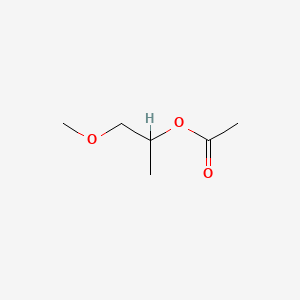
Propylene glycol methyl ether acetate
Propylene glycol methyl ether acetate is a colorless liquid with a sweet ether-like odor. (USCG, 1999) — CAMEO Chemicals
- IUPAC name
- 1-methoxypropan-2-yl acetate
- Molecular formula
- C6H12O3
- Molecular weight
- 132.16 g/mol
- Exact mass
- 132.078644241 Da
- XLogP3
- 0.4
- Topological polar surface area
- 35.5 Ų
- Hydrogen-bond donors
- 0
- Hydrogen-bond acceptors
- 3
- Covalent units
- 1
- Defined stereocentres
- 0
Also known as
16 more reported names
External database identifiers
- ChEMBL:CHEMBL3182130
- EPA DTXSID:DTXSID1026796
- PubMed:20358921
- PubMed:19553892
- PubMed:18385873
Evidence from additional scientific databases
NIH PubChem PUG-View
Attributed physical-property, hazard, environmental and use annotations.
- Autoignition Temperature: 670 °F (USCG, 1999) Source: CAMEO Chemicals
- Autoignition Temperature: 670 °F (354 °C) Source: Hazardous Substances Data Bank (HSDB)
- Boiling Point: 302 °F at 760 mmHg (USCG, 1999) Source: CAMEO Chemicals
- Boiling Point: 145-146 °C Source: Hazardous Substances Data Bank (HSDB)
- Boiling Point: BP: 145.8 °C at 101.325 kPa Source: Hazardous Substances Data Bank (HSDB)
- Boiling Point: BP: 302 °F = 150 °C = 423 K at 1 atm Source: Hazardous Substances Data Bank (HSDB)
- Boiling Point: 146 °C Source: ILO-WHO International Chemical Safety Cards (ICSCs)
- Boiling Point: 302 °F Source: Occupational Safety and Health Administration (OSHA)
- Color/Form: Colorless liquid at 15 °C and 1 atm Source: Hazardous Substances Data Bank (HSDB)
- Density: 0.969 at 68 °F (USCG, 1999) - Less dense than water; will float Source: CAMEO Chemicals
- Density: 0.969 at 20 °C Source: Hazardous Substances Data Bank (HSDB)
- Density: Saturated liquid density: 8.090 lbs/cu ft at 68 °F. Saturated vapor pressure: 0.072 lbs/sq in at 68 °C Source: Hazardous Substances Data Bank (HSDB)
- Density: Saturated vapor density: 0.00167 lbs/cu ft at 68 °C Source: Hazardous Substances Data Bank (HSDB)
- Density: Relative density (water = 1): 0.96 Source: ILO-WHO International Chemical Safety Cards (ICSCs)
- Density: 0.969 Source: Occupational Safety and Health Administration (OSHA)
- Flash Point: 114 °F (USCG, 1999) Source: CAMEO Chemicals
- Flash Point: 42 °C Source: Haz-Map, Information on Hazardous Chemicals and Occupational Diseases
- Flash Point: 45.5 °C (113.9 °F) - closed cup Source: Hazardous Substances Data Bank (HSDB)
- Flash Point: 108 °F (42 °C) - closed cup Source: Hazardous Substances Data Bank (HSDB)
- Flash Point: 42 °C c.c. Source: ILO-WHO International Chemical Safety Cards (ICSCs)
- LogP: log Kow = 0.56 Source: Hazardous Substances Data Bank (HSDB)
- Melting Point: -66 °C Source: Hazardous Substances Data Bank (HSDB)
- Odor: Sweet, ether-like Source: Hazardous Substances Data Bank (HSDB)
- Physical Description: Propylene glycol methyl ether acetate is a colorless liquid with a sweet ether-like odor. (USCG, 1999) Source: CAMEO Chemicals
- Physical Description: Dry Powder; Large Crystals; CBI; Liquid Source: EPA Chemical Data Reporting (CDR)
- Physical Description: Colorless, hygroscopic liquid, with a characteristic odor; [ICSC] Source: Haz-Map, Information on Hazardous Chemicals and Occupational Diseases
- Physical Description: Colorless liquid with a sweet odor like ether; [CAMEO] Source: Haz-Map, Information on Hazardous Chemicals and Occupational Diseases
- Physical Description: COLOURLESS HYGROSCOPIC LIQUID WITH CHARACTERISTIC ODOUR. Source: ILO-WHO International Chemical Safety Cards (ICSCs)
- Physical Description: Colorless, flammable liquid with sweet ether-like odor. Source: Occupational Safety and Health Administration (OSHA)
- Solubility: In water, 1.98X10+5 mg/L at 25 °C Source: Hazardous Substances Data Bank (HSDB)
- Solubility: In water, 198 g/L at 20 °C, pH 6.8 Source: Hazardous Substances Data Bank (HSDB)
- Solubility: Solubility in water, g/100ml: 19.8 Source: ILO-WHO International Chemical Safety Cards (ICSCs)
- Vapor Pressure: 3.92 [mmHg] Source: Haz-Map, Information on Hazardous Chemicals and Occupational Diseases
- Vapor Pressure: 7.72 [mmHg] Source: Haz-Map, Information on Hazardous Chemicals and Occupational Diseases
- Vapor Pressure: 3.92 mm Hg at 25 °C Source: Hazardous Substances Data Bank (HSDB)
- Vapor Pressure: Vapor pressure, kPa at 20 °C: 0.5 Source: ILO-WHO International Chemical Safety Cards (ICSCs)
- Viscosity: 1.23 sq mm/sec at 20 °C Source: Hazardous Substances Data Bank (HSDB)
- Exposure Routes: The substance can be absorbed into the body by inhalation of its aerosol or vapour and by ingestion. Source: ILO-WHO International Chemical Safety Cards (ICSCs)
- First Aid: Call for medical aid.; EYES: Wash with water for 15 min.; call a physician.; SKIN: Remove contaminated clothing and wash skin with soap and water.; INGESTION: Induce vomiting after drinking two glasses of water. (USCG, 1999) Source: CAMEO Chemicals
- Signal: Warning Source: Regulation (EC) No 1272/2008 of the European Parliament and of the Council
- GHS Hazard Statements: H226: Flammable liquid and vapor [Warning Flammable liquids] Source: Regulation (EC) No 1272/2008 of the European Parliament and of the Council
- Precautionary Statement Codes: P210, P233, P240, P241, P242, P243, P280, P303+P361+P353, P370+P378, P403+P235, and P501 (click each P-code to see the statement) Source: Regulation (EC) No 1272/2008 of the European Parliament and of the Council
- Note: This chemical does not meet GHS hazard criteria for < 0.1% (1 of 3028) of reports. Source: European Chemicals Agency (ECHA)
- Signal: Warning Source: European Chemicals Agency (ECHA)
- GHS Hazard Statements: H226 (> 99.9%): Flammable liquid and vapor [Warning Flammable liquids]; H336 (15.6%): May cause drowsiness or dizziness [Warning Specific target organ toxicity, single exposure; Narcotic effects] Source: European Chemicals Agency (ECHA)
- Precautionary Statement Codes: P210, P233, P240, P241, P242, P243, P261, P271, P280, P303+P361+P353, P304+P340, P319, P370+P378, P403+P233, P403+P235, P405, and P501 (click each P-code to see the statement) Source: European Chemicals Agency (ECHA)
- ECHA C&L Notifications Summary: Aggregated GHS information provided per 3028 reports by companies from 38 notifications to the ECHA C&L Inventory. Each notification may be associated with multiple companies.; Reported as not meeting GHS hazard criteria per 1 of 3028 reports by companies.; There are 37 notifications provided by 3027 of 3028 reports by companies with hazard statement code(s).; Information may vary between notifications depending on impurities, additives, and other factors. The percentage value in parenthesis indicates the notified classification ratio from companies that provide hazard codes. Only hazard codes with percentage values above 10% are shown. For more detailed information, please visit ECHA C&L website. Source: European Chemicals Agency (ECHA)
- Signal: Warning Source: NITE-CMC
- GHS Hazard Statements: H320: Causes eye irritation [Warning Serious eye damage/eye irritation]; H336: May cause drowsiness or dizziness [Warning Specific target organ toxicity, single exposure; Narcotic effects] Source: NITE-CMC
- Precautionary Statement Codes: P261, P264+P265, P271, P304+P340, P305+P351+P338, P319, P337+P317, P403+P233, P405, and P501 (click each P-code to see the statement) Source: NITE-CMC
- GHS Hazard Statements: H226: Flammable liquid and vapor [Warning Flammable liquids]; H320: Causes eye irritation [Warning Serious eye damage/eye irritation]; H335: May cause respiratory irritation [Warning Specific target organ toxicity, single exposure; Respiratory tract irritation]; H336: May cause drowsiness or dizziness [Warning Specific target organ toxicity, single exposure; Narcotic effects] Source: NITE-CMC
- NFPA Health Rating: 1 - Materials that, under emergency conditions, can cause significant irritation. Source: Hazardous Substances Data Bank (HSDB)
- NFPA Fire Rating: 2 - Materials that must be moderately heated or exposed to relatively high ambient temperatures before ignition can occur. Materials would not under normal conditions form hazardous atmospheres with air, but under high ambient temperatures or under moderate heating could release vapor in sufficient quantities to produce hazardous atmospheres with air. Source: Hazardous Substances Data Bank (HSDB)
- NFPA Instability Rating: 0 - Materials that in themselves are normally stable, even under fire conditions. Source: Hazardous Substances Data Bank (HSDB)
- Cosmetic Ingredient Review Finding(s): Safe in the present practices of use and concentration. Ingredient, concentration, and use information are available in documents discoverable at https://cir-reports.cir-safety.org Source: Cosmetic Ingredient Review (CIR)
- Toxicity Summary: IDENTIFICATION AND USE: 1-Methoxy-2-propyl acetate is used as a solvent in cosmetic formulations, as well as in surface coatings, inks, and cleaners. HUMAN STUDIES: The substance defats the skin, which may cause dryness or cracking. It is irritating to the eyes and respiratory tract. Exposure at high levels could cause depression of the central nervous system. ANIMAL STUDIES: Watery eyes, anorexia, rapid shallow breathing, and excess salivation were observed in rats given a single dose of 4000, 6300, or 10,000 mg/kg 1-methoxy-2-propyl acetate. 1-Methoxy-2-propyl acetate was not a skin irritant in rabbits. 10% 1-methoxy-2-propyl acetate in water was not a sensitizer in a guinea pig maximization test. Some slight changes were observed in the appearance of renal tissues in rats exposed to 3000 ppm 1-methoxy-2-propyl acetate. Slight to moderate degeneration of the olfactory epithelium in the nasal cavities was seen in rats and in mice. 1-Methoxy-2-propyl acetate had no adverse effect on reproductive parameters in rat developmental studies. 1-Methoxy-2-propyl acetate did not induce mutations or toxicity in Salmonella typhimurium strains TA98, TA100, TA1535, or TA1537 or in Escherichia c Source: Hazardous Substances Data Bank (HSDB)
- Environmental Bioconcentration: An estimated BCF of 3 was calculated in fish for 1-methoxy-2-propyl acetate(SRC), using a log Kow of 0.56(1) and a regression-derived equation(1). According to a classification scheme(2), this BCF suggests the potential for bioconcentration in aquatic organisms is low(SRC). Source: Hazardous Substances Data Bank (HSDB)
- Environmental Fate: TERRESTRIAL FATE: Based on a classification scheme(1), a measured log Koc of 0.362, corresponding to a Koc of 2.3(2) indicates that 1-methoxy-2-propyl acetate is expected to have very high mobility in soil(SRC). Volatilization of 1-methoxy-2-propyl acetate from moist soil surfaces is expected to be an important fate process(SRC) given an estimated Henry's Law constant of 3.4X10⁻⁶ atm-cu m/mole(SRC), based upon its vapor pressure, 3.92 mm Hg(3), and water solubility, 1.98X10+5 mg/L(2). 1-Methoxy-2-propyl acetate is expected to volatilize from dry soil surfaces(SRC) based upon its vapor pressure(2). 50% Biodegradation in less than one day using sandy and sandy loam soils(4) suggests that biodegradation is an important environmental fate process in soil(SRC). Source: Hazardous Substances Data Bank (HSDB)
- Environmental Fate: AQUATIC FATE: Based on a classification scheme(1), a measured log Koc of 0.362, corresponding to a Koc of 2.3(2) indicates that 1-methoxy-2-propyl acetate is not expected to adsorb to suspended solids and sediment(SRC). Volatilization from water surfaces is expected(3) based upon an estimated Henry's Law constant of 3.4X10⁻⁶ atm-cu m/mole(SRC), derived from its vapor pressure, 3.92 mm Hg(4), and water solubility, 1.2X10+5 mg/L(2). Using this Henry's Law constant and an estimation method(3), volatilization half-lives for a model river and model lake are 12 and 93 days, respectively(SRC). According to a classification scheme(5), an estimated BCF of 3(SRC), from its log Kow of 0.56(2) and a regression-derived equation(6), suggests the potential for bioconcentration in aquatic organisms is low(SRC). 100% Biodegadation in the Zahn-Wellens test(7) indicates that biodegradation is an important environmental fate process in water(SRC). Source: Hazardous Substances Data Bank (HSDB)
- Environmental Fate: ATMOSPHERIC FATE: According to a model of gas/particle partitioning of semivolatile organic compounds in the atmosphere(1), 1-methoxy-2-propyl acetate, which has a vapor pressure of 3.92 mm Hg at 25 °C(2), is expected to exist solely as a vapor in the ambient atmosphere. Vapor-phase 1-methoxy-2-propyl acetate is degraded in the atmosphere by reaction with photochemically-produced hydroxyl radicals(SRC); the half-life for this reaction in air is estimated to be 32 hrs(SRC), calculated from its rate constant of 1.2X10⁻¹¹ cu cm/molecule-sec at 25 °C(SRC) that was derived using a structure estimation method(3). d(1); this corresponds to half-lives of 2.4 yrs and 88 days at pH values of 7 and 8, respectively(1). Using an atmospheric simulation chamber, no photolysis of 1-methoxy-2-propyl acetate was observed(4); therefore, the compound is not expected to be susceptible to direct photolysis by sunlight(SRC). Source: Hazardous Substances Data Bank (HSDB)
- Consumer Uses: Cleaning agent; Not Known or Reasonably Ascertainable; Filler; Hardener; Pigment; Defoamer; Polymerization promoter; Dispersing agent; Solvent; Insulators; Binder; Monomers; Semiconductor and photovoltaic agent; Tanning agents not otherwise specified Source: EPA Chemical Data Reporting (CDR)
- Industry Uses: Not Known or Reasonably Ascertainable; Diluent; Cleaning agent; Hardener; Pigment; Drier; Adhesion/cohesion promoter; Intermediate; Other; Binder; Polymerization promoter; Solvent; Dispersing agent; Plating agent; Chemical reaction regulator; UV stabilizer; Processing aids not otherwise specified; Semiconductor and photovoltaic agent; Monomers; Tanning agents not otherwise specified Source: EPA Chemical Data Reporting (CDR)
- Cosmetic Ingredient Review Link: CIR ingredient: Methoxyisopropyl Acetate Source: Cosmetic Ingredient Review (CIR)
- Sources/Uses: Used as a solvent for paints, inks, lacquers, varnishes, cleaners, coatings, ink-removers, and pesticides; [eChemPortal: SIDSUNEP] Used in photoresist formulations in the semiconductor industry; Also used in solvents for degreasing circuit boards and in food contact applications; [CHEMINFO] Source: Haz-Map, Information on Hazardous Chemicals and Occupational Diseases
- Industrial Processes with risk of exposure: Metal Degreasing [Category: Clean]; Semiconductor Manufacturing [Category: Industry]; Painting (Solvents) [Category: Paint]; Silk-Screen Printing [Category: Other] Source: Haz-Map, Information on Hazardous Chemicals and Occupational Diseases
- Sources/Uses: Permitted for use as an inert ingredient in non-food pesticide products; [EPA] Source: Haz-Map, Information on Hazardous Chemicals and Occupational Diseases
- Uses: Methoxyisopropyl acetate functions as a solvent in cosmetic formulations ... . Methoxyisopropyl acetate is used in surface coatings, inks, and cleaners. Source: Hazardous Substances Data Bank (HSDB)
Mapped by: Existing checksum-valid CAS to unique PubChem CID match. Retrieved: 2026-08-31. Open source record
Scientific classifications and hazard annotations provide context and do not replace the market-specific regulatory decision shown above.
Additional source coverage and match status
| Source | Result | Checked |
|---|---|---|
| NIH PubChem PUG-View | Exact match | 2026-08-31 |
A recorded no-match is useful evidence that the source was checked; it is not a claim that the substance does not exist elsewhere.
Retrieved from NIH PubChem on 2026-09-02 by checksum-valid CAS matching. Chemical properties do not replace the regulatory decision on this page.
Inventory details for METHOXYISOPROPYL ACETATE
INCI name
METHOXYISOPROPYL ACETATE
Description
2-methoxy-1-methylethyl acetate
Record provenance
- Inventory reference
- 35268
- Imported identity
- METHOXYISOPROPYL ACETATE
- Source update
- 15/10/2010
Annex records for METHOXYISOPROPYL ACETATE
Key data
Official EU ingredient-name evidence
The ingredient name exactly matches the official 2025 EU glossary of common ingredient names.
Related inventory evidence
Ingredients with overlapping formulation functions
Additional official and scientific sources
11 external databases to check this identity in
Each link searches that source for this identity. What each source is, and its legal weight
How METHOXYISOPROPYL ACETATE appears in the CosIng inventory
The CosIng inventory lists METHOXYISOPROPYL ACETATE as a cosmetic ingredient and this page links it to 0 annex records. The inventory entry captures names and identifiers, while the annex records show where the substance is prohibited, restricted or positively listed in EU cosmetics law.
METHOXYISOPROPYL ACETATE is also tagged with 1 cosmetic function in the official data. Function labels describe intended use, but they do not replace regulatory review of linked annex records before formulation or labelling work.
Frequently asked questions
Source note for METHOXYISOPROPYL ACETATE
This page reproduces the CosIng inventory entry for METHOXYISOPROPYL ACETATE from public European Commission cosmetic ingredient materials and shows linked identifiers even when no direct annex match is currently attached.
Use this inventory page to research METHOXYISOPROPYL ACETATE and compare linked records, but verify restrictions and legal status against the current official source text and law before making regulatory decisions.
Tools & next steps
Check your formula
Scan a full INCI list to detect METHOXYISOPROPYL ACETATE and any linked EU annex restrictions or allergen flags.
INCI CheckerSearch similar ingredients
Find other inventory ingredients and annex entries related to METHOXYISOPROPYL ACETATE, its identifiers or nearby name variants.
Search