
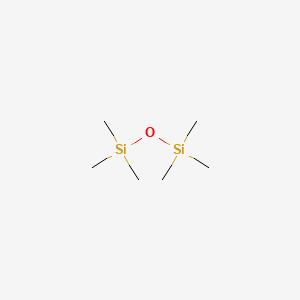
Hexamethyldisiloxane
Hexamethyldisiloxane is an organosiloxane consisting of two trimethylsilyl groups covalently bound to a central oxygen. — ChEBI
- IUPAC name
- trimethyl(trimethylsilyloxy)silane
- Molecular formula
- C6H18OSi2
- Molecular weight
- 162.38 g/mol
- Exact mass
- 162.08961826 Da
- Topological polar surface area
- 9.2 Ų
- Hydrogen-bond donors
- 0
- Hydrogen-bond acceptors
- 1
- Covalent units
- 1
- Defined stereocentres
- 0
Also known as
16 more reported names
External database identifiers
- ChEBI:CHEBI:78002
- ChEMBL:CHEMBL3184090
- EPA DTXSID:DTXSID4026769
- PubMed:23063792
- PubMed:23032697
- PubMed:22854496
- PubMed:22812650
- PubMed:22654788
- PubMed:22645580
- PubMed:22616015
- PubMed:22427945
- PubMed:22415221
- PubMed:22368056
- PubMed:22364745
- PubMed:22347616
Evidence from additional scientific databases
EMBL-EBI ChEBI
hexamethyldisiloxane
An organosiloxane consisting of two trimethylsilyl groups covalently bound to a central oxygen.
- Formula
- C6H18OSi2
- Average mass
- 162.381 g/mol
- Monoisotopic mass
- 162.08962 Da
- Formal charge
- 0
- organosiloxane — is a (CHEBI:48150)
- organosiloxane — is a (CHEBI:48150)
Additional curated names
Cross-references from this source
- CAS: 107-46-0 — NIST Chemistry WebBook
- CAS: 107-46-0 — ChemIDplus
- REGISTRY_NUMBER: 1736258 — Reaxys
- MANUAL_X_REF: Hexamethyldisiloxane — Wikipedia
Mapped by: Exact CAS cross-reference in the ChEBI compound record. Source updated: 2014-03-31. Retrieved: 2026-08-31. Open source record
NIH PubChem PUG-View
Attributed physical-property, hazard, environmental and use annotations.
- Boiling Point: 99 °C Source: Hazardous Substances Data Bank (HSDB)
- Boiling Point: 101 °C @760 [mm Hg] Source: PAC Chemical Database, U.S. Department of Energy
- Color/Form: FLUID Source: Hazardous Substances Data Bank (HSDB)
- Density: 0.7638 at 20 °C Source: Hazardous Substances Data Bank (HSDB)
- Density: 0.76 @ 20°C Source: PAC Chemical Database, U.S. Department of Energy
- Flash Point: -30 °C Source: Hazardous Substances Data Bank (HSDB)
- LogP: log Kow = 4.2 Source: Hazardous Substances Data Bank (HSDB)
- Melting Point: -66 °C Source: Hazardous Substances Data Bank (HSDB)
- Melting Point: -59 °C Source: PAC Chemical Database, U.S. Department of Energy
- Physical Description: Liquid; Liquid; Other Solid; CBI; Dry Powder Source: EPA Chemical Data Reporting (CDR)
- Physical Description: Liquid; [HSDB] Colorless liquid; [MSDSonline] Source: Haz-Map, Information on Hazardous Chemicals and Occupational Diseases
- Refractive Index: Index of Refraction: 1.3774 at 20 °C Source: Hazardous Substances Data Bank (HSDB)
- Solubility: In water, 0.93 mg/L at 25 °C Source: Hazardous Substances Data Bank (HSDB)
- Solubility: 0.93 mg/L @ 25 °C (exp) Source: Human Metabolome Database (HMDB)
- Vapor Pressure: 42.0 [mmHg] Source: Haz-Map, Information on Hazardous Chemicals and Occupational Diseases
- Viscosity: 0.51 centistokes at 20 °C Source: Hazardous Substances Data Bank (HSDB)
- Note: This chemical does not meet GHS hazard criteria for 0.1% (5 of 3584) of reports. Source: European Chemicals Agency (ECHA)
- Signal: Danger Source: European Chemicals Agency (ECHA)
- GHS Hazard Statements: H225 (98.8%): Highly Flammable liquid and vapor [Danger Flammable liquids]; H400 (92.6%): Very toxic to aquatic life [Warning Hazardous to the aquatic environment, acute hazard]; H410 (19.3%): Very toxic to aquatic life with long lasting effects [Warning Hazardous to the aquatic environment, long-term hazard]; H411 (71.3%): Toxic to aquatic life with long lasting effects [Hazardous to the aquatic environment, long-term hazard] Source: European Chemicals Agency (ECHA)
- Precautionary Statement Codes: P210, P233, P240, P241, P242, P243, P273, P280, P303+P361+P353, P370+P378, P391, P403+P235, and P501 (click each P-code to see the statement) Source: European Chemicals Agency (ECHA)
- ECHA C&L Notifications Summary: Aggregated GHS information provided per 3584 reports by companies from 24 notifications to the ECHA C&L Inventory. Each notification may be associated with multiple companies.; Reported as not meeting GHS hazard criteria per 5 of 3584 reports by companies.; There are 23 notifications provided by 3579 of 3584 reports by companies with hazard statement code(s).; Information may vary between notifications depending on impurities, additives, and other factors. The percentage value in parenthesis indicates the notified classification ratio from companies that provide hazard codes. Only hazard codes with percentage values above 10% are shown. For more detailed information, please visit ECHA C&L website. Source: European Chemicals Agency (ECHA)
- Signal: Danger Source: NITE-CMC
- GHS Hazard Statements: H225: Highly Flammable liquid and vapor [Danger Flammable liquids]; H315: Causes skin irritation [Warning Skin corrosion/irritation]; H332: Harmful if inhaled [Warning Acute toxicity, inhalation]; H372: Causes damage to organs through prolonged or repeated exposure [Danger Specific target organ toxicity, repeated exposure]; H400: Very toxic to aquatic life [Warning Hazardous to the aquatic environment, acute hazard]; H410: Very toxic to aquatic life with long lasting effects [Warning Hazardous to the aquatic environment, long-term hazard] Source: NITE-CMC
- Precautionary Statement Codes: P210, P233, P240, P241, P242, P243, P260, P261, P264, P270, P271, P273, P280, P302+P352, P303+P361+P353, P304+P340, P317, P319, P321, P332+P317, P362+P364, P370+P378, P391, P403+P235, and P501 (click each P-code to see the statement) Source: NITE-CMC
- GHS Hazard Statements: H225: Highly Flammable liquid and vapor [Danger Flammable liquids] Source: NITE-CMC
- Precautionary Statement Codes: P210, P233, P240, P241, P242, P243, P280, P303+P361+P353, P370+P378, P403+P235, and P501 (click each P-code to see the statement) Source: NITE-CMC
- Environmental Bioconcentration: An estimated BCF of 340 was calculated for hexamethyldisiloxane(SRC), using a log Kow of 4.2(1) and a regression-derived equation(2). According to a classification scheme(3), this BCF suggests the potential for bioconcentration in aquatic organisms is high(SRC), provided the compound is not metabolized by the organism(SRC). Source: Hazardous Substances Data Bank (HSDB)
- Environmental Fate: TERRESTRIAL FATE: Based on a classification scheme(1), an estimated Koc value of 4,600(SRC), determined from a log Kow of 4.2(2) and a regression-derived equation(3), indicates that hexamethyldisiloxane is expected to have slight mobility in soil(SRC). Volatilization of hexamethyldisiloxane from moist soil surfaces is expected to be an important fate process(SRC) given a estimated Henry's Law constant of 0.0453 atm-cu m/mole(4). Hexamethyldisiloxane is expected to volatilize from dry soil surfaces(SRC) based upon a vapor pressure of 42.1 mm Hg(5). However, adsorption to soil is expected to attenuate volatilization(SRC). No biodegradation data regarding hexamethyldisiloxane were found; however, dimethyl siloxanes in general are highly resistant to biodegradation(6). As a member of this class biodegradation is not expected to be an important fate process. Source: Hazardous Substances Data Bank (HSDB)
- Environmental Fate: TERRESTRIAL FATE: Poly(dimethylsiloxane) (PDMS) fluids in intimate contact with many soils undergo siloxane redistribution and hydrolysis, resulting in the formation of low molecular weight cyclic and linear oligomers. Low molecular weight hydroxy-functional hydrolysis products are water soluble, and the cyclics and trimethylsiloxy-end-blocked oligomers are volatile, thus providing materials which can partition from the soil to the water and atmospheric environmental compartments(1). /Poly(dimethylsiloxane)/ Source: Hazardous Substances Data Bank (HSDB)
- Environmental Fate: AQUATIC FATE: Based on a classification scheme(1), an estimated Koc value of 4,600(SRC), determined from a log Kow of 4.2(2) and a regression-derived equation(3), indicates that hexamethyldisiloxane is expected to adsorb to suspended solids and sediment(SRC). Volatilization from water surfaces is expected(3) based upon a Henry's Law constant of 0.0453 atm-cu m/mole(4). Using this Henry's Law constant and an estimation method(3), volatilization half-lives for a model river and model lake are 1.3 hours and 5 days, respectively(SRC). However, volatilization from water surfaces is expected to be attenuated by adsorption to suspended solids and sediment in the water column. The estimated volatilization half-life from a model pond is 30 days if adsorption is considered(5). According to a classification scheme(6), an estimated BCF of 340(SRC), from its log Kow(2) and a regression-derived equation(7), suggests the potential for bioconcentration in aquatic organisms is high(SRC). Polydimethylsiloxane fluids undergo siloxane bond rearrangement to form low molecular weight linear and cyclic oligomers that are water soluble(8), indicating that hydrolysis of hexamethyldisiloxane may be an impor Source: Hazardous Substances Data Bank (HSDB)
- Environmental Fate: ATMOSPHERIC FATE: According to a model of gas/particle partitioning of semivolatile organic compounds in the atmosphere(1), hexamethyldisiloxane, which has a vapor pressure of 42.1 mm Hg at 25 °C(2), is expected to exist solely as a vapor in the ambient atmosphere. Vapor-phase hexamethyldisiloxane is degraded in the atmosphere by reaction with photochemically-produced hydroxyl radicals(SRC); the half-life for this reaction in air is estimated to be 18 days(SRC), calculated from its rate constant of 1.4x10⁻¹² cu cm/molecule-sec at 25 °C(3). Methyl siloxanes are transparent to UV radiation >290 nm(4) and therefore hexamethyldisiloxane is not expected to undergo direct photolytic degradation(SRC). Source: Hazardous Substances Data Bank (HSDB)
- Consumer Uses: Diluent; Not Known or Reasonably Ascertainable; Anti-static agent; Insulators; Solvent; Other Source: EPA Chemical Data Reporting (CDR)
- Industry Uses: Other; Binder; Dispersing agent; Solvent; Insulators; Anti-adhesive/cohesive; Terminator/Blocker; Surface modifier; Adhesion/cohesion promoter; Intermediate; Diluent; Not Known or Reasonably Ascertainable; Cleaning agent Source: EPA Chemical Data Reporting (CDR)
- Sources/Uses: Used to make silicone fluids, elastomers, octamethylcyclotetrasiloxane, and fluorosilicone oils; Also used in cosmetics and in photolithography applications (adhesion promoter/priming agent); [HSDB] Source: Haz-Map, Information on Hazardous Chemicals and Occupational Diseases
- Uses: Hydraulic fluid /Organo Silicate MLO 5277/ Source: Hazardous Substances Data Bank (HSDB)
- Uses: Chemical intermediate for silicone fluids and elastomers Source: Hazardous Substances Data Bank (HSDB)
- Uses: Hexamethyldisiloxane is used in cosmetic and personal care products, in the production of octamethylcyclotetrasiloxane, as an adhesion promotor-priming agent for photolithography applications, and as an end blocking agent in the production of fluorosilicone oils. Source: Hazardous Substances Data Bank (HSDB)
- Uses: /Used/ ... for headlights ... as a protective layer 20-30 nm thick ... effective diffusion barrier (condensed water resistance is 1000 times greater than without coating) ... . Other applications include the hydrophilic coating of contact lenses and the coating of medical materials to improve biocompatibility. Source: Hazardous Substances Data Bank (HSDB)
- Uses: Used as antifoams in aqueous systems, in petroleum processing, and in laundry detergents ... In human and veterinary medicine ... used as antiflatulent agents ... Useful as lubricants (eg, for films, yarn, medical articles, wine corks, and fillers). /Polydimethylsiloxanes/ Source: Hazardous Substances Data Bank (HSDB)
Mapped by: Existing checksum-valid CAS to unique PubChem CID match. Retrieved: 2026-08-31. Open source record
Scientific classifications and hazard annotations provide context and do not replace the market-specific regulatory decision shown above.
Additional source coverage and match status
| Source | Result | Checked |
|---|---|---|
| EMBL-EBI ChEBI | Exact match | 2026-08-31 |
| NIH PubChem PUG-View | Exact match | 2026-08-31 |
A recorded no-match is useful evidence that the source was checked; it is not a claim that the substance does not exist elsewhere.
Retrieved from NIH PubChem on 2026-08-31 by checksum-valid CAS matching. Chemical properties do not replace the regulatory decision on this page.