
Official EU label nameGlossary entry 6476
CI 77499
This record confirms an official common ingredient name for EU cosmetic product labelling. It does not by itself confirm that the substance is permitted, unrestricted or safe.
Global evidence snapshot
The resolved identity has matching regulatory evidence in 3 of 13 indexed market datasets: 7 country records and 1 EU Annex records. Every result and evidence gap is listed below.
Markets checked
13
Markets with evidence
3
Evidence gaps
10
Resolved identifiers
19
Resolved substance identity
CAS:12227-89-31309-37-11317-61-91345-25-11345-27-352357-70-71332-25-851274-00-120344-49-4
EC:235-442-5215-168-2215-277-5215-721-8215-722-3257-870-1257-098-5215-570-8257-670-1235-442-9
Ingredient index records:
CI 77015
Cosmetic functions: COLORANT
Aluminum silicate coloured with ferric oxide
Inventory restriction note: IV/121
12 matched or reported names
CI 77499CI 77015CI 77489CI 77491CI 77492Iron Oxide BlackIron Oxide RedIron Oxide YellowIron oxideIron oxide red (Pigment Red 101)Iron oxide yellow (Pigment Yellow 42)Iron oxide black (Pigment Black 11)
Regulatory evidence in all 13 markets
Open each matched record for its scope, concentration, conditions, warnings and official source version.
Swipe or scroll horizontally to see dataset coverage and next actions.
| Market | Result | Records | Dataset | Meaning / next action |
|---|---|---|---|---|
| European Union EU | Conditional positive-list match | 1Open record 1 | Complete annex dataset Regulation (EC) 1223/2009 consolidated to 1 May 2026 | Review every linked record and exact conditions. |
| Great Britain GB | Permitted list with conditions | 3Open record 1Open record 2 | Complete consolidated annex dataset GB retained Regulation 1223/2009 schedules, effective 15 August 2026 | Review every linked record and exact conditions. |
| Canada CA | No local match | 0 | Complete Hotlist snapshot Health Canada Cosmetic Ingredient Hotlist, 13 August 2025 | The Hotlist is an administrative compliance tool, not an exhaustive safety approval list. |
| New Zealand NZ | Permitted list with conditions | 4Open record 1Open record 2 | Complete schedules dataset Cosmetic Products Group Standard schedules effective 1 January 2026 | Review every linked record and exact conditions. |
| ASEAN ASEAN | No local match | 0 | Complete regional annex dataset ASEAN Cosmetic Directive annexes 2026-1, 22 June 2026 | Regional annex coverage does not replace member-state implementation dates, notifications or national deviations. |
| China CN | No local match | 0 | Complete prohibited catalogues plus official-source workflow NMPA 2021 banned catalogues plus dynamic IECIC List I/List II system current since 2025 | IECIC listing is not blanket approval; absence may require the new cosmetic ingredient route, and restrictions are checked separately. |
| Japan JP | No local match | 0 | Complete Standards appendices dataset MHLW Standards for Cosmetics official English source and Japanese amendments checked for the imported snapshot | The Japanese text and subsequent notices are canonical; no local match is not a product-compliance conclusion. |
| South Korea KR | No local match | 0 | Complete current appendix dataset MFDS Notice 2026-19, effective 18 March 2026 | Korean source wording is canonical and other positive lists/notices may still apply to the formulation. |
| United States US | No local match | 0 | Complete enumerated federal ingredient rules eCFR Title 21 issue date 27 August 2026 | FDA has no general approved-cosmetic-ingredient catalogue; absence from these sections is not approval or proof of safety. |
| Australia AU | No local match | 0 | Complete cosmetic-relevant Poisons Standard subset plus official workflow Therapeutic Goods (Poisons Standard—June 2026) Instrument 2026 | An AICIS Inventory match is not cosmetic approval; no Inventory match can indicate a new, exempted, reported or confidential introduction. |
| Brazil BR | No local match | 0 | Complete prohibited dataset plus current restricted-list workflow ANVISA RDC 1.029/2026 and RDC 1.030/2026, published 15 June 2026 | RDC 1.030/2026 amends rather than replaces the prohibited baseline, and the second restricted-list revision was still under consultation in July 2026. |
| India IN | No local match | 0 | Complete current Part 2 dataset plus official workflow for Parts 1, 3 and 4 Cosmetics Rules 2020 plus current BIS IS 4707 parts (1:2020, 2:2025, 3:2025, 4:2022) | The standards are separate controlled publications; absence from a locally indexed excerpt is not permission. |
| Saudi Arabia SA | No local match | 0 | Complete official list index SFDA live prohibited/restricted lists, snapshot 30 August 2026 | No list match is not permission; Gulf/SFDA product, claim, notification and technical requirements still apply. |
No market rows match this filter.
Matching market records and conditions
Great Britain
GB retained Regulation 1223/2009 schedules, effective 15 August 2026Iron Oxide RedPermitted list with conditions
Purity criteria as set out in Commission Directive 95/45/EC (E 172)
GB Cosmetics Regulation, Annex IV, entry 135 · 2026-08-15
Iron Oxide YellowPermitted list with conditions
Purity criteria as set out in Commission Directive 95/45/EC (E 172)
GB Cosmetics Regulation, Annex IV, entry 136 · 2026-08-15
Iron Oxide BlackPermitted list with conditions
Purity criteria as set out in Commission Directive 95/45/EC (E 172)
GB Cosmetics Regulation, Annex IV, entry 137 · 2026-08-15
New Zealand
Cosmetic Products Group Standard schedules effective 1 January 2026Iron oxidePermitted list with conditions
Colour index: 77489 · CAS: 1345-25-1 · Colour: Orange
Schedule 6, reference 134, source row 150 · effective-2026-01-01
Iron oxide red (Pigment Red 101)Permitted list with conditions
Colour index: 77491 · CAS: 1309-37-1 · Colour: Red · Other limitations: E 172
Schedule 6, reference 135, source row 151 · effective-2026-01-01
Iron oxide yellow (Pigment Yellow 42)Permitted list with conditions
Colour index: 77492 · CAS: 51274-00-1 · Colour: Yellow · Other limitations: E 172
Schedule 6, reference 136, source row 152 · effective-2026-01-01
Iron oxide black (Pigment Black 11)Permitted list with conditions
Colour index: 77499 · CAS: 12227-89-3 · Colour: Black · Other limitations: E 172
Schedule 6, reference 137, source row 153 · effective-2026-01-01
Exact Annex II–VI evidence
Annex IVentry 137
Open full regulatory recordCI 77499
Warnings: Purity criteria as set out in Commission Directive 95/45/EC (E172)
Chemical identity and properties
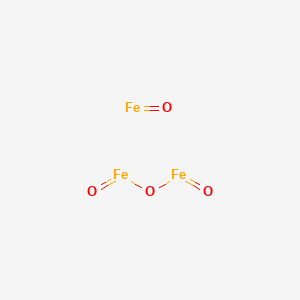
CAS 12227-89-3CAS 1317-61-9PubChem CID 16211978
Iron oxide (Fe3O4)
- IUPAC name
- oxoiron;oxo(oxoferriooxy)iron
- Molecular formula
- Fe3O4
- Molecular weight
- 231.53 g/mol
- Exact mass
- 231.784465 Da
- Topological polar surface area
- 60.4 Ų
- Hydrogen-bond donors
- 0
- Hydrogen-bond acceptors
- 4
- Covalent units
- 2
- Defined stereocentres
- 0
Also known as
Ferriferrous OxideOxide, FerriferrousOxide, FerrosoferricRefChem:9235661317-61-9215-277-5Black Iron OxideC.I. 77499
16 more reported names
CHEBI:50821EPT 500ferric ferrous oxideFerrosoferric OxideIron (II, III) OxideIron ores, magnetiteiron(II) diiron(III) oxideMagnetic BlackXM0M87F357Iron Oxide BlackIron(II,III)oxideEINECS 235-442-5Iron Oxide Pigment BlackIron(II,III) oxide, CPIron Oxide BlackDISCONTINUEDoxo[(oxoferrio)oxy]iron; oxoiron
Evidence from additional scientific databases
NIH PubChem PUG-View
Exact identifier match16211978
Attributed physical-property, hazard, environmental and use annotations.
- Density: 5.17 @25 °C Source: PAC Chemical Database, U.S. Department of Energy
- Melting Point: 1597 °C Source: PAC Chemical Database, U.S. Department of Energy
- Physical Description: CBI; Other Solid Source: EPA Chemical Data Reporting (CDR)
- Physical Description: CBI; Dry Powder; Wet Solid; Large Crystals; Wet Solid; Other Solid; Dry Powder; Dry Powder; Other Solid; Liquid; Other Solid; Dry Powder; Large Crystals; Liquid; Liquid; Dry Powder; Large Crystals Source: EPA Chemical Data Reporting (CDR)
- Note: This chemical does not meet GHS hazard criteria for 47% (956 of 2034) of reports. Source: European Chemicals Agency (ECHA)
- Signal: Warning Source: European Chemicals Agency (ECHA)
- GHS Hazard Statements: H252 (13%): Self-heating in large quantities; may catch fire [Warning Self-heating substances and mixtures]; H315 (32.3%): Causes skin irritation [Warning Skin corrosion/irritation]; H319 (32.8%): Causes serious eye irritation [Warning Serious eye damage/eye irritation]; H335 (32.3%): May cause respiratory irritation [Warning Specific target organ toxicity, single exposure; Respiratory tract irritation] Source: European Chemicals Agency (ECHA)
- Precautionary Statement Codes: P235, P261, P264, P264+P265, P271, P280, P302+P352, P304+P340, P305+P351+P338, P319, P321, P332+P317, P337+P317, P362+P364, P403+P233, P405, P407, P410, P413, P420, and P501 (click each P-code to see the statement) Source: European Chemicals Agency (ECHA)
- ECHA C&L Notifications Summary: Aggregated GHS information provided per 2034 reports by companies from 19 notifications to the ECHA C&L Inventory. Each notification may be associated with multiple companies.; Reported as not meeting GHS hazard criteria per 956 of 2034 reports by companies.; There are 17 notifications provided by 1078 of 2034 reports by companies with hazard statement code(s).; Information may vary between notifications depending on impurities, additives, and other factors. The percentage value in parenthesis indicates the notified classification ratio from companies that provide hazard codes. Only hazard codes with percentage values above 10% are shown. For more detailed information, please visit ECHA C&L website. Source: European Chemicals Agency (ECHA)
- Note: This chemical does not meet GHS hazard criteria for 98.1% (355 of 362) of all reports. Source: European Chemicals Agency (ECHA)
- GHS Hazard Statements: Not Classified; Reported as not meeting GHS hazard criteria by 355 of 362 companies (only 1.9% companies provided GHS information). For more detailed information, please visit ECHA C&L website. Source: European Chemicals Agency (ECHA)
- ECHA C&L Notifications Summary: Aggregated GHS information provided per 362 reports by companies from 5 notifications to the ECHA C&L Inventory.; Reported as not meeting GHS hazard criteria per 355 of 362 reports by companies.; There are 4 notifications provided by 7 of 362 reports by companies with hazard statement code(s).; Information may vary between notifications depending on impurities, additives, and other factors. The percentage value in parenthesis indicates the notified classification ratio from companies that provide hazard codes. Only hazard codes with percentage values above 10% are shown. For more detailed information, please visit ECHA C&L website. Source: European Chemicals Agency (ECHA)
- Consumer Uses: Pigment Source: EPA Chemical Data Reporting (CDR)
- Consumer Uses: Not Known or Reasonably Ascertainable; Filler; Pigment; Dye; Magnetic element; Other Source: EPA Chemical Data Reporting (CDR)
- Industry Uses: Pigment Source: EPA Chemical Data Reporting (CDR)
- Industry Uses: Adsorbent; Laboratory chemicals; Dye; Pigment; Filler; Not Known or Reasonably Ascertainable; Abrasives; CBI; Other; Alloys; Magnetic element Source: EPA Chemical Data Reporting (CDR)
Mapped by: Existing checksum-valid CAS to unique PubChem CID match. Retrieved: 2026-08-31. Open source record
Scientific classifications and hazard annotations provide context and do not replace the market-specific regulatory decision shown above.
Additional source coverage and match status
| Source | Result | Checked |
|---|---|---|
| NIH PubChem PUG-View | Exact match | 2026-08-31 |
A recorded no-match is useful evidence that the source was checked; it is not a claim that the substance does not exist elsewhere.
Retrieved from NIH PubChem on 2026-09-02 by checksum-valid CAS matching. Chemical properties do not replace the regulatory decision on this page.
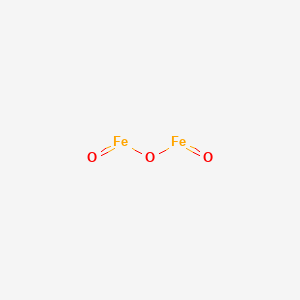
- IUPAC name
- oxo(oxoferriooxy)iron
- Molecular formula
- Fe2O3
- Molecular weight
- 159.69 g/mol
- Exact mass
- 159.854615 Da
- Topological polar surface area
- 43.4 Ų
- Hydrogen-bond donors
- 0
- Hydrogen-bond acceptors
- 3
- Covalent units
- 1
- Defined stereocentres
- 0
Also known as
Iron trioxideIron oxide, rediron(3+) oxideiron (III) oxideAnhydrous Ferric OxideAnhydrous Iron (III) OxideCHEBI:50819Ferrum Oxydatum
16 more reported names
Iron oxide,Hematite 8124Anhydrous Iron (III)RefChem:55186Ferric oxide (anhydrous)616-935-811554 Red1K09F3G675215-168-2Anchred standardAnhydrous iron oxideAnhydrous oxide of ironArmenian boleBayer S 11Bayferrox 105MBlack oxide of iron
External database identifiers
- ChEBI:CHEBI:50819
Evidence from additional scientific databases
NIH PubChem PUG-View
Exact identifier match518696
Attributed physical-property, hazard, environmental and use annotations.
- Color/Form: Reddish-brown hexagonal crystals Source: Hazardous Substances Data Bank (HSDB)
- Color/Form: Reddish or blueish-black powder Source: Hazardous Substances Data Bank (HSDB)
- Color/Form: Steel gray to red hexagonal Source: Hazardous Substances Data Bank (HSDB)
- Color/Form: Red-brown solid. /Iron oxide dust and fume, as Fe/ Source: Hazardous Substances Data Bank (HSDB)
- Color/Form: A fine, red powder of ferric oxide. /Rouge/ Source: Hazardous Substances Data Bank (HSDB)
- Density: 5.25 g/cu cm Source: Hazardous Substances Data Bank (HSDB)
- Density: 5.24 g/cm³ Source: ILO-WHO International Chemical Safety Cards (ICSCs)
- Density: 5.24 Source: Occupational Safety and Health Administration (OSHA)
- Density: 5.24 Source: The National Institute for Occupational Safety and Health (NIOSH)
- Melting Point: Iron 2664 °F Source: Haz-Map, Information on Hazardous Chemicals and Occupational Diseases
- Melting Point: 1539 °C Source: Hazardous Substances Data Bank (HSDB)
- Melting Point: 1565 °C Source: ILO-WHO International Chemical Safety Cards (ICSCs)
- Melting Point: 2664 °F Source: Occupational Safety and Health Administration (OSHA)
- Melting Point: 2664 °F Source: The National Institute for Occupational Safety and Health (NIOSH)
- Melting Point: 2849 °F Source: The National Institute for Occupational Safety and Health (NIOSH)
- Physical Description: Dry Powder; Other Solid; Dry Powder; Large Crystals; Liquid; Liquid; Dry Powder; Large Crystals; Liquid; Wet Solid; Other Solid; CBI; Large Crystals; Wet Solid; Other Solid; Dry Powder Source: EPA Chemical Data Reporting (CDR)
- Physical Description: Reddish-brown solid; Note: Exposure to fume may occur during the arc-welding of iron; [NIOSH] Insoluble in water; [CHEMINFO] Source: Haz-Map, Information on Hazardous Chemicals and Occupational Diseases
- Physical Description: REDDISH BROWN-TO-BLACK CRYSTALS OR POWDER. Source: ILO-WHO International Chemical Safety Cards (ICSCs)
- Physical Description: Reddish-brown solid. Source: Occupational Safety and Health Administration (OSHA)
- Physical Description: Reddish-brown solid. [Note: Exposure to fume may occur during the arc-welding of iron.] Source: The National Institute for Occupational Safety and Health (NIOSH)
- Physical Description: A fine, red powder of ferric oxide. [Note: Usually used in cake form or impregnated in paper or cloth.] Source: The National Institute for Occupational Safety and Health (NIOSH)
- Refractive Index: Index of refraction: 3.01, 2.94 (LI) Source: Hazardous Substances Data Bank (HSDB)
- Solubility: Soluble in acids; insoluble in water, alcohol, ether Source: Hazardous Substances Data Bank (HSDB)
- Solubility: Solubility in water: none Source: ILO-WHO International Chemical Safety Cards (ICSCs)
- Solubility: Insoluble Source: The National Institute for Occupational Safety and Health (NIOSH)
- Vapor Pressure: 0 mm Hg (approximate) Source: Hazardous Substances Data Bank (HSDB)
- Vapor Pressure: 0 mmHg (approx) Source: Occupational Safety and Health Administration (OSHA)
- Vapor Pressure: 0 mmHg (approx) Source: The National Institute for Occupational Safety and Health (NIOSH)
- IARC Carcinogenic Agent: Ferric oxide Source: International Agency for Research on Cancer (IARC)
- IARC Carcinogenic Classes: Group 3: Not classifiable as to its carcinogenicity to humans Source: International Agency for Research on Cancer (IARC)
- IARC Monographs: Volume 1: (1972) Some Inorganic Substances, Chlorinated Hydrocarbons, Aromatic Amines, N-Nitroso Compounds, and Natural Products; Volume Sup 7: Overall Evaluations of Carcinogenicity: An Updating of IARC Monographs Volumes 1 to 42, 1987; 440 pages; ISBN 92-832-1411-0 (out of print) Source: International Agency for Research on Cancer (IARC)
- Publication Year: 1987 Source: International Agency for Research on Cancer (IARC)
- Evaluation Year: 1987 Source: International Agency for Research on Cancer (IARC)
- Exposure Routes: inhalation Source: The National Institute for Occupational Safety and Health (NIOSH)
- Exposure Routes: inhalation, skin and/or eye contact Source: The National Institute for Occupational Safety and Health (NIOSH)
- First Aid: (General first aid procedures); Breathing: Respiratory support Source: The National Institute for Occupational Safety and Health (NIOSH)
- First Aid: (General first aid procedures); Eye: Irrigate immediately - If this chemical contacts the eyes, immediately wash (irrigate) the eyes with large amounts of water, occasionally lifting the lower and upper lids. Get medical attention immediately.; Breathing: Fresh air Source: The National Institute for Occupational Safety and Health (NIOSH)
- Note: This chemical does not meet GHS hazard criteria for 66.9% (2296 of 3433) of all reports. Source: European Chemicals Agency (ECHA)
- Signal: Warning Source: European Chemicals Agency (ECHA)
- GHS Hazard Statements: H319 (18.5%): Causes serious eye irritation [Warning Serious eye damage/eye irritation]; H411 (12%): Toxic to aquatic life with long lasting effects [Hazardous to the aquatic environment, long-term hazard] Source: European Chemicals Agency (ECHA)
- Precautionary Statement Codes: P264+P265, P273, P280, P305+P351+P338, P337+P317, P391, and P501 (click each P-code to see the statement) Source: European Chemicals Agency (ECHA)
- ECHA C&L Notifications Summary: Aggregated GHS information provided per 3433 reports by companies from 44 notifications to the ECHA C&L Inventory. Each notification may be associated with multiple companies.; Reported as not meeting GHS hazard criteria per 2296 of 3433 reports by companies.; There are 40 notifications provided by 1137 of 3433 reports by companies with hazard statement code(s).; Information may vary between notifications depending on impurities, additives, and other factors. The percentage value in parenthesis indicates the notified classification ratio from companies that provide hazard codes. Only hazard codes with percentage values above 10% are shown. For more detailed information, please visit ECHA C&L website. Source: European Chemicals Agency (ECHA)
- Signal: Danger Source: NITE-CMC
- GHS Hazard Statements: H370: Causes damage to organs [Danger Specific target organ toxicity, single exposure]; H372: Causes damage to organs through prolonged or repeated exposure [Danger Specific target organ toxicity, repeated exposure] Source: NITE-CMC
- Precautionary Statement Codes: P260, P264, P270, P308+P316, P319, P321, P405, and P501 (click each P-code to see the statement) Source: NITE-CMC
- GHS Hazard Statements: H315: Causes skin irritation [Warning Skin corrosion/irritation]; H318: Causes serious eye damage [Danger Serious eye damage/eye irritation]; H335: May cause respiratory irritation [Warning Specific target organ toxicity, single exposure; Respiratory tract irritation]; H372: Causes damage to organs through prolonged or repeated exposure [Danger Specific target organ toxicity, repeated exposure] Source: NITE-CMC
- Precautionary Statement Codes: P260, P261, P264, P264+P265, P270, P271, P280, P302+P352, P304+P340, P305+P354+P338, P317, P319, P321, P332+P317, P362+P364, P403+P233, P405, and P501 (click each P-code to see the statement) Source: NITE-CMC
- Target Organs: respiratory system Source: The National Institute for Occupational Safety and Health (NIOSH)
- Target Organs: Eyes, skin, respiratory system Source: The National Institute for Occupational Safety and Health (NIOSH)
- Consumer Uses: Other; Soil amendments (fertilizers); Catalyst; Filler; Not Known or Reasonably Ascertainable; Pigment; Intermediate; Dye Source: EPA Chemical Data Reporting (CDR)
- Industry Uses: Reducing agent; Soil amendments (fertilizers); Catalyst; Not Known or Reasonably Ascertainable; Filler; Oxidizing agent; Adsorbent; Laboratory chemicals; Dye; Pigment; Solids separation (precipitating) agent, not otherwise specified; Intermediate; Heat stabilizer; Processing aids, specific to petroleum production; Other; Alloys; Abrasives Source: EPA Chemical Data Reporting (CDR)
- Sources/Uses: Iron oxide is used in pigments, abrasives (jeweler's rouge), and magnetic tapes. Exposure can occur in mining, smelting, grinding steel, polishing, and welding; [ACGIH] Source: Haz-Map, Information on Hazardous Chemicals and Occupational Diseases
- Industrial Processes with risk of exposure: Steel Producing [Category: Industry]; Abrasive Blasting [Category: Clean]; Metal Preparation and Pouring [Category: Foundry]; Welding [Category: Weld]; Painting (Pigments, Binders, and Biocides) [Category: Paint]; Mining [Category: Industry]; Cement Producing [Category: Industry]; Metal Extraction and Refining [Category: Industry] Source: Haz-Map, Information on Hazardous Chemicals and Occupational Diseases
- Uses: Polishing agent for glass, precious metals, diamonds; in magnets, magnetic tapes; as catalyst; pigment for paper, linoleum, ceramics, glass; paint for ironwork, ship hulls; in electrical resistors and semiconductors; as colloidal solutions as stain for polysaccharides. Source: Hazardous Substances Data Bank (HSDB)
- Uses: As a pigment, mfr of ferrites for electronic uses. Source: Hazardous Substances Data Bank (HSDB)
- Uses: Metallurgy, gas purification, paint and rubber pigment, component of thermite, polishing compounds, mordant, lab reagent, catalyst (p-hydrogen), feed additive, electronic pigments for TV, permanent magnets, memory cores for computers, magnetic tapes. Source: Hazardous Substances Data Bank (HSDB)
- Uses: Used almost exclusively to color decorative concrete; in paints and coatings Source: Hazardous Substances Data Bank (HSDB)
- Uses: For more Uses (Complete) data for FERRIC OXIDE (8 total), please visit the HSDB record page. Source: Hazardous Substances Data Bank (HSDB)
Mapped by: Existing checksum-valid CAS to unique PubChem CID match. Retrieved: 2026-08-31. Open source record
Scientific classifications and hazard annotations provide context and do not replace the market-specific regulatory decision shown above.
Additional source coverage and match status
| Source | Result | Checked |
|---|---|---|
| NIH PubChem PUG-View | Exact match | 2026-08-31 |
A recorded no-match is useful evidence that the source was checked; it is not a claim that the substance does not exist elsewhere.
Retrieved from NIH PubChem on 2026-09-02 by checksum-valid CAS matching. Chemical properties do not replace the regulatory decision on this page.
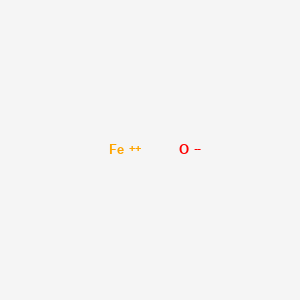
CAS 1345-25-1PubChem CID 449809
Ferrous oxide
- IUPAC name
- iron(2+);oxygen(2-)
- Molecular formula
- FeO
- Molecular weight
- 71.84 g/mol
- Exact mass
- 71.929850 Da
- Topological polar surface area
- 1.0 Ų
- Hydrogen-bond donors
- 0
- Hydrogen-bond acceptors
- 1
- Covalent units
- 2
- Defined stereocentres
- 0
Also known as
Iron oxide (FeO)G7036X8B5HCI 77489C.I. 77489IRON (II) OXIDERefChem:921574215-721-8CHEBI:50820
9 more reported names
Iron monooxideIron monoxideIron(II) oxideNatural wuestiteFERROUS OXIDE [II]FERROUS OXIDE [MI]FERROUS OXIDE [HSDB]FERROUS OXIDE [VANDF]VBMVTYDPPZVILR-UHFFFAOYSA-N
External database identifiers
- EPA DTXSID:DTXSID1041976
Retrieved from NIH PubChem on 2026-09-02 by checksum-valid CAS matching. Chemical properties do not replace the regulatory decision on this page.
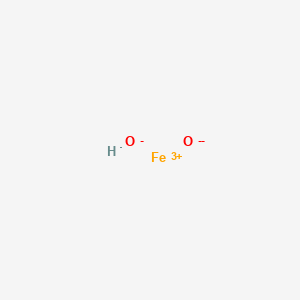
CAS 20344-49-4PubChem CID 9793696
iron hydroxide oxide (Fe(OH)O)
Ferric oxyhydroxide is a Phosphate Binder. The mechanism of action of ferric oxyhydroxide is as a Phosphate Chelating Activity. — FDA Pharm Classes
- IUPAC name
- iron(3+);oxygen(2-);hydroxide
- Molecular formula
- FeHO2
- Molecular weight
- 88.85 g/mol
- Exact mass
- 88.932590 Da
- Topological polar surface area
- 2.0 Ų
- Hydrogen-bond donors
- 1
- Hydrogen-bond acceptors
- 2
- Covalent units
- 3
- Defined stereocentres
- 0
Also known as
Ferric oxyhydroxideFerric hydroxide oxideFERRIC OXY-HYDROXIDEIRON HYDROXIDE OXIDE (FEO(OH))5Fe2O3.9H2OFERRIC OXYHYDROXIDE (FEO2H)FERRIC HYDROXIDE OXIDE (FEOOH)Proferdex
10 more reported names
RefChem:791334243-746-487PZU03K0KIron hydroxide oxideiron(III) oxyhydroxideFeHO2ferric;oxygen(2-);hydroxideFERRIC HYDROXIDE [MI]IEECXTSVVFWGSE-UHFFFAOYSA-MIron(3+) hydroxide oxide (1/1/1)
External database identifiers
- EPA DTXSID:DTXSID3042057
Retrieved from NIH PubChem on 2026-08-31 by checksum-valid CAS matching. Chemical properties do not replace the regulatory decision on this page.
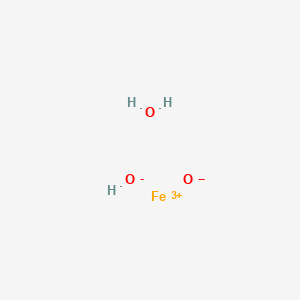
CAS 51274-00-1PubChem CID 23320441
C.I. Pigment Yellow 42
- IUPAC name
- iron(3+);oxygen(2-);hydroxide;hydrate
- Molecular formula
- FeH3O3
- Molecular weight
- 106.87 g/mol
- Exact mass
- 106.943154 Da
- Topological polar surface area
- 3.0 Ų
- Hydrogen-bond donors
- 2
- Hydrogen-bond acceptors
- 3
- Covalent units
- 4
- Defined stereocentres
- 0
Also known as
Ferric oxide YellowEX438O2MRTC.I. 77492RefChem:1080569Yellow iron oxideFerric oxide, yellowBayferrox 920UNII-EX438O2MRT
16 more reported names
Iron hydroxide oxide yellowFerric oxide, yellow [NF]CCRIS 4378EINECS 257-098-5MAPICO YELLOWIRON OXIDE,YELLOWFERRIC OXIDE,YELLOWEC 257-098-5HYDRATED FERRIC-OXIDEFERRIC OXIDE, HYDRATEDINS NO.172(III)INS-172(III)FERRIC OXIDE YELLOW [II]FERRIC OXYHYDROXIDE HYDRATEHYDRATED IRON (III) OXIDEIRON OXIDE,YELLOW [VANDF]
Retrieved from NIH PubChem on 2026-09-02 by checksum-valid CAS matching. Chemical properties do not replace the regulatory decision on this page.
Additional authoritative substance research
Each link searches that source for this identity. A link is a research route, not a claim that the source holds an exact record. What each source is, and its legal weight
Take this record further
Official source and scope
Imported from Commission Implementing Decision (EU) 2025/1175 (dataset version EU 2025/1175). The glossary supplies common ingredient names for the ingredient list required by Article 19(1)(g); it is not an approval or safety list.
Open official Decision