
Official EU label nameGlossary entry 5951
CETRIMONIUM CHLORIDE
This record confirms an official common ingredient name for EU cosmetic product labelling. It does not by itself confirm that the substance is permitted, unrestricted or safe.
Global evidence snapshot
The resolved identity has matching regulatory evidence in 6 of 13 indexed market datasets: 7 country records and 0 EU Annex records. Every result and evidence gap is listed below.
Markets checked
13
Markets with evidence
6
Evidence gaps
7
Resolved identifiers
3
Resolved substance identity
CAS:112-02-7112-03-8
EC:203-928-6
Ingredient index records:
CETRIMONIUM CHLORIDE
Cosmetic functions: ANTIMICROBIAL, ANTISTATIC, PRESERVATIVE, SURFACTANT - EMULSIFYING
1-Hexadecanaminium, N,N,N-trimethyl-, chloride
Inventory restriction note: V/44
8 matched or reported names
CETRIMONIUM CHLORIDECetrimonium chlorideAlkyl (C12-22) trimethyl ammonium, bromide and chloride e.g. cetrimonium chlorideC16-Alkyltrimethylammonium chloride (cetrimonium chloride)C16-alkyltrimethylammonium chloride C18-alkyltrimethylammonium chloride Cetrimonium chloride CAS No. 112-02-7 Steartrimonium chloride CAS No. 112-03-8세트리모늄 클로라이드,스테아트리모늄 클로라이드C -alkyltrimethy 16 lammonium chloride 21 Cetrimonium Chloride ( ) (CAS No. 112-02-7) C -alkyltrimethyl 18 ammonium chloride 21 Steartrimonium chloride ( ) (CAS No. 112-03-8)C16-alkyltrimethylammonium chloride,C18-alkyltrimethyammonium chloride
Regulatory evidence in all 13 markets
Open each matched record for its scope, concentration, conditions, warnings and official source version.
Swipe or scroll horizontally to see dataset coverage and next actions.
| Market | Result | Records | Dataset | Meaning / next action |
|---|---|---|---|---|
| European Union EU | No local match | 0 | Complete annex dataset Regulation (EC) 1223/2009 consolidated to 1 May 2026 | No annex match only means that these five annexes did not return a match; CosIng identity data and other EU obligations still need review. |
| Great Britain GB | Restricted | 1Open record 1 | Complete consolidated annex dataset GB retained Regulation 1223/2009 schedules, effective 15 August 2026 | Review every linked record and exact conditions. |
| Canada CA | No local match | 0 | Complete Hotlist snapshot Health Canada Cosmetic Ingredient Hotlist, 13 August 2025 | The Hotlist is an administrative compliance tool, not an exhaustive safety approval list. |
| New Zealand NZ | Restricted | 2Open record 1Open record 2 | Complete schedules dataset Cosmetic Products Group Standard schedules effective 1 January 2026 | Review every linked record and exact conditions. |
| ASEAN ASEAN | Restricted | 1Open record 1 | Complete regional annex dataset ASEAN Cosmetic Directive annexes 2026-1, 22 June 2026 | Review every linked record and exact conditions. |
| China CN | No local match | 0 | Complete prohibited catalogues plus official-source workflow NMPA 2021 banned catalogues plus dynamic IECIC List I/List II system current since 2025 | IECIC listing is not blanket approval; absence may require the new cosmetic ingredient route, and restrictions are checked separately. |
| Japan JP | No local match | 0 | Complete Standards appendices dataset MHLW Standards for Cosmetics official English source and Japanese amendments checked for the imported snapshot | The Japanese text and subsequent notices are canonical; no local match is not a product-compliance conclusion. |
| South Korea KR | Restricted | 1Open record 1 | Complete current appendix dataset MFDS Notice 2026-19, effective 18 March 2026 | Review every linked record and exact conditions. |
| United States US | No local match | 0 | Complete enumerated federal ingredient rules eCFR Title 21 issue date 27 August 2026 | FDA has no general approved-cosmetic-ingredient catalogue; absence from these sections is not approval or proof of safety. |
| Australia AU | No local match | 0 | Complete cosmetic-relevant Poisons Standard subset plus official workflow Therapeutic Goods (Poisons Standard—June 2026) Instrument 2026 | An AICIS Inventory match is not cosmetic approval; no Inventory match can indicate a new, exempted, reported or confidential introduction. |
| Brazil BR | No local match | 0 | Complete prohibited dataset plus current restricted-list workflow ANVISA RDC 1.029/2026 and RDC 1.030/2026, published 15 June 2026 | RDC 1.030/2026 amends rather than replaces the prohibited baseline, and the second restricted-list revision was still under consultation in July 2026. |
| India IN | Restricted | 1Open record 1 | Complete current Part 2 dataset plus official workflow for Parts 1, 3 and 4 Cosmetics Rules 2020 plus current BIS IS 4707 parts (1:2020, 2:2025, 3:2025, 4:2022) | Review every linked record and exact conditions. |
| Saudi Arabia SA | Restricted | 1Open record 1 | Complete official list index SFDA live prohibited/restricted lists, snapshot 30 August 2026 | Review every linked record and exact conditions. |
No market rows match this filter.
Matching market records and conditions
New Zealand
Cosmetic Products Group Standard schedules effective 1 January 2026Alkyl (C12-22) trimethyl ammonium, bromide and chloride e.g. cetrimonium chloridePermitted list with conditions
Maximum concentration: 0.1%
Schedule 7, reference 44, source row 114 · effective-2026-01-01
C16-Alkyltrimethylammonium chloride (cetrimonium chloride)Restricted
Product scope: (a) Rinse-off hair products (b) Leave-on hair products (c) Leave-on face products · Maximum concentration: (a) 2.5% for the individual concentrations or the sum of the individual concentrations of cetrimonium chloride and steartrimonium chloride (b) 1.0% for the i…
Schedule 5, reference 286, source row 346 · effective-2026-01-01
ASEAN
ASEAN Cosmetic Directive annexes 2026-1, 22 June 2026South Korea
MFDS Notice 2026-19, effective 18 March 2026India
Cosmetics Rules 2020 plus current BIS IS 4707 parts (1:2020, 2:2025, 3:2025, 4:2022)Saudi Arabia
SFDA live prohibited/restricted lists, snapshot 30 August 2026Chemical identity and properties
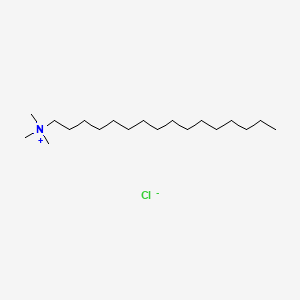
CAS 112-02-7PubChem CID 8154
Hexadecyltrimethylammonium chloride
Cetyltrimethylammonium chloride is the organic chloride salt of cetyltrimethylammonium. It has a role as a surfactant. It is a quaternary ammonium salt and an organic chloride salt. It contains a cetyltrimethylammonium ion. — ChEBI
- IUPAC name
- hexadecyl(trimethyl)azanium chloride
- Molecular formula
- C19H42ClN
- Molecular weight
- 320.0 g/mol
- Exact mass
- 319.3005780 Da
- Topological polar surface area
- 0.0 Ų
- Hydrogen-bond donors
- 0
- Hydrogen-bond acceptors
- 1
- Covalent units
- 2
- Defined stereocentres
- 0
Also known as
Cetrimonium chlorideN-Hexadecyltrimethylammonium chlorideDehyquart AGenamin CTACAliquat 6Cetyl trimethyl ammonium chlorideCETACHTAC
16 more reported names
Adogen 444Surfroyal CTACMorpan CHAQuartamin 60WTrimethylcetylammonium chlorideArquad 16-29Arquad 16-50Ammonyx Cetac 30TRIMETHYLHEXADECYLAMMONIUM CHLORIDEIntexsan CTC 29Intexsan CTC 50Arquad 16Barquat CT 29Intexan CTC 29Palmityltrimethylammonium chlorideVariquat E 228
External database identifiers
- ChEBI:CHEBI:53581
- ChEMBL:CHEMBL1895807
- EPA DTXSID:DTXSID6026901
- PubMed:10124
Evidence from additional scientific databases
NIH PubChem PUG-View
Exact identifier match8154
Attributed physical-property, hazard, environmental and use annotations.
- Autoignition Temperature: 750 °F (USCG, 1999) Source: CAMEO Chemicals
- Autoignition Temperature: 750 °F /ISOPROPYL ALCOHOL SOLN OF CETYLTRIMETHYLAMMONIUM CHLORIDE/ Source: Hazardous Substances Data Bank (HSDB)
- Boiling Point: 180 °F at 760 mmHg (isopropyl alcohol) (USCG, 1999) Source: CAMEO Chemicals
- Density: 0.9 at 77 °F (approx.) (USCG, 1999) - Less dense than water; will float Source: CAMEO Chemicals
- Flash Point: 69 °F (USCG, 1999) Source: CAMEO Chemicals
- LogP: log Kow= 3.23 Source: Hazardous Substances Data Bank (HSDB)
- Physical Description: Hexadecyltrimethylammonium chloride appears as colorless to pale yellow liquid with an odor of rubbing alcohol. Floats or sinks in water. (USCG, 1999) Source: CAMEO Chemicals
- Physical Description: Liquid; CBI Source: EPA Chemical Data Reporting (CDR)
- Physical Description: Solution: Clear to pale yellow liquid; [HSDB] White powder; [MSDSonline] Source: Haz-Map, Information on Hazardous Chemicals and Occupational Diseases
- Solubility: Water solubility: 440 mg/l at 30 °C Source: Hazardous Substances Data Bank (HSDB)
- First Aid: INGESTION: do NOT induce vomiting; drink large quanities of fluid and call a physician immediately.; EYES: flush with water for at least 15 min. and call a physician.; SKIN: flush with water. (USCG, 1999) Source: CAMEO Chemicals
- Note: This chemical does not meet GHS hazard criteria for 0.5% (5 of 1105) of reports. Source: European Chemicals Agency (ECHA)
- Signal: Danger Source: European Chemicals Agency (ECHA)
- GHS Hazard Statements: H302 (49%): Harmful if swallowed [Warning Acute toxicity, oral]; H311 (28.6%): Toxic in contact with skin [Danger Acute toxicity, dermal]; H314 (41.5%): Causes severe skin burns and eye damage [Danger Skin corrosion/irritation]; H315 (52.3%): Causes skin irritation [Warning Skin corrosion/irritation]; H318 (85.7%): Causes serious eye damage [Danger Serious eye damage/eye irritation]; H335 (44.3%): May cause respiratory irritation [Warning Specific target organ toxicity, single exposure; Respiratory tract irritation]; H400 (99.4%): Very toxic to aquatic life [Warning Hazardous to the aquatic environment, acute hazard]; H410 (40.9%): Very toxic to aquatic life with long lasting effects [Warning Hazardous to the aquatic environment, long-term hazard] Source: European Chemicals Agency (ECHA)
- Precautionary Statement Codes: P260, P261, P262, P264, P264+P265, P270, P271, P273, P280, P301+P317, P301+P330+P331, P302+P352, P302+P361+P354, P304+P340, P305+P354+P338, P316, P317, P319, P321, P330, P332+P317, P361+P364, P362+P364, P363, P391, P403+P233, P405, and P501 (click each P-code to see the statement) Source: European Chemicals Agency (ECHA)
- ECHA C&L Notifications Summary: Aggregated GHS information provided per 1105 reports by companies from 42 notifications to the ECHA C&L Inventory. Each notification may be associated with multiple companies.; Reported as not meeting GHS hazard criteria per 5 of 1105 reports by companies.; There are 41 notifications provided by 1100 of 1105 reports by companies with hazard statement code(s).; Information may vary between notifications depending on impurities, additives, and other factors. The percentage value in parenthesis indicates the notified classification ratio from companies that provide hazard codes. Only hazard codes with percentage values above 10% are shown. For more detailed information, please visit ECHA C&L website. Source: European Chemicals Agency (ECHA)
- Signal: Danger Source: NITE-CMC
- GHS Hazard Statements: H302: Harmful if swallowed [Warning Acute toxicity, oral]; H315: Causes skin irritation [Warning Skin corrosion/irritation]; H318: Causes serious eye damage [Danger Serious eye damage/eye irritation]; H335: May cause respiratory irritation [Warning Specific target organ toxicity, single exposure; Respiratory tract irritation]; H400: Very toxic to aquatic life [Warning Hazardous to the aquatic environment, acute hazard]; H410: Very toxic to aquatic life with long lasting effects [Warning Hazardous to the aquatic environment, long-term hazard] Source: NITE-CMC
- Precautionary Statement Codes: P261, P264, P264+P265, P270, P271, P273, P280, P301+P317, P302+P352, P304+P340, P305+P354+P338, P317, P319, P321, P330, P332+P317, P362+P364, P391, P403+P233, P405, and P501 (click each P-code to see the statement) Source: NITE-CMC
- Signal: Warning Source: NITE-CMC
- GHS Hazard Statements: H302: Harmful if swallowed [Warning Acute toxicity, oral]; H315: Causes skin irritation [Warning Skin corrosion/irritation]; H319: Causes serious eye irritation [Warning Serious eye damage/eye irritation]; H335: May cause respiratory irritation [Warning Specific target organ toxicity, single exposure; Respiratory tract irritation] Source: NITE-CMC
- Precautionary Statement Codes: P261, P264, P264+P265, P270, P271, P280, P301+P317, P302+P352, P304+P340, P305+P351+P338, P319, P321, P330, P332+P317, P337+P317, P362+P364, P403+P233, P405, and P501 (click each P-code to see the statement) Source: NITE-CMC
- Signal: Danger Source: Hazardous Chemical Information System (HCIS), Safe Work Australia
- Cosmetic Ingredient Review Conclusion: The CIR Expert Panel concluded the following ingredients are safe in the present practices of use and concentration described in the safety assessment when formulated to be non-irritating...Cetrimonium Chloride... Source: Cosmetic Ingredient Review (CIR)
- Cosmetic Ingredient Review Finding(s): Safe for use in cosmetics, with qualifications Source: Cosmetic Ingredient Review (CIR)
- Environmental Bioconcentration: An estimated BCF of 71 was calculated for trimethylhexadecylammonium chloride(SRC), using an estimated log Kow of 3.23(1) and a regression-derived equation(2). According to a classification scheme(3), this BCF suggests the potential for bioconcentration in aquatic organisms is moderate. Source: Hazardous Substances Data Bank (HSDB)
- Environmental Fate: TERRESTRIAL FATE: Based on a classification scheme(1), an estimated Koc value of 2.2X10+5(SRC), determined from a structure estimation method(2), indicates that trimethylhexadecylammonium chloride is expected to be immobile in soil(SRC). Volatilization of trimethylhexadecylammonium chloride from moist soil surfaces is not expected to be an important fate process(SRC) given an estimated Henry's Law constant of 2.9X10⁻¹⁰ atm-cu m/mole(SRC), using a fragment constant estimation method(3). Trimethylhexadecylammonium chloride is not expected to volatilize from dry soil surfaces(SRC) based upon an estimated vapor pressure of 2.8X10⁻¹⁰ mm Hg(SRC), determined from a fragment constant method(4). Source: Hazardous Substances Data Bank (HSDB)
- Environmental Fate: AQUATIC FATE: Based on a classification scheme(1), an estimated Koc value of 2.2X10+5(SRC), determined from an estimation method(2), indicates that trimethylhexadecylammonium chloride is expected to adsorb to suspended solids and sediment in water(SRC). Volatilization from water surfaces is not expected(3) based upon an estimated Henry's Law constant of 2.9X10⁻¹⁰ atm-cu m/mole(SRC), developed using a fragment constant estimation method(4). According to a classification scheme(5), an estimated BCF of 71(SRC), from its log Kow of 3.23(6) and a regression-derived equation(7), suggests the potential for bioconcentration in aquatic organisms is moderate. The MITI, closed bottle, and Sturm tests revealed no degradation after 10 days, microbial growth after 17 days, and 84% degradation after 13 days, respectively(8). 10-20 ppm trimethylhexadecylammonium chloride was degraded with a half-life of 3.1 days in freshwater collected from the Ohio river 1 mile below discharge from a municipal treatment plant at 20 °C and pH 6.9(9). Source: Hazardous Substances Data Bank (HSDB)
- Environmental Fate: ATMOSPHERIC FATE: According to a model of gas/particle partitioning of semivolatile organic compounds in the atmosphere(1), trimethylhexadecylammonium chloride, which has an estimated vapor pressure of 2.8X10⁻¹⁰ mm Hg at 25 °C(SRC), using a fragment constant estimation method(2), is expected to exist solely in the particulate phase in the ambient atmosphere. Particulate-phase trimethylhexadecylammonium chloride may be removed from the air by wet and dry deposition(SRC). Source: Hazardous Substances Data Bank (HSDB)
- Consumer Uses: Cleaning agent; Corrosion inhibitor; Softener and conditioner; Surface modifier; Surfactant (surface active agent) Source: EPA Chemical Data Reporting (CDR)
- Industry Uses: Corrosion inhibitor; Processing aids, specific to petroleum production; Softener and conditioner; Surface modifier; CBI; Processing aids not otherwise specified; Surfactant (surface active agent) Source: EPA Chemical Data Reporting (CDR)
- Cosmetic Ingredient Review Link: CIR ingredient: Cetrimonium Chloride Source: Cosmetic Ingredient Review (CIR)
- Sources/Uses: Available as a 25% aqueous solution and 50% solution in isopropyl alcohol and water for use in antifungal formulations and hair conditioners; Also used as a disinfectant/germicide, cationic detergent, fermentation aid, dispersant, coagulant for antibiotic production, and antistatic and softening agent for textile finishes; [HSDB] Source: Haz-Map, Information on Hazardous Chemicals and Occupational Diseases
- Industrial Processes with risk of exposure: Using Disinfectants or Biocides [Category: Clean]; Textiles (Printing, Dyeing, or Finishing) [Category: Industry] Source: Haz-Map, Information on Hazardous Chemicals and Occupational Diseases
- Uses: USED IN ANTIFUNGAL FORMULATION; IN HAIR CONDITIONER FORMULATION; DISINFECTANT; CATIONIC DETERGENT Source: Hazardous Substances Data Bank (HSDB)
- Uses: SOFTENER IN HAIR TREATMENTS, EG, CREME RINSES Source: Hazardous Substances Data Bank (HSDB)
- Uses: FERMENTATION AID Source: Hazardous Substances Data Bank (HSDB)
- Uses: GERMICIDE Source: Hazardous Substances Data Bank (HSDB)
- Uses: For more Uses (Complete) data for TRIMETHYLHEXADECYLAMMONIUM CHLORIDE (6 total), please visit the HSDB record page. Source: Hazardous Substances Data Bank (HSDB)
Mapped by: Existing checksum-valid CAS to unique PubChem CID match. Retrieved: 2026-08-31. Open source record
Scientific classifications and hazard annotations provide context and do not replace the market-specific regulatory decision shown above.
Additional source coverage and match status
| Source | Result | Checked |
|---|---|---|
| NIH PubChem PUG-View | Exact match | 2026-08-31 |
A recorded no-match is useful evidence that the source was checked; it is not a claim that the substance does not exist elsewhere.
Retrieved from NIH PubChem on 2026-08-31 by checksum-valid CAS matching. Chemical properties do not replace the regulatory decision on this page.
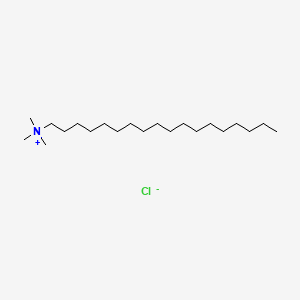
CAS 112-03-8PubChem CID 8155
Stearyltrimethylammonium chloride
Stearyltrimethylammonium chloride is an organic molecular entity. — ChEBI
- IUPAC name
- trimethyl(octadecyl)azanium chloride
- Molecular formula
- C21H46ClN
- Molecular weight
- 348.0 g/mol
- Exact mass
- 347.3318782 Da
- Topological polar surface area
- 0.0 Ų
- Hydrogen-bond donors
- 0
- Hydrogen-bond acceptors
- 1
- Covalent units
- 2
- Defined stereocentres
- 0
Also known as
Trimethylstearylammonium chlorideStacCation ABAliquat 7Nissan cation ABQuaternium-10Arquad 18Stearyl trimethyl ammonium chloride
16 more reported names
Arquad 18-50Monostearyl trimethyl ammonium chlorideN,N,N-Trimethyl-1-octadecanaminium chlorideRefChem:871332N,N,N-trimethyloctadecan-1-aminium chlorideTrimethyloctadecylammonium chlorideOCTADECYLTRIMETHYLAMMONIUM CHLORIDE1-Octadecanaminium, N,N,N-trimethyl-, chlorideSteartrimonium chlorideStearyl trimethyl ammoium chlorideOctadecy trimethyl ammonium chloridetrimethyl octadecyl ammonium chlorideOctadecyl trimethyl ammonium chloridetrimethyloctadecylamine, chloridetrimethyl(octadecyl)azanium;chlorideEINECS 203-929-1
External database identifiers
- ChEBI:CHEBI:81710
- ChEMBL:CHEMBL118745
- EPA DTXSID:DTXSID1026902
Evidence from additional scientific databases
NIH PubChem PUG-View
Exact identifier match8155
Attributed physical-property, hazard, environmental and use annotations.
- Physical Description: CBI; Large Crystals Source: EPA Chemical Data Reporting (CDR)
- Carcinogen Classification: Not listed by IARC. Certain nitrosamines are classified by IARC as either probably or possibly carcinogenic to humans (Groups 2A and 2B, respectively). (L135) Source: Toxin and Toxin Target Database (T3DB)
- Exposure Routes: Oral (A2880) ; inhalation (A2880) ; dermal (L1889) Source: Toxin and Toxin Target Database (T3DB)
- Note: This chemical does not meet GHS hazard criteria for 3.7% (10 of 268) of reports. Source: European Chemicals Agency (ECHA)
- Signal: Danger Source: European Chemicals Agency (ECHA)
- GHS Hazard Statements: H302 (88.1%): Harmful if swallowed [Warning Acute toxicity, oral]; H311 (54.5%): Toxic in contact with skin [Danger Acute toxicity, dermal]; H312 (19.8%): Harmful in contact with skin [Warning Acute toxicity, dermal]; H314 (79.1%): Causes severe skin burns and eye damage [Danger Skin corrosion/irritation]; H318 (29.5%): Causes serious eye damage [Danger Serious eye damage/eye irritation]; H400 (71.6%): Very toxic to aquatic life [Warning Hazardous to the aquatic environment, acute hazard]; H410 (78.7%): Very toxic to aquatic life with long lasting effects [Warning Hazardous to the aquatic environment, long-term hazard] Source: European Chemicals Agency (ECHA)
- Precautionary Statement Codes: P260, P262, P264, P264+P265, P270, P273, P280, P301+P317, P301+P330+P331, P302+P352, P302+P361+P354, P304+P340, P305+P354+P338, P316, P317, P321, P330, P361+P364, P362+P364, P363, P391, P405, and P501 (click each P-code to see the statement) Source: European Chemicals Agency (ECHA)
- ECHA C&L Notifications Summary: Aggregated GHS information provided per 268 reports by companies from 19 notifications to the ECHA C&L Inventory. Each notification may be associated with multiple companies.; Reported as not meeting GHS hazard criteria per 10 of 268 reports by companies.; There are 18 notifications provided by 258 of 268 reports by companies with hazard statement code(s).; Information may vary between notifications depending on impurities, additives, and other factors. The percentage value in parenthesis indicates the notified classification ratio from companies that provide hazard codes. Only hazard codes with percentage values above 10% are shown. For more detailed information, please visit ECHA C&L website. Source: European Chemicals Agency (ECHA)
- Signal: Warning Source: NITE-CMC
- GHS Hazard Statements: H302: Harmful if swallowed [Warning Acute toxicity, oral]; H312: Harmful in contact with skin [Warning Acute toxicity, dermal] Source: NITE-CMC
- Precautionary Statement Codes: P264, P270, P280, P301+P317, P302+P352, P317, P321, P330, P362+P364, and P501 (click each P-code to see the statement) Source: NITE-CMC
- Signal: Danger Source: Hazardous Chemical Information System (HCIS), Safe Work Australia
- GHS Hazard Statements: H302: Harmful if swallowed [Warning Acute toxicity, oral]; H312: Harmful in contact with skin [Warning Acute toxicity, dermal]; H314: Causes severe skin burns and eye damage [Danger Skin corrosion/irritation] Source: Hazardous Chemical Information System (HCIS), Safe Work Australia
- Precautionary Statement Codes: P260, P264, P270, P280, P301+P317, P301+P330+P331, P302+P352, P302+P361+P354, P304+P340, P305+P354+P338, P316, P317, P321, P330, P362+P364, P363, P405, and P501 (click each P-code to see the statement) Source: Hazardous Chemical Information System (HCIS), Safe Work Australia
- Health Effects: Quaternium-10 may react to produce nitrosamines, which are believed to be carcinogenic. (L1890) Source: Toxin and Toxin Target Database (T3DB)
- Cosmetic Ingredient Review Conclusion: The CIR Expert Panel concluded the following ingredients are safe in the present practices of use and concentration described in the safety assessment when formulated to be non-irritating...Steartrimonium Chloride... Source: Cosmetic Ingredient Review (CIR)
- Cosmetic Ingredient Review Finding(s): Safe for use in cosmetics, with qualifications Source: Cosmetic Ingredient Review (CIR)
- Toxicity Summary: While quaternium-10 itself is not toxic, it is a nitrosating agent. Nitrosating agents may decompose and/or react to cause nitrosamine contamination. Nitrosamines are produced from secondary amines and amides in the presence of nitrite ions and are believed to be carcinogenic. Once in the body, nitrosamines are activated by cytochrome P-450 enzymes. They are then believed to induce their carcinogenic effects by forming DNA adducts at the N- and O-atoms. (L1889, L1890, A2878, A2879, A2880) Source: Toxin and Toxin Target Database (T3DB)
- Cosmetic Ingredient Review Link: CIR ingredient: Steartrimonium Chloride Source: Cosmetic Ingredient Review (CIR)
- Uses: Quaternium-10 is a quaternary ammonium salt found in numerous cosmetics. (L1890) Source: Toxin and Toxin Target Database (T3DB)
Mapped by: Existing checksum-valid CAS to unique PubChem CID match. Retrieved: 2026-08-31. Open source record
Scientific classifications and hazard annotations provide context and do not replace the market-specific regulatory decision shown above.
Additional source coverage and match status
| Source | Result | Checked |
|---|---|---|
| NIH PubChem PUG-View | Exact match | 2026-08-31 |
A recorded no-match is useful evidence that the source was checked; it is not a claim that the substance does not exist elsewhere.
Retrieved from NIH PubChem on 2026-08-31 by checksum-valid CAS matching. Chemical properties do not replace the regulatory decision on this page.
Additional authoritative substance research
Each link searches that source for this identity. A link is a research route, not a claim that the source holds an exact record. What each source is, and its legal weight
Take this record further
Official source and scope
Imported from Commission Implementing Decision (EU) 2025/1175 (dataset version EU 2025/1175). The glossary supplies common ingredient names for the ingredient list required by Article 19(1)(g); it is not an approval or safety list.
Open official Decision