1,3-Butanediol
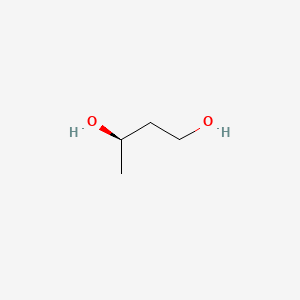
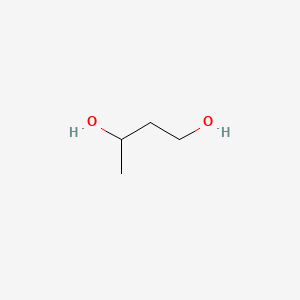
Butane-1,3-diol is a butanediol compound having two hydroxy groups in the 1- and 3-positions. It is a glycol and a butanediol. — ChEBI
- IUPAC name
- butane-1,3-diol
- Molecular formula
- C4H10O2
- Molecular weight
- 90.12 g/mol
- Exact mass
- 90.068079557 Da
- XLogP3
- -0.4
- Topological polar surface area
- 40.5 Ų
- Hydrogen-bond donors
- 2
- Hydrogen-bond acceptors
- 2
- Covalent units
- 1
- Defined stereocentres
- 0
Also known as
16 more reported names
External database identifiers
- ChEBI:CHEBI:52683
- ChEMBL:CHEMBL3186475
- EPA DTXSID:DTXSID8026773
- PubMed:22980845
- PubMed:22361860
- PubMed:22320888
- PubMed:22266471
- PubMed:21722932
- PubMed:21720824
- PubMed:21507620
- PubMed:21417381
- PubMed:21369620
- PubMed:21304735
- PubMed:21154890
- PubMed:21105677
Evidence from additional scientific databases
EMBL-EBI ChEBI
butane-1,3-diol
A butanediol compound having two hydroxy groups in the 1- and 3-positions.
- Formula
- C4H10O2
- Average mass
- 90.122 g/mol
- Monoisotopic mass
- 90.06808 Da
- Formal charge
- 0
- glycol — is a (CHEBI:13643)
- butanediol — is a (CHEBI:52684)
- glycol — is a (CHEBI:13643)
- butanediol — is a (CHEBI:52684)
- 7455861 Source: PubMed
Additional curated names
Cross-references from this source
- CAS: 107-88-0 — ChemIDplus
- CAS: 107-88-0 — NIST Chemistry WebBook
- MANUAL_X_REF: 1,3-Butanediol — Wikipedia
- MANUAL_X_REF: CPD-12276 — MetaCyc
- MANUAL_X_REF: HMDB0031320 — HMDB
- REGISTRY_NUMBER: 1718945 — Reaxys
- REGISTRY_NUMBER: 2409 — Gmelin
Mapped by: Exact CAS cross-reference in the ChEBI compound record. Source updated: 2022-01-17. Retrieved: 2026-08-31. Open source record
NIH PubChem PUG-View
Attributed physical-property, hazard, environmental and use annotations.
- Autoignition Temperature: 741 °F (393 °C) Source: Hazardous Substances Data Bank (HSDB)
- Autoignition Temperature: 394 °C Source: ILO-WHO International Chemical Safety Cards (ICSCs)
- Boiling Point: 207.5 °C Source: Hazardous Substances Data Bank (HSDB)
- Boiling Point: 207.50 °C. @ 760.00 mm Hg Source: Human Metabolome Database (HMDB)
- Boiling Point: 207.5 °C Source: ILO-WHO International Chemical Safety Cards (ICSCs)
- Boiling Point: 207.5 °C @760 [mm Hg] Source: PAC Chemical Database, U.S. Department of Energy
- Color/Form: Viscous liquid Source: Hazardous Substances Data Bank (HSDB)
- Color/Form: Pure compound is colorless Source: Hazardous Substances Data Bank (HSDB)
- Density: 1.0053 g/cu cm at 20 °C Source: Hazardous Substances Data Bank (HSDB)
- Density: Relative density (water = 1): 1.00 Source: ILO-WHO International Chemical Safety Cards (ICSCs)
- Density: 1.006 @ 20°C Source: PAC Chemical Database, U.S. Department of Energy
- Dissociation Constants: pKa = 15.1 at 25 °C Source: Hazardous Substances Data Bank (HSDB)
- Flash Point: 121 °C Source: Haz-Map, Information on Hazardous Chemicals and Occupational Diseases
- Flash Point: 250 °F (121 °C) (Cleveland Open Cup) Source: Hazardous Substances Data Bank (HSDB)
- Flash Point: 121 °C Source: ILO-WHO International Chemical Safety Cards (ICSCs)
- LogP: -0.290 Source: Human Metabolome Database (HMDB)
- Melting Point: < -50 °C Source: Hazardous Substances Data Bank (HSDB)
- Melting Point: < -50 °C Source: Human Metabolome Database (HMDB)
- Odor: Practically odorless Source: Hazardous Substances Data Bank (HSDB)
- Odor: Odorless when pure Source: Hazardous Substances Data Bank (HSDB)
- Physical Description: Liquid Source: EPA Chemical Data Reporting (CDR)
- Physical Description: Very hygroscopic liquid; Pure form is colorless; [Merck Index] Source: Haz-Map, Information on Hazardous Chemicals and Occupational Diseases
- Physical Description: Liquid Source: Human Metabolome Database (HMDB)
- Physical Description: COLOURLESS VISCOUS HYGROSCOPIC LIQUID. Source: ILO-WHO International Chemical Safety Cards (ICSCs)
- Refractive Index: Index of refraction: 1.4401 at 20 °C Source: Hazardous Substances Data Bank (HSDB)
- Solubility: Miscible with water Source: Hazardous Substances Data Bank (HSDB)
- Solubility: Practically insoluble in aliphatic hydrocarbons, benzene, toluene, carbon tetrachloride, ethanolamines, mineral and linseed oil; soluble in acetone, methyl ethyl ketone, ethanol, dibutyl phthalate, castor oil Source: Hazardous Substances Data Bank (HSDB)
- Solubility: Slightly soluble in ether Source: Hazardous Substances Data Bank (HSDB)
- Solubility: 1000 mg/mL at 25 °C Source: Human Metabolome Database (HMDB)
- Solubility: Solubility in water: good Source: ILO-WHO International Chemical Safety Cards (ICSCs)
- Vapor Pressure: 0.02 [mmHg] Source: Haz-Map, Information on Hazardous Chemicals and Occupational Diseases
- Vapor Pressure: 0.02 mm Hg at 20 °C Source: Hazardous Substances Data Bank (HSDB)
- Vapor Pressure: Vapor pressure, Pa at 20 °C: 8 Source: ILO-WHO International Chemical Safety Cards (ICSCs)
- Vapor Pressure: 0.06 [mm Hg] @20 °C Source: PAC Chemical Database, U.S. Department of Energy
- Viscosity: 96 cSt at 25 °C Source: Hazardous Substances Data Bank (HSDB)
- Carcinogen Classification: No indication of carcinogenicity to humans (not listed by IARC). Source: Toxin and Toxin Target Database (T3DB)
- Exposure Routes: The substance can be absorbed into the body by inhalation of its vapour. Source: ILO-WHO International Chemical Safety Cards (ICSCs)
- Note: This chemical does not meet GHS hazard criteria for 46.2% (1160 of 2513) of reports. Source: European Chemicals Agency (ECHA)
- Signal: Warning Source: European Chemicals Agency (ECHA)
- GHS Hazard Statements: H226 (51.2%): Flammable liquid and vapor [Warning Flammable liquids] Source: European Chemicals Agency (ECHA)
- Precautionary Statement Codes: P210, P233, P240, P241, P242, P243, P280, P303+P361+P353, P370+P378, P403+P235, and P501 (click each P-code to see the statement) Source: European Chemicals Agency (ECHA)
- ECHA C&L Notifications Summary: Aggregated GHS information provided per 2513 reports by companies from 8 notifications to the ECHA C&L Inventory.; Reported as not meeting GHS hazard criteria per 1160 of 2513 reports by companies.; There are 6 notifications provided by 1353 of 2513 reports by companies with hazard statement code(s).; Information may vary between notifications depending on impurities, additives, and other factors. The percentage value in parenthesis indicates the notified classification ratio from companies that provide hazard codes. Only hazard codes with percentage values above 10% are shown. For more detailed information, please visit ECHA C&L website. Source: European Chemicals Agency (ECHA)
- NFPA Health Rating: 1 - Materials that, under emergency conditions, can cause significant irritation. Source: Hazardous Substances Data Bank (HSDB)
- NFPA Fire Rating: 1 - Materials that must be preheated before ignition can occur. Materials require considerable preheating, under all ambient temperature conditions, before ignition and combustion can occur. Source: Hazardous Substances Data Bank (HSDB)
- NFPA Instability Rating: 0 - Materials that in themselves are normally stable, even under fire conditions. Source: Hazardous Substances Data Bank (HSDB)
- Cosmetic Ingredient Review Finding(s): Safe in the present practices of use and concentration. Ingredient, concentration, and use information are available in documents discoverable at https://cir-reports.cir-safety.org Source: Cosmetic Ingredient Review (CIR)
- Toxicity Summary: IDENTIFICATION AND USE: 1,3-Butanediol is an odorless, colorless, viscous liquid with a sweet flavor and bitter aftertaste. It is used as an intermediate in manufacture of polyester plasticizers; humectant for cellophane, tobacco; and in the cosmetic and pharmaceutical industry as a glycerin substitute.1,3-Butanediol also has some mold inhibiting action. It is not registered for current pesticide use in the U.S., but approved pesticide uses may change periodically and so federal, state and local authorities must be consulted for currently approved uses. HUMAN EXPOSURE AND TOXICITY: 1,3-Butanediol is not irritating to human skin or mucous membranes. When applied to the human eye it causes immediate severe stinging, but irrigation with water brings rapid complete relief. ANIMAL STUDIES: Eye irritation occurred in one individual, although its irritant potency in rabbits appeared low. It was of low acute oral toxicity to rodents. No treatment-related effects on mortality, body weight gain, organ weights, hematology, histopathology or neoplastic changes were observed in rats fed 1,3-butanediol in the diet at 1, 3 or 10% (~ 643, 1960 or 6230 mg/kg-bw/day for males or ~ 844, 2330 or 7300 Source: Hazardous Substances Data Bank (HSDB)
- Environmental Bioconcentration: An estimated BCF of 3 was calculated in fish for 1,3-butanediol(SRC), using an estimated log Kow of -0.29(1) and a regression-derived equation(1). According to a classification scheme(2), this BCF suggests the potential for bioconcentration in aquatic organisms is low(SRC). Source: Hazardous Substances Data Bank (HSDB)
- Environmental Fate: TERRESTRIAL FATE: Based on a classification scheme(1), an estimated Koc value of 1(SRC), determined from a structure estimation method(2), indicates that 1,3-butanediol is expected to have very high mobility in soil(SRC). Volatilization of 1,3-butanediol from moist soil surfaces is not expected(SRC) given an estimated Henry's Law constant of 2.4X10⁻⁹ atm-cu m/mole(SRC), based upon its vapor pressure, 0.02 mm Hg(3), and assigned value for water solubility, 1X10+6 mg/L (miscible)(4). 1,3-Butanediol is not expected to volatilize from dry soil surfaces(SRC) based upon its vapor pressure(3). 1,3-Butanediol is expected to be readily biodegraded based on modified Sturm test results of 80.5% in 28 days(5). Source: Hazardous Substances Data Bank (HSDB)
- Environmental Fate: AQUATIC FATE: Based on a classification scheme(1), an estimated Koc value of 1(SRC), determined from a structure estimation method(2), indicates that 1,3-butanediol is not expected to adsorb to suspended solids and sediment(SRC). Volatilization from water surfaces is not expected(3) based upon an estimated Henry's Law constant of 2.4X10⁻⁹ atm-cu m/mole(SRC), derived from its vapor pressure, 0.02 mm Hg(4), and assigned value for water solubility, 1X10+6 mg/L (miscible)(5). 1,3-Butanediol is not expected to undergo hydrolysis in the environment due to the lack of functional groups that hydrolyze under environmental conditions(3). According to a classification scheme(6), an estimated BCF of 3(SRC), from an estimated log Kow of -0.29(2) and a regression-derived equation(2), suggests the potential for bioconcentration in aquatic organisms is low(SRC). 1,3-Butanediol is expected to be readily biodegraded based on modified Sturm test results of 80.5% in 28 days(7). Source: Hazardous Substances Data Bank (HSDB)
- Environmental Fate: ATMOSPHERIC FATE: According to a model of gas/particle partitioning of semivolatile organic compounds in the atmosphere(1), 1,3-butanediol, which has a vapor pressure of 0.02 mm Hg at 25 °C(2), is expected to exist solely as a vapor in the ambient atmosphere. Vapor-phase 1,3-butanediol is degraded in the atmosphere by reaction with photochemically-produced hydroxyl radicals(SRC); the half-life for this reaction in air is estimated to be 12 hours(SRC), calculated from its rate constant of 3.32X10⁻¹¹ cu cm/molecule-sec at 25 °C(3). 1,3-Butanediol does not contain chromophores that absorb at wavelengths >290 nm(4) and, therefore, is not expected to be susceptible to direct photolysis by sunlight(SRC). Source: Hazardous Substances Data Bank (HSDB)
- Consumer Uses: Solvent; Adhesion/cohesion promoter Source: EPA Chemical Data Reporting (CDR)
- Industry Uses: Solvent; Monomers; Adhesion/cohesion promoter; Intermediate Source: EPA Chemical Data Reporting (CDR)
- Cosmetic Ingredient Review Link: CIR ingredient: Butylene Glycol Source: Cosmetic Ingredient Review (CIR)
- Sources/Uses: Used as an intermediate in the manufacture of polyester plasticizers; as a humectant for cellophane and tobacco; in polyurethanes and special polyester resins; in surface active agents; as a coupling agent; as a solvent; as a food additive and flavoring; in the cosmetics and pharmaceutical industries as a glycerin substitute; for deicing of aircraft; [HSDB] Source: Haz-Map, Information on Hazardous Chemicals and Occupational Diseases
- Uses: For 1,3-butanediol (USEPA/OPP Pesticide Code: 042205) there are 0 labels match. /SRP: Not registered for current use in the U.S., but approved pesticide uses may change periodically and so federal, state and local authorities must be consulted for currently approved uses./ Source: Hazardous Substances Data Bank (HSDB)
- Uses: The active ingredient is no longer contained in any registered pesticide products ... "cancelled." Source: Hazardous Substances Data Bank (HSDB)
- Uses: Intermediate in manufacture of polyester plasticizers; humectant for cellophane, tobacco. Has some mold inhibiting action. Source: Hazardous Substances Data Bank (HSDB)
- Uses: Polyesters, polyurethanes, surface active agents; plasticizers, humectant, coupling agent, solvent, food additive, flavoring. Source: Hazardous Substances Data Bank (HSDB)
- Uses: For more Uses (Complete) data for 1,3-BUTANEDIOL (9 total), please visit the HSDB record page. Source: Hazardous Substances Data Bank (HSDB)
- Uses: 1,3-Butanediol is found in pepper (c. annuum). It is commonly used as a solvent for food flavouring agents and is a co-monomer used in certain polyurethane and polyester resins. In biology, 1,3-butanediol is used as a hypoglycaemic agent. Source: Toxin and Toxin Target Database (T3DB)
Mapped by: Existing checksum-valid CAS to unique PubChem CID match. Retrieved: 2026-08-31. Open source record
Scientific classifications and hazard annotations provide context and do not replace the market-specific regulatory decision shown above.
Additional source coverage and match status
| Source | Result | Checked |
|---|---|---|
| EMBL-EBI ChEBI | Exact match | 2026-08-31 |
| NIH PubChem PUG-View | Exact match | 2026-08-31 |
A recorded no-match is useful evidence that the source was checked; it is not a claim that the substance does not exist elsewhere.
Retrieved from NIH PubChem on 2026-08-31 by checksum-valid CAS matching. Chemical properties do not replace the regulatory decision on this page.