
Official EU label nameGlossary entry 3879
BORIC ACID
This record confirms an official common ingredient name for EU cosmetic product labelling. It does not by itself confirm that the substance is permitted, unrestricted or safe.
Global evidence snapshot
The resolved identity has matching regulatory evidence in 10 of 13 indexed market datasets: 11 country records and 0 EU Annex records. Every result and evidence gap is listed below.
Markets checked
13
Markets with evidence
10
Evidence gaps
3
Resolved identifiers
19
Resolved substance identity
CAS:10043-35-311113-50-110377-81-868130-12-126038-90-468003-13-410192-46-81332-07-622694-75-327522-09-413703-82-712007-62-41333-73-913840-56-77775-19-11330-43-41303-96-4
EC:233-139-2234-343-4
Ingredient index records:
BORIC ACID
Ph. Eur. name: acidum boricum
Cosmetic functions: ANTIMICROBIAL, BUFFERING, DENATURANT
Boric acid
13 matched or reported names
BORIC ACIDboric acidacidum boricumBoric acid and its saltsBoric acid [1]Boric acid [2]Boric acid, borates and tetraborates with the exception of substance No 1184 in Annex II CAS No 10043-35-3/11113-50-1硼酸 — Boric acid (CAS No. 10043-35-3 / CAS No. 11113-50-1)Boric acid붕산Ácido bórico (BORIC ACID)Boric acid [1] boric acid [2] (CAS No. 10043-35-3 [1] 11113-50-1 [2])Boric acid [1]; Boric acid [2]
Regulatory evidence in all 13 markets
Open each matched record for its scope, concentration, conditions, warnings and official source version.
Swipe or scroll horizontally to see dataset coverage and next actions.
| Market | Result | Records | Dataset | Meaning / next action |
|---|---|---|---|---|
| European Union EU | No local match | 0 | Complete annex dataset Regulation (EC) 1223/2009 consolidated to 1 May 2026 | No annex match only means that these five annexes did not return a match; CosIng identity data and other EU obligations still need review. |
| Great Britain GB | No local match | 0 | Complete consolidated annex dataset GB retained Regulation 1223/2009 schedules, effective 15 August 2026 | No annex match is not approval and does not cover Northern Ireland, which follows the applicable EU framework. |
| Canada CA | Restricted | 1Open record 1 | Complete Hotlist snapshot Health Canada Cosmetic Ingredient Hotlist, 13 August 2025 | Review every linked record and exact conditions. |
| New Zealand NZ | Prohibited | 2Open record 1Open record 2 | Complete schedules dataset Cosmetic Products Group Standard schedules effective 1 January 2026 | Review every linked record and exact conditions. |
| ASEAN ASEAN | Restricted | 1Open record 1 | Complete regional annex dataset ASEAN Cosmetic Directive annexes 2026-1, 22 June 2026 | Review every linked record and exact conditions. |
| China CN | Prohibited | 1Open record 1 | Complete prohibited catalogues plus official-source workflow NMPA 2021 banned catalogues plus dynamic IECIC List I/List II system current since 2025 | Review every linked record and exact conditions. |
| Japan JP | Prohibited | 1Open record 1 | Complete Standards appendices dataset MHLW Standards for Cosmetics official English source and Japanese amendments checked for the imported snapshot | Review every linked record and exact conditions. |
| South Korea KR | Prohibited | 1Open record 1 | Complete current appendix dataset MFDS Notice 2026-19, effective 18 March 2026 | Review every linked record and exact conditions. |
| United States US | No local match | 0 | Complete enumerated federal ingredient rules eCFR Title 21 issue date 27 August 2026 | FDA has no general approved-cosmetic-ingredient catalogue; absence from these sections is not approval or proof of safety. |
| Australia AU | Restricted | 1Open record 1 | Complete cosmetic-relevant Poisons Standard subset plus official workflow Therapeutic Goods (Poisons Standard—June 2026) Instrument 2026 | Review every linked record and exact conditions. |
| Brazil BR | Prohibited | 1Open record 1 | Complete prohibited dataset plus current restricted-list workflow ANVISA RDC 1.029/2026 and RDC 1.030/2026, published 15 June 2026 | Review every linked record and exact conditions. |
| India IN | Prohibited | 1Open record 1 | Complete current Part 2 dataset plus official workflow for Parts 1, 3 and 4 Cosmetics Rules 2020 plus current BIS IS 4707 parts (1:2020, 2:2025, 3:2025, 4:2022) | Review every linked record and exact conditions. |
| Saudi Arabia SA | Prohibited | 1Open record 1 | Complete official list index SFDA live prohibited/restricted lists, snapshot 30 August 2026 | Review every linked record and exact conditions. |
No market rows match this filter.
Matching market records and conditions
New Zealand
Cosmetic Products Group Standard schedules effective 1 January 2026ASEAN
ASEAN Cosmetic Directive annexes 2026-1, 22 June 2026China
NMPA 2021 banned catalogues plus dynamic IECIC List I/List II system current since 2025Japan
MHLW Standards for Cosmetics official English source and Japanese amendments checked for the imported snapshotSouth Korea
MFDS Notice 2026-19, effective 18 March 2026Australia
Therapeutic Goods (Poisons Standard—June 2026) Instrument 2026Brazil
ANVISA RDC 1.029/2026 and RDC 1.030/2026, published 15 June 2026India
Cosmetics Rules 2020 plus current BIS IS 4707 parts (1:2020, 2:2025, 3:2025, 4:2022)Saudi Arabia
SFDA live prohibited/restricted lists, snapshot 30 August 2026Chemical identity and properties
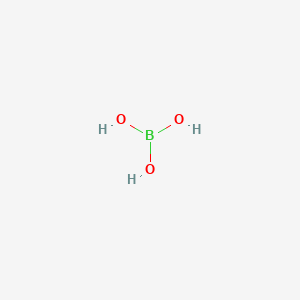
CAS 10043-35-3CAS 11113-50-1PubChem CID 7628
Boric Acid
Boric acid is a member of boric acids. It has a role as an astringent. It is a conjugate acid of a dihydrogenborate. — ChEBI
- IUPAC name
- boric acid
- Molecular formula
- BH3O3
- Molecular weight
- 61.84 g/mol
- Exact mass
- 62.0175241 Da
- Topological polar surface area
- 60.7 Ų
- Hydrogen-bond donors
- 3
- Hydrogen-bond acceptors
- 3
- Covalent units
- 1
- Defined stereocentres
- 0
Also known as
Orthoboric acidBoracic acidBorofaxBoron hydroxideBoric acid (H3BO3)Boron trihydroxideBasilit BThree Elephant
16 more reported names
Boric acid (BH3O3)TrihydroxyboraneTrihydroxyboroneFlea PrufeSuper Flea EliminatorOrthoborsaeureBorsaeureBorsaureOrthoboric acid (B(OH)3)NCI-C56417Dr.'s 1 Flea Terminator DTDr.'s 1 Flea Terminator DFPBOCollyrium Eye Washhydrogen orthoborateDr.'s 1 Flea Terminator DFB(OH)3
External database identifiers
- ChEBI:CHEBI:33118
- ChEMBL:CHEMBL42403
- EPA DTXSID:DTXSID1020194
- PubMed:40682482
- PubMed:38108610
- PubMed:37572183
- PubMed:37045926
- PubMed:35020164
- PubMed:34175401
- PubMed:33137424
- PubMed:32553615
- PubMed:32179172
- PubMed:31823256
- PubMed:31368021
- PubMed:30997025
Evidence from additional scientific databases
EMBL-EBI ChEBI
Exact identifier matchCHEBI:33118
boric acid
- Formula
- H3BO3
- Average mass
- 61.833 g/mol
- Monoisotopic mass
- 62.01752 Da
- Formal charge
- 0
- boric acids — is a (CHEBI:59765)
- astringent — has role (CHEBI:74783)
- plastic heat stabilizer — has role (CHEBI:747338)
- astringent — has role (CHEBI:74783)
- plastic heat stabilizer — has role (CHEBI:747338)
- boric acids — is a (CHEBI:59765)
- dihydrogenborate — is conjugate acid of (CHEBI:29254)
Additional curated names
trihydroxidoboron[B(OH)3]B(OH)3boric acidBoric acidBORIC ACIDboron trihydroxideH3BO3orthoboric acid
Cross-references from this source
- CAS: 10043-35-3 — KEGG COMPOUND
- CAS: 10043-35-3 — NIST Chemistry WebBook
- CAS: 10043-35-3 — ChemIDplus
- CAS: 11113-50-1 — ChemIDplus
- REGISTRY_NUMBER: 1585 — Gmelin
- MANUAL_X_REF: 1644 — MolBase
- MANUAL_X_REF: 2136 — PPDB
- MANUAL_X_REF: 2136 — BPDB
- MANUAL_X_REF: 3035 — DrugCentral
- MANUAL_X_REF: BO3 — PDBeChem
- MANUAL_X_REF: C12486 — KEGG COMPOUND
- MANUAL_X_REF: D01089 — KEGG DRUG
Mapped by: Exact CAS cross-reference in the ChEBI compound record. Source updated: 2025-09-18. Retrieved: 2026-08-31. Open source record
NIH PubChem PUG-View
Exact identifier match7628
Attributed physical-property, hazard, environmental and use annotations.
- Boiling Point: 572 °F at 760 mmHg (decomposes) (NTP, 1992) Source: CAMEO Chemicals
- Boiling Point: 300 Source: DrugBank
- Boiling Point: 572 °F Source: Occupational Safety and Health Administration (OSHA)
- Color/Form: Colorless, transparent crystals or white granules or powder Source: Hazardous Substances Data Bank (HSDB)
- Color/Form: Colorless triclinic crystals Source: Hazardous Substances Data Bank (HSDB)
- Color/Form: White waxy triclinic solid plates Source: Hazardous Substances Data Bank (HSDB)
- Density: 1.435 at 68 °F (USCG, 1999) - Denser than water; will sink Source: CAMEO Chemicals
- Density: 1.5 g/cu cm Source: Hazardous Substances Data Bank (HSDB)
- Density: Relative density (water = 1): 1.5 Source: ILO-WHO International Chemical Safety Cards (ICSCs)
- Density: 1.435 Source: Occupational Safety and Health Administration (OSHA)
- Density: 1.435 @25 °C Source: PAC Chemical Database, U.S. Department of Energy
- Dissociation Constants: Ka = 5.80X10⁻¹⁰ at 25 °C (pKa = 9.24) Source: Hazardous Substances Data Bank (HSDB)
- LogP: log Kow = 0.175 Source: Hazardous Substances Data Bank (HSDB)
- LogP: 0.18 Source: Human Metabolome Database (HMDB)
- LogP: -1.09 Source: ILO-WHO International Chemical Safety Cards (ICSCs)
- Melting Point: 340 °F (NTP, 1992) Source: CAMEO Chemicals
- Melting Point: 169 Source: DrugBank
- Melting Point: 171 °C Source: Haz-Map, Information on Hazardous Chemicals and Occupational Diseases
- Melting Point: 170.9 °C Source: Hazardous Substances Data Bank (HSDB)
- Melting Point: 171 °C Source: Human Metabolome Database (HMDB)
- Melting Point: 340 °F Source: Occupational Safety and Health Administration (OSHA)
- Melting Point: 170.9 °C Source: PAC Chemical Database, U.S. Department of Energy
- Odor: Odorless Source: Hazardous Substances Data Bank (HSDB)
- Physical Description: Boric acid is an odorless white solid. Melting point 171 °C. Sinks and mixes with water. (USCG, 1999) Source: CAMEO Chemicals
- Physical Description: Dry Powder; Other Solid; Large Crystals; Dry Powder; Large Crystals; Liquid; Other Solid Source: EPA Chemical Data Reporting (CDR)
- Physical Description: Colourless, odourless, transparent crystals or white granules or powder; slightly unctuous to the touch; occurs in nature as the mineral sassolite Source: EU Food Improvement Agents
- Physical Description: Colorless crystals or white powder or granules; odorless; [Merck Index] White odorless powder; [Alfa Aesar MSDS] Source: Haz-Map, Information on Hazardous Chemicals and Occupational Diseases
- Physical Description: Solid Source: Human Metabolome Database (HMDB)
- Physical Description: ODOURLESS COLOURLESS CRYSTALS OR WHITE POWDER. Source: ILO-WHO International Chemical Safety Cards (ICSCs)
- Physical Description: Odorless white solid. Source: Occupational Safety and Health Administration (OSHA)
- Refractive Index: Index of refraction: 1.337, 1.461, 1.462 Source: Hazardous Substances Data Bank (HSDB)
- Solubility: 10 to 50 mg/mL at 66 °F (NTP, 1992) Source: CAMEO Chemicals
- Solubility: Soluble in hot water, partially soluble in cold water Source: DrugBank
- Solubility: Slightly unctuous to touch; volatile with steam; solubility in water increased by hydrochloric, citric or tartaric acids Source: Hazardous Substances Data Bank (HSDB)
- Solubility: Solubility: in glycerol 17.5% at 25 °C; ethylene glycol 18.5% at 25 °C; in methanol 173.9 g/L at 25 °C; in ethanol 94.4 g/L at 25 °C; in acetone 0.6% at 25 °C; ethyl acetate 1.5% at 25 °C Source: Hazardous Substances Data Bank (HSDB)
- Solubility: Water solubility: 2.52% at 0 °C; 3.49% at 10 °C; 4.72% at 20 °C; 6.23% at 30 °C; 8.08% at 40 °C; 10.27% at 50 °C; 12.97% at 60 °C; 15.75% at 70 °C; 19.10% at 80 °C; 23.27% at 90 °C; 27.53% at 100 °C Source: Hazardous Substances Data Bank (HSDB)
- Solubility: Solubility in water is increased by hydrochloric acid Source: Hazardous Substances Data Bank (HSDB)
- Solubility: In water, 5.0X10+4 mg/L at 25 °C Source: Hazardous Substances Data Bank (HSDB)
- Solubility: 50 mg/mL at 25 °C Source: Human Metabolome Database (HMDB)
- Solubility: Solubility in water, g/100ml at 20 °C: 5.6 Source: ILO-WHO International Chemical Safety Cards (ICSCs)
- Vapor Pressure: 1.6X10⁻⁶ mm Hg at 25 °C (2.136X10⁻⁴ Pa); log P (in Pa) = 26.83 - 9094/T where T is deg K Source: Hazardous Substances Data Bank (HSDB)
- Vapor Pressure: Vapor pressure at 20 °C: negligible Source: ILO-WHO International Chemical Safety Cards (ICSCs)
- pH: 3,8-4,8 (3,3 % aqueous solution) Source: EU Food Improvement Agents
- pH: pH = 5.1 (0.1 Molar) Source: Hazardous Substances Data Bank (HSDB)
- Substance: Boric Acid Source: NTP Technical Reports
- NTP Technical Report: TR-324: Toxicology and Carcinogenesis Studies of Boric Acid (CASRN 10043-35-3) in B6C3F1 Mice (Feed Studies) (1987 ) Source: NTP Technical Reports
- Peer Review Date: 03/26/86 Source: NTP Technical Reports
- Conclusion for Male Rat: Chemical Not Tested in Species/Sex Source: NTP Technical Reports
- Conclusion for Female Rat: Chemical Not Tested in Species/Sex Source: NTP Technical Reports
- Conclusion for Male Mice: No Evidence Source: NTP Technical Reports
- Conclusion for Female Mice: No Evidence Source: NTP Technical Reports
- Summary: Under the conditions of these 2--year feed studies, there was no evidence of carcinogenicity of boric acid at doses of 2,500 or 5,000 ppm for male or female B6C3F1 mice. Testicular atrophy and interstitial cell hyperplasia were observed in high dose male mice. The decrease in survival of dosed male mice may have reduced the sensitivity of this study. Source: NTP Technical Reports
- Carcinogen Classification: No indication of carcinogenicity to humans (not listed by IARC). Source: Toxin and Toxin Target Database (T3DB)
- Exposure Routes: The substance can be absorbed into the body by inhalation of dust and by ingestion. Source: ILO-WHO International Chemical Safety Cards (ICSCs)
- First Aid: EYES: First check the victim for contact lenses and remove if present. Flush victim's eyes with water or normal saline solution for 20 to 30 minutes while simultaneously calling a hospital or poison control center. Do not put any ointments, oils, or medication in the victim's eyes without specific instructions from a physician. IMMEDIATELY transport the victim after flushing eyes to a hospital even if no symptoms (such as redness or irritation) develop.; SKIN: IMMEDIATELY flood affected skin with water while removing and isolating all contaminated clothing. Gently wash all affected skin areas thoroughly with soap and water. If symptoms such as redness or irritation develop, IMMEDIATELY call a physician and be prepared to transport the victim to a hospital for treatment.; INHALATION: IMMEDIATELY leave the contaminated area; take deep breaths of fresh air. If symptoms (such as wheezing, coughing, shortness of breath, or burning in the mouth, throat, or chest) develop, call a physician and be prepared to transport the victim to a hospital. Provide proper respiratory protection to rescuers entering an unknown atmosphere. Whenever possible, Self-Contained Breathing Apparatus (SCBA) shou Source: CAMEO Chemicals
- Signal: Danger Source: Regulation (EC) No 1272/2008 of the European Parliament and of the Council
- GHS Hazard Statements: H360FD: May damage fertility; May damage the unborn child [Danger Reproductive toxicity] Source: Regulation (EC) No 1272/2008 of the European Parliament and of the Council
- Precautionary Statement Codes: P203, P280, P318, P405, and P501 (click each P-code to see the statement) Source: Regulation (EC) No 1272/2008 of the European Parliament and of the Council
- Note: This chemical does not meet GHS hazard criteria for < 0.1% (1 of 2123) of reports. Source: European Chemicals Agency (ECHA)
- Signal: Danger Source: European Chemicals Agency (ECHA)
- GHS Hazard Statements: H360 (88.7%): May damage fertility or the unborn child [Danger Reproductive toxicity]; H360FD (11.2%): May damage fertility; May damage the unborn child [Danger Reproductive toxicity] Source: European Chemicals Agency (ECHA)
- Precautionary Statement Codes: P203, P280, P318, P405, and P501 (click each P-code to see the statement) Source: European Chemicals Agency (ECHA)
- ECHA C&L Notifications Summary: Aggregated GHS information provided per 2123 reports by companies from 49 notifications to the ECHA C&L Inventory. Each notification may be associated with multiple companies.; Reported as not meeting GHS hazard criteria per 1 of 2123 reports by companies.; There are 48 notifications provided by 2122 of 2123 reports by companies with hazard statement code(s).; Information may vary between notifications depending on impurities, additives, and other factors. The percentage value in parenthesis indicates the notified classification ratio from companies that provide hazard codes. Only hazard codes with percentage values above 10% are shown. For more detailed information, please visit ECHA C&L website. Source: European Chemicals Agency (ECHA)
- GHS Hazard Statements: H360 (100%): May damage fertility or the unborn child [Danger Reproductive toxicity] Source: European Chemicals Agency (ECHA)
- ECHA C&L Notifications Summary: Aggregated GHS information provided per 241 reports by companies from 5 notifications to the ECHA C&L Inventory.; Information may vary between notifications depending on impurities, additives, and other factors. The percentage value in parenthesis indicates the notified classification ratio from companies that provide hazard codes. Only hazard codes with percentage values above 10% are shown. For more detailed information, please visit ECHA C&L website. Source: European Chemicals Agency (ECHA)
- Signal: Danger Source: NITE-CMC
- GHS Hazard Statements: H315: Causes skin irritation [Warning Skin corrosion/irritation]; H319: Causes serious eye irritation [Warning Serious eye damage/eye irritation]; H335: May cause respiratory irritation [Warning Specific target organ toxicity, single exposure; Respiratory tract irritation]; H360: May damage fertility or the unborn child [Danger Reproductive toxicity]; H370: Causes damage to organs [Danger Specific target organ toxicity, single exposure]; H402: Harmful to aquatic life [Hazardous to the aquatic environment, acute hazard] Source: NITE-CMC
- Cosmetic Ingredient Review Conclusion: The Expert Panel concludes that Sodium Borate and Boric Acid, in concentrations less than or equal to 5 percent, are safe as cosmetic ingredients when used as currently recommended; however, cosmetic formulations containing free Sodium Borate or Boric Acid at this concentration should not be used on infant skin or injured skin. Note: In 2003, the CIR Expert Panel considered available new data on these ingredients and reaffirmed the above conclusion. Source: Cosmetic Ingredient Review (CIR)
- Cosmetic Ingredient Review Finding(s): Safe for use in cosmetics, with qualifications Source: Cosmetic Ingredient Review (CIR)
- Environmental Bioconcentration: Highly water soluble materials are unlikely to bioaccumulate to any significant degree, and borate species are all present essentially as undissociated boric acid at neutral pH(1). The octanol/water partition coefficient for boric acid has been measured as 0.175(1), indicating low bioaccumulation potential(1). Boron did not bioaccumulate in 47-day and 21-day exposure tests using oysters and sockeye salmon respectively(1). Source: Hazardous Substances Data Bank (HSDB)
- Environmental Fate: TERRESTRIAL FATE: The pKa of boric acid is 9.24 at 25 °C(1), indicating that this compound will exist primarily in the undissociated form at an environmental pH range between pH 5 and pH 9, although the anion form will partially exist in alkaline soils(SRC). Adsorption of boron in soils depends on pH, organic content and types of clay and minerals in the soil(1). At acidic pH, boron exists in solutions in the form of undissociated boric acid; at alkaline pH, presence of borate ion occurs, which reaches maximum adsorption at pH 8.5-9(2). Field studies have observed boron to leach readily in soil(1); undissociated boric acid is transported in soil with little adsorption(2). Volatilization of boric acid from moist soil surfaces is not expected to be an important fate process(SRC) given an estimated Henry's Law constant of 2.6X10⁻¹² atm-cu m/mole(SRC), based upon its vapor pressure, 1.6X10⁻⁶ mm Hg(3), and water solubility, 5X10+4 mg/L(4). Boric acid is not expected to volatilize from dry soil surfaces(SRC) based upon its vapor pressure. No biotransformation processes have been reported for boron compounds, including boric acid(2). Source: Hazardous Substances Data Bank (HSDB)
- Environmental Fate: AQUATIC FATE: The pKa of boric acid is 9.24 at 25 °C(1), indicating that this compound will exist primarily in the undissociated form at an environmental pH range between 5 and 9, although the anion form will partially exist in alkaline waters(SRC). Boric acid leaches readily in soils(2) which indicates adsorption to suspended solids and sediment in water will not be an important fate process(SRC). Volatilization from water surfaces is not expected(3) based upon an estimated Henry's Law constant of 2.6X10⁻¹² atm-cu m/mole(SRC), derived from its vapor pressure, 1.6X10⁻⁶ mm Hg(4), and water solubility, 5X10+4 mg/L(5). However, evaporation of seawater itself is reported to be the biggest environmental contribution of boric acid to air(2). No biotransformation processes have been reported for boron compounds, including boric acid(2). Source: Hazardous Substances Data Bank (HSDB)
- Environmental Fate: ATMOSPHERIC FATE: According to a model of gas/particle partitioning of semivolatile organic compounds in the atmosphere(1), boric acid, which has a vapor pressure of 1.6X10⁻⁶ mm Hg at 25 °C(2), will exist in both the vapor and particulate phases in the ambient atmosphere. One monitoring study found that approximately 90% of boric acid in the atmosphere is in gaseous form and 10% in particulate form(3). Vapor-phase boric acid is degraded in the atmosphere by reaction with photochemically-produced hydroxyl radicals(SRC); the half-life for this reaction in air is estimated to be about 38 days(SRC), calculated from its rate constant of 4.2X10⁻¹³ cu cm/molecule-sec at 25 °C(SRC) that was derived using a structure estimation method(4). Particulate-phase boric acid may be removed from the air by wet or dry deposition(SRC). Source: Hazardous Substances Data Bank (HSDB)
- Consumer Uses: Chemical reaction regulator; pH regulating agent; Bleaching agent; Tanning agents not otherwise specified; Other; Lubricating agent; Anti-adhesive/cohesive; Adhesion/cohesion promoter; Anti-scaling agent; Viscosity modifiers; Soil amendments (fertilizers); Corrosion inhibitor; Not Known or Reasonably Ascertainable Source: EPA Chemical Data Reporting (CDR)
- Industry Uses: Processing aids not otherwise specified; Plating agent; Chemical reaction regulator; Bleaching agent; Fuel agents; pH regulating agent; Binder; Other; Lubricating agent; Anti-static agent; Chelating agent; Etching agent; Adhesion/cohesion promoter; Surface modifier; Dye; Flux agent; Flame retardant; Cleaning agent; Stabilizing agent; Not Known or Reasonably Ascertainable; Soil amendments (fertilizers) Source: EPA Chemical Data Reporting (CDR)
- Cosmetic Ingredient Review Link: CIR ingredient: Boric Acid Source: Cosmetic Ingredient Review (CIR)
- Sources/Uses: Used as an insecticide to kill ants and roaches, as a soldering flux, a flame retardant and weatherproofing agent; also used as an additive to dyes, nickeling baths, film developers, glass, enamels, soaps, paints, paper, adhesives, and steel; [HSDB] Used as a flux, an additive for heat-resistant borosilcate glass and glass fibers, a flame retardant for textile and insulation products, a fungicide for citrus fruits, an eye medicine, and a solute for nickel electroplating baths; Boric acid is formed by crystallizing a solution of hydrochloric acid or sulfuric acid and borax. [Hawley] Used for weatherproofing wood, as a preservative, in cosmetics, printing and dyeing, electric condensers, photography, and painting, for impregnating wicks and hardening steel, and to make cements, crockery, porcelain, borates, leather, carpets, hats, and artificial gems; Used therapeutically as an astringent and antiseptic and as a veterinary antibacterial and antifungal; [Merck Index] Registered US pesticide uses include insecticides (stomach poisons for ants, cockroaches, silverfish, and termites), fungicides (wood preservatives), and herbicides (desiccants, photosynthesis interrupters, and algae cont Source: Haz-Map, Information on Hazardous Chemicals and Occupational Diseases
- Industrial Processes with risk of exposure: Steel Producing [Category: Industry]; Welding [Category: Weld]; Brazing [Category: Heat or Machine]; Electroplating [Category: Plate]; Textiles (Fiber & Fabric Manufacturing) [Category: Industry]; Painting (Pigments, Binders, and Biocides) [Category: Paint]; Applying Wood Preservatives [Category: Other]; Using Disinfectants or Biocides [Category: Clean]; Farming (Pesticides) [Category: Industry]; Sewer and Wastewater Treatment [Category: Industry]; Leather Tanning and Processing [Category: Industry]; Photographic Processing [Category: Other]; Cement Producing [Category: Industry]; Textiles (Printing, Dyeing, or Finishing) [Category: Industry]; Glass Manufacturing [Category: Industry] Source: Haz-Map, Information on Hazardous Chemicals and Occupational Diseases
- Uses: Both oil base and water base fracturing fluids are being used in the fracturing industry. Water base, which includes alcohol-water mixtures and low strength acids, make up the majority of treating fluids. The common chemicals added to these fluids are polymers for viscosity development, crosslinkers for viscosity enhancement, pH control chemicals, gel breakers for polymer degradation following the treatment, surfactants, clay stabilizers, alcohol, bactericides, fluid loss additives and friction reducer. /Hydraulic fracturing/ Source: Hazardous Substances Data Bank (HSDB)
- Uses: Hydraulic fracturing uses a specially blended liquid which is pumped into a well under extreme pressure causing cracks in rock formations underground. These cracks in the rock then allow oil and natural gas to flow, increasing resource production. ... Chemical Name: Boric acid; Chemical Purpose: Maintains fluid viscosity as temperature increases; Product Function: Crosslinker. Source: Hazardous Substances Data Bank (HSDB)
- Uses: For boric acid (USEPA/OPP Pesticide Code: 011001) ACTIVE products with label matches. /SRP: Registered for use in the U.S. but approved pesticide uses may change periodically and so federal, state and local authorities must be consulted for currently approved uses./ Source: Hazardous Substances Data Bank (HSDB)
- Uses: For weatherproofing wood and fireproofing fabrics; as a preservative; manufacture of cements, crockery, porcelain, enamels, glass, borates, leather, carpets, hats, soaps, artificial gems; in nickeling baths; cosmetics; printing and dyeing, painting; photography; for impregnating wicks; electric condensers; hardening steel. Also used as insecticide for cockroaches and black carpet beetles. Source: Hazardous Substances Data Bank (HSDB)
- Uses: For more Uses (Complete) data for BORIC ACID (20 total), please visit the HSDB record page. Source: Hazardous Substances Data Bank (HSDB)
Mapped by: Existing checksum-valid CAS to unique PubChem CID match. Retrieved: 2026-08-31. Open source record
Scientific classifications and hazard annotations provide context and do not replace the market-specific regulatory decision shown above.
Additional source coverage and match status
| Source | Result | Checked |
|---|---|---|
| EMBL-EBI ChEBI | Exact match | 2026-08-31 |
| NIH PubChem PUG-View | Exact match | 2026-08-31 |
A recorded no-match is useful evidence that the source was checked; it is not a claim that the substance does not exist elsewhere.
Retrieved from NIH PubChem on 2026-08-31 by checksum-valid CAS matching. Chemical properties do not replace the regulatory decision on this page.
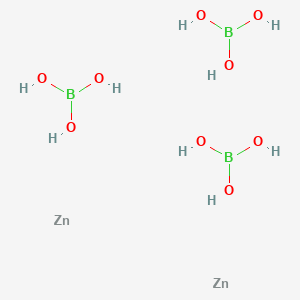
CAS 10192-46-8PubChem CID 159268
Boric acid (H3BO3), zinc salt (2:3)
- IUPAC name
- boric acid;zinc
- Molecular formula
- B3H9O9Zn2
- Molecular weight
- 316.3 g/mol
- Exact mass
- 315.90775 Da
- Topological polar surface area
- 182.0 Ų
- Hydrogen-bond donors
- 9
- Hydrogen-bond acceptors
- 9
- Covalent units
- 5
- Defined stereocentres
- 0
Also known as
Diboron trizinc hexaoxideEINECS 233-471-8RefChem:569989233-471-8Zinc borate (Zn3(BO3)2)NQRYWXBQCVKRRU-UHFFFAOYSA-N
Evidence from additional scientific databases
NIH PubChem PUG-View
Exact identifier match159268
Attributed physical-property, hazard, environmental and use annotations.
- Signal: Warning Source: European Chemicals Agency (ECHA)
- GHS Hazard Statements: H302 (100%): Harmful if swallowed [Warning Acute toxicity, oral]; H317 (100%): May cause an allergic skin reaction [Warning Sensitization, Skin] Source: European Chemicals Agency (ECHA)
- Precautionary Statement Codes: P261, P264, P270, P272, P280, P301+P317, P302+P352, P321, P330, P333+P317, P362+P364, and P501 (click each P-code to see the statement) Source: European Chemicals Agency (ECHA)
- ECHA C&L Notifications Summary: Aggregated GHS information provided per 7 reports by companies from 1 notifications to the ECHA C&L Inventory. Each notification may be associated with multiple companies.; Information may vary between notifications depending on impurities, additives, and other factors. The percentage value in parenthesis indicates the notified classification ratio from companies that provide hazard codes. Only hazard codes with percentage values above 10% are shown. For more detailed information, please visit ECHA C&L website. Source: European Chemicals Agency (ECHA)
- Signal: Danger Source: Hazardous Chemical Information System (HCIS), Safe Work Australia
- GHS Hazard Statements: H360FD: May damage fertility; May damage the unborn child [Danger Reproductive toxicity] Source: Hazardous Chemical Information System (HCIS), Safe Work Australia
- Precautionary Statement Codes: P203, P280, P318, P405, and P501 (click each P-code to see the statement) Source: Hazardous Chemical Information System (HCIS), Safe Work Australia
Mapped by: Existing checksum-valid CAS to unique PubChem CID match. Retrieved: 2026-08-31. Open source record
Scientific classifications and hazard annotations provide context and do not replace the market-specific regulatory decision shown above.
Additional source coverage and match status
| Source | Result | Checked |
|---|---|---|
| EMBL-EBI ChEBI | No exact record | 2026-08-31 |
| NIH PubChem PUG-View | Exact match | 2026-08-31 |
A recorded no-match is useful evidence that the source was checked; it is not a claim that the substance does not exist elsewhere.
Retrieved from NIH PubChem on 2026-08-31 by checksum-valid CAS matching. Chemical properties do not replace the regulatory decision on this page.
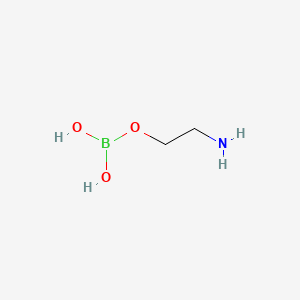
CAS 10377-81-8CAS 68130-12-1PubChem CID 82594
Monoethanolamine borate
- IUPAC name
- 2-aminoethoxyboronic acid
- Molecular formula
- C2H8BNO3
- Molecular weight
- 104.90 g/mol
- Exact mass
- 105.0597233 Da
- Topological polar surface area
- 75.7 Ų
- Hydrogen-bond donors
- 3
- Hydrogen-bond acceptors
- 4
- Covalent units
- 1
- Defined stereocentres
- 0
Also known as
Actracor MMEA-BorateEthanolamine borate (1:1)Ethanol, 2-amino-, monoester with boric acid (H3BO3)Ethanol, 2-amino-, ester with boric acid (H3BO3) (1:1)5I4T660488RefChem:1089826233-829-3
12 more reported names
Ethanolamine borateTrigamine2-Aminoethanol, monoester with boric acidBoric acid, 2-aminoethyl ester2-aminoethyl dihydrogen borateUNII-5I4T660488EINECS 233-829-3EC 233-829-3boric acid-beta-aminoethylesterJCAYXDKNUSEQRT-UHFFFAOYSA-NBC 140Ethanol, 2-amino-, monoester with boric acid
External database identifiers
- EPA DTXSID:DTXSID3049673
Evidence from additional scientific databases
NIH PubChem PUG-View
Exact identifier match82594
Attributed physical-property, hazard, environmental and use annotations.
- Note: This chemical does not meet GHS hazard criteria for 29.7% (11 of 37) of reports. Source: European Chemicals Agency (ECHA)
- Signal: Warning Source: European Chemicals Agency (ECHA)
- GHS Hazard Statements: H315 (70.3%): Causes skin irritation [Warning Skin corrosion/irritation]; H319 (70.3%): Causes serious eye irritation [Warning Serious eye damage/eye irritation]; H335 (67.6%): May cause respiratory irritation [Warning Specific target organ toxicity, single exposure; Respiratory tract irritation] Source: European Chemicals Agency (ECHA)
- Precautionary Statement Codes: P261, P264, P264+P265, P271, P280, P302+P352, P304+P340, P305+P351+P338, P319, P321, P332+P317, P337+P317, P362+P364, P403+P233, P405, and P501 (click each P-code to see the statement) Source: European Chemicals Agency (ECHA)
- ECHA C&L Notifications Summary: Aggregated GHS information provided per 37 reports by companies from 3 notifications to the ECHA C&L Inventory. Each notification may be associated with multiple companies.; Reported as not meeting GHS hazard criteria per 11 of 37 reports by companies.; There are 2 notifications provided by 26 of 37 reports by companies with hazard statement code(s).; Information may vary between notifications depending on impurities, additives, and other factors. The percentage value in parenthesis indicates the notified classification ratio from companies that provide hazard codes. Only hazard codes with percentage values above 10% are shown. For more detailed information, please visit ECHA C&L website. Source: European Chemicals Agency (ECHA)
Mapped by: Existing checksum-valid CAS to unique PubChem CID match. Retrieved: 2026-08-31. Open source record
Scientific classifications and hazard annotations provide context and do not replace the market-specific regulatory decision shown above.
Additional source coverage and match status
| Source | Result | Checked |
|---|---|---|
| EMBL-EBI ChEBI | No exact record | 2026-08-31 |
| NIH PubChem PUG-View | Exact match | 2026-08-31 |
A recorded no-match is useful evidence that the source was checked; it is not a claim that the substance does not exist elsewhere.
Retrieved from NIH PubChem on 2026-09-02 by checksum-valid CAS matching. Chemical properties do not replace the regulatory decision on this page.
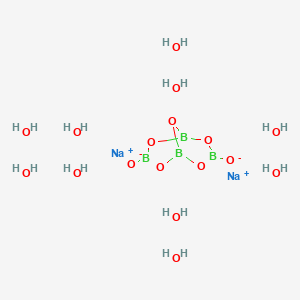
CAS 1303-96-4PubChem CID 16211214
Borax (B4Na2O7.10H2O)
Borax is a mineral with formula of Na2B4O5(OH)4·8H2O. The IMA symbol is Brx. — RRUFF Project
- IUPAC name
- disodium;3,7-dioxido-2,4,6,8,9-pentaoxa-1,3,5,7-tetraborabicyclo[3.3.1]nonane;decahydrate
- Molecular formula
- B4H20Na2O17
- Molecular weight
- 381.4 g/mol
- Exact mass
- 382.0868084 Da
- Topological polar surface area
- 102.0 Ų
- Hydrogen-bond donors
- 10
- Hydrogen-bond acceptors
- 17
- Covalent units
- 13
- Defined stereocentres
- 0
Also known as
BORAXBorax decahydrateSodium borate decahydrateSodium pyroborate decahydrateAntipyoninBorascuBoricinSolubor
16 more reported names
TronaborJaikinNeoborBuraGerstley borateGertley borateBoro-spray91MBZ8H3QODisodium tetraborate decahydrateSodium borate, decahydrateSodium biborate decahydrateBoric acid (H2B4O7), disodium salt, decahydrateBoron sodium oxide (B4Na2O7), decahydratesodium diboratesodium meta borateBorax 200ck
External database identifiers
- ChEMBL:CHEMBL3833375
- EPA DTXSID:DTXSID701014356
- PubMed:10010
Evidence from additional scientific databases
NIH PubChem PUG-View
Exact identifier match16211214
Attributed physical-property, hazard, environmental and use annotations.
- Boiling Point: 608 °F Source: Occupational Safety and Health Administration (OSHA)
- Boiling Point: 608 °F Source: The National Institute for Occupational Safety and Health (NIOSH)
- Color/Form: White, monoclinic crystals Source: Hazardous Substances Data Bank (HSDB)
- Color/Form: Hard crystals, granules or crystalline powder; efflorescent in dry air, the crystals often being coated with white powder Source: Hazardous Substances Data Bank (HSDB)
- Color/Form: Crystalline granules or crystalline powder Source: Hazardous Substances Data Bank (HSDB)
- Color/Form: White, crystalline solid [Note: Becomes anhydrous at 608 degrees F] Source: Hazardous Substances Data Bank (HSDB)
- Density: 1.73 g/cu cm Source: Hazardous Substances Data Bank (HSDB)
- Density: Relative density (water = 1): 1.7 Source: ILO-WHO International Chemical Safety Cards (ICSCs)
- Density: 1.73 Source: Occupational Safety and Health Administration (OSHA)
- Density: 1.73 @25 °C Source: PAC Chemical Database, U.S. Department of Energy
- Density: 1.73 Source: The National Institute for Occupational Safety and Health (NIOSH)
- Melting Point: 75 °C (decomposes) Source: Hazardous Substances Data Bank (HSDB)
- Melting Point: 167 °F Source: Occupational Safety and Health Administration (OSHA)
- Melting Point: 167 °F Source: The National Institute for Occupational Safety and Health (NIOSH)
- Odor: Odorless Source: Hazardous Substances Data Bank (HSDB)
- Physical Description: Liquid; Other Solid; Large Crystals; Wet Solid; Dry Powder Source: EPA Chemical Data Reporting (CDR)
- Physical Description: White, odorless, crystalline solid; Becomes anhydrous at 608 degrees F; [NIOSH] Source: Haz-Map, Information on Hazardous Chemicals and Occupational Diseases
- Physical Description: WHITE CRYSTALS OR CRYSTALLINE POWDER. Source: ILO-WHO International Chemical Safety Cards (ICSCs)
- Physical Description: White, odorless, crystalline solid. Source: Occupational Safety and Health Administration (OSHA)
- Physical Description: White, odorless, crystalline solid. [herbicide] [Note: Becomes anhydrous at 608 °F.] Source: The National Institute for Occupational Safety and Health (NIOSH)
- Refractive Index: Index of refraction: 1.447 (alpha); 1.469 (beta); 1.472 (gamma) Source: Hazardous Substances Data Bank (HSDB)
- Solubility: Aqueous solution is alkaline to litmus and phenolphthalein; pH about pH = 9.5 Source: Hazardous Substances Data Bank (HSDB)
- Solubility: At 100 °C loses 5H2O; at 150 °C loses 9H2O; becomes anhydrous at 320 °C; borax dissolves many metallic oxides when fused with them Source: Hazardous Substances Data Bank (HSDB)
- Solubility: In water, 5.93X10+4 mg/L at 25 °C Source: Hazardous Substances Data Bank (HSDB)
- Solubility: 3.17 g/100 g water at 25 °C Source: Hazardous Substances Data Bank (HSDB)
- Solubility: 1 g/16 mL in water; 1 g/0.6 mL boiling water; 1 g/1 mL glycerol; insoluble in alcohol Source: Hazardous Substances Data Bank (HSDB)
- Solubility: Insoluble in ethanol Source: Hazardous Substances Data Bank (HSDB)
- Solubility: 0.60 g/100 g acetone Source: Hazardous Substances Data Bank (HSDB)
- Solubility: Solubility in water, g/100ml at 20 °C: 5.1 Source: ILO-WHO International Chemical Safety Cards (ICSCs)
- Solubility: 6% Source: The National Institute for Occupational Safety and Health (NIOSH)
- Vapor Pressure: Approximately 0 mm Hg Source: Hazardous Substances Data Bank (HSDB)
- Vapor Pressure: 0 mmHg (approx) Source: Occupational Safety and Health Administration (OSHA)
- Vapor Pressure: 0 mmHg (approx) Source: The National Institute for Occupational Safety and Health (NIOSH)
- pH: pH at 20 °C: 9.3 (0.1% solution); 9.2 (1.0% solution) Source: Hazardous Substances Data Bank (HSDB)
- Exposure Routes: The substance can be absorbed into the body by inhalation and by ingestion. Source: ILO-WHO International Chemical Safety Cards (ICSCs)
- Exposure Routes: inhalation, ingestion, skin and/or eye contact Source: The National Institute for Occupational Safety and Health (NIOSH)
- First Aid: (General first aid procedures); Eye: Irrigate immediately - If this chemical contacts the eyes, immediately wash (irrigate) the eyes with large amounts of water, occasionally lifting the lower and upper lids. Get medical attention immediately.; Skin: Soap wash - If this chemical contacts the skin, wash the contaminated skin with soap and water.; Breathing: Respiratory support; Swallow: Medical attention immediately - If this chemical has been swallowed, get medical attention immediately. Source: The National Institute for Occupational Safety and Health (NIOSH)
- Signal: Danger Source: Regulation (EC) No 1272/2008 of the European Parliament and of the Council
- GHS Hazard Statements: H360FD: May damage fertility; May damage the unborn child [Danger Reproductive toxicity] Source: Regulation (EC) No 1272/2008 of the European Parliament and of the Council
- Precautionary Statement Codes: P203, P280, P318, P405, and P501 (click each P-code to see the statement) Source: Regulation (EC) No 1272/2008 of the European Parliament and of the Council
- Note: This chemical does not meet GHS hazard criteria for < 0.1% (1 of 2865) of reports. Source: European Chemicals Agency (ECHA)
- Signal: Danger Source: European Chemicals Agency (ECHA)
- GHS Hazard Statements: H319 (12.6%): Causes serious eye irritation [Warning Serious eye damage/eye irritation]; H360 (93.2%): May damage fertility or the unborn child [Danger Reproductive toxicity] Source: European Chemicals Agency (ECHA)
- Precautionary Statement Codes: P203, P264+P265, P280, P305+P351+P338, P318, P337+P317, P405, and P501 (click each P-code to see the statement) Source: European Chemicals Agency (ECHA)
- ECHA C&L Notifications Summary: Aggregated GHS information provided per 2865 reports by companies from 31 notifications to the ECHA C&L Inventory. Each notification may be associated with multiple companies.; Reported as not meeting GHS hazard criteria per 1 of 2865 reports by companies.; There are 30 notifications provided by 2864 of 2865 reports by companies with hazard statement code(s).; Information may vary between notifications depending on impurities, additives, and other factors. The percentage value in parenthesis indicates the notified classification ratio from companies that provide hazard codes. Only hazard codes with percentage values above 10% are shown. For more detailed information, please visit ECHA C&L website. Source: European Chemicals Agency (ECHA)
- Signal: Danger Source: NITE-CMC
- GHS Hazard Statements: H315: Causes skin irritation [Warning Skin corrosion/irritation]; H319: Causes serious eye irritation [Warning Serious eye damage/eye irritation]; H335: May cause respiratory irritation [Warning Specific target organ toxicity, single exposure; Respiratory tract irritation]; H360: May damage fertility or the unborn child [Danger Reproductive toxicity]; H370: Causes damage to organs [Danger Specific target organ toxicity, single exposure]; H372: Causes damage to organs through prolonged or repeated exposure [Danger Specific target organ toxicity, repeated exposure]; H413: May cause long lasting harmful effects to aquatic life [Hazardous to the aquatic environment, long-term hazard] Source: NITE-CMC
- Precautionary Statement Codes: P203, P260, P261, P264, P264+P265, P270, P271, P273, P280, P302+P352, P304+P340, P305+P351+P338, P308+P316, P318, P319, P321, P332+P317, P337+P317, P362+P364, P403+P233, P405, and P501 (click each P-code to see the statement) Source: NITE-CMC
- GHS Hazard Statements: H303: May be harmful if swallowed [Warning Acute toxicity, oral]; H315: Causes skin irritation [Warning Skin corrosion/irritation]; H319: Causes serious eye irritation [Warning Serious eye damage/eye irritation]; H361: Suspected of damaging fertility or the unborn child [Warning Reproductive toxicity]; H370: Causes damage to organs [Danger Specific target organ toxicity, single exposure]; H372: Causes damage to organs through prolonged or repeated exposure [Danger Specific target organ toxicity, repeated exposure]; H373: May causes damage to organs through prolonged or repeated exposure [Warning Specific target organ toxicity, repeated exposure] Source: NITE-CMC
- Target Organs: Eyes, skin, respiratory system Source: The National Institute for Occupational Safety and Health (NIOSH)
- Cosmetic Ingredient Review Conclusion: The Expert Panel concludes that Sodium Borate and Boric Acid, in concentrations less than or equal to 5 percent, are safe as cosmetic ingredients when used as currently recommended; however, cosmetic formulations containing free Sodium Borate or Boric Acid at this concentration should not be used on infant skin or injured skin. Note: In 2003, the CIR Expert Panel considered available new data on these ingredients and reaffirmed the above conclusion. Source: Cosmetic Ingredient Review (CIR)
- Cosmetic Ingredient Review Finding(s): Safe for use in cosmetics, with qualifications Source: Cosmetic Ingredient Review (CIR)
- Environmental Bioconcentration: In a greenhouse experiment with sandy loam soil treated with 0-8.0 ppm boron as borax, boron toxicity symptoms appeared earliest in lentil plants and barley seedlings exposed to 8.0 ppm boron. In barley the severity of boron toxicity decreased with the decrease in boron levels, whereas in lentil the severity of the symptoms eventually reached the same level in 2 and 4 ppm boron treatments as with the highest concentration. Dry matter yield decreased 38.6% in lentil and 23.4% in barley exposed to 8.0 ppm boron in comparison with controls. Boron contents of lentil and barley plants on soil treated with 8 ppm boron were approximately 7- and approximately 8-fold those of control plants, respectively. Source: Hazardous Substances Data Bank (HSDB)
- Environmental Fate: TERRESTRIAL FATE: Boron is naturally occurring and ubiquitous in the environment. No microbial degradation. Disappearance from soil is by washing out. Persistence in soil is about 2 years, depending on rainfall and soil structure. Source: Hazardous Substances Data Bank (HSDB)
- Consumer Uses: Other; Adhesion/cohesion promoter; Soil amendments (fertilizers); Not Known or Reasonably Ascertainable; Flame retardant Source: EPA Chemical Data Reporting (CDR)
- Industry Uses: Abrasives; Plating agent; Etching agent; Chelating agent; Flame retardant; Soil amendments (fertilizers) Source: EPA Chemical Data Reporting (CDR)
- Cosmetic Ingredient Review Link: CIR ingredient: Sodium Borate Source: Cosmetic Ingredient Review (CIR)
- Sources/Uses: Used as a preservative, antiseptic and fungicide; also used to manufacture glazes, enamels, soldering fluxes and cleaning compounds and to fireproof textiles and wood; [ACGIH] Boric acid and borates as tablets or powder are used to kill larvae in barns and other insects in houses. Rarely, they are sprayed as herbicides. [EPA: Recognition of Pesticide Poisonings] Used in photo developing bath; [www.ci.tucson.az.us/arthazards/medium.html] Borax (borax decahydrate) is found naturally in some salt lakes and alkaline soils. Boric acid is formed by crystallizing a solution of hydrochloric acid or sulfuric acid and borax. [Hawley] Source: Haz-Map, Information on Hazardous Chemicals and Occupational Diseases
- Industrial Processes with risk of exposure: Soldering [Category: Heat or Machine]; Using Disinfectants or Biocides [Category: Clean]; Farming (Pesticides) [Category: Industry]; Photographic Processing [Category: Other]; Textiles (Printing, Dyeing, or Finishing) [Category: Industry] Source: Haz-Map, Information on Hazardous Chemicals and Occupational Diseases
- Uses: For borax (USEPA/OPP Pesticide Code: 011102) ACTIVE products with label matches. /SRP: Registered for use in the U.S. but approved pesticide uses may change periodically and so federal, state and local authorities must be consulted for currently approved uses./ Source: Hazardous Substances Data Bank (HSDB)
- Uses: Long been used as a mild antiseptic fungicide and as a herbicide ... Total control of vegetation on non-crop land, such as paths, giving long-term control. Also used in insect baits for food stores to control Formicidae. Source: Hazardous Substances Data Bank (HSDB)
- Uses: Soldering metals; manufacture of glazes and enamels; tanning; in cleaning compounds; artificially aging wood; as preservative, either alone or with other antiseptics against wood fungus; fireproofing fabrics and wood; curing and preserving skins; in cockroach control. In buffers; as a complexing or masking agent in analytical chemistry. Pharmaceutic aid (alkalizer). Source: Hazardous Substances Data Bank (HSDB)
- Uses: Used in ant poisons, for fly control around refuse and manure piles, as a larvicide, in manufacture of glazes, enamels, cleaning compounds, and in soldering metals Source: Hazardous Substances Data Bank (HSDB)
- Uses: For more Uses (Complete) data for BORAX (17 total), please visit the HSDB record page. Source: Hazardous Substances Data Bank (HSDB)
Mapped by: Existing checksum-valid CAS to unique PubChem CID match. Retrieved: 2026-08-31. Open source record
Scientific classifications and hazard annotations provide context and do not replace the market-specific regulatory decision shown above.
Additional source coverage and match status
| Source | Result | Checked |
|---|---|---|
| NIH PubChem PUG-View | Exact match | 2026-08-31 |
A recorded no-match is useful evidence that the source was checked; it is not a claim that the substance does not exist elsewhere.
Retrieved from NIH PubChem on 2026-09-02 by checksum-valid CAS matching. Chemical properties do not replace the regulatory decision on this page.
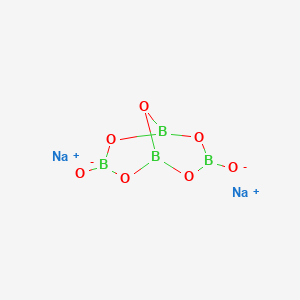
CAS 1330-43-4PubChem CID 10219853
Sodium Tetraborate
- IUPAC name
- disodium;3,7-dioxido-2,4,6,8,9-pentaoxa-1,3,5,7-tetraborabicyclo[3.3.1]nonane
- Molecular formula
- B4Na2O7
- Molecular weight
- 201.2 g/mol
- Exact mass
- 201.9811616 Da
- Topological polar surface area
- 92.3 Ų
- Hydrogen-bond donors
- 0
- Hydrogen-bond acceptors
- 7
- Covalent units
- 3
- Defined stereocentres
- 0
Also known as
Sodium Tetraborate, AnhydrousBorax glassBoron sodium oxide (B4Na2O7)Anhydrous boraxSodium biborateBorax AnhydrousFused boraxSodium borate anhydrous
16 more reported names
Borax, fusedSodium pyroborateDehyborGranuborSprayborSodium borate, anhydrousBorax, dehydratedSodium boron oxideRasorite 658191EN8ZMDBoric acid, disodium saltBoric acid (H2B4O7), disodium saltSodium tetraborate anhydrousINS NO.285Sodium boron oxide (na2b4o7)INS-285
External database identifiers
- EPA DTXSID:DTXSID101014358
- PubMed:21774671
- PubMed:19059942
- PubMed:1432568
Retrieved from NIH PubChem on 2026-09-02 by checksum-valid CAS matching. Chemical properties do not replace the regulatory decision on this page.
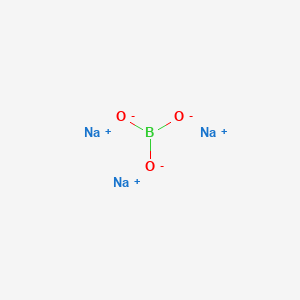
CAS 1333-73-9PubChem CID 159383
boric acid, sodium salt
Trisodium borate is a member of borate salts. — ChEBI
- IUPAC name
- trisodium;borate
- Molecular formula
- BNa3O3
- Molecular weight
- 127.78 g/mol
- Exact mass
- 127.9633569 Da
- Topological polar surface area
- 69.2 Ų
- Hydrogen-bond donors
- 0
- Hydrogen-bond acceptors
- 3
- Covalent units
- 4
- Defined stereocentres
- 0
Also known as
EINECS 215-604-1CCRIS 3628RefChem:570017215-604-1trisodium borateNatriumboratBoric acid sodium saltNa3BO3
5 more reported names
Orthoboric acid sodium saltSCHEMBL3846CHEBI:38909DB-254093DB-255891
External database identifiers
- ChEBI:CHEBI:38909
- EPA DTXSID:DTXSID801360728
Retrieved from NIH PubChem on 2026-08-31 by checksum-valid CAS matching. Chemical properties do not replace the regulatory decision on this page.
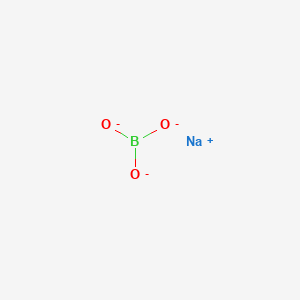
CAS 13840-56-7PubChem CID 160998
Boric acid (H3BO3), sodium salt (1:?)
- IUPAC name
- sodium borate
- Molecular formula
- BNaO3-2
- Molecular weight
- 81.80 g/mol
- Exact mass
- 81.9838183 Da
- Topological polar surface area
- 69.2 Ų
- Hydrogen-bond donors
- 0
- Hydrogen-bond acceptors
- 3
- Covalent units
- 2
- Defined stereocentres
- 0
Also known as
Boric acid (H3BO3), sodium saltTrisodium orthoborateOrthoboric acid, sodium saltEINECS 238-253-6EINECS 237-560-2RefChem:569982237-560-2238-253-6
2 more reported names
sodium;borateWJZOJDGNGVXSIK-UHFFFAOYSA-N
Retrieved from NIH PubChem on 2026-09-02 by checksum-valid CAS matching. Chemical properties do not replace the regulatory decision on this page.
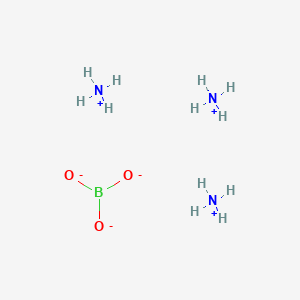
CAS 22694-75-3PubChem CID 161571
Ammonium borate
- IUPAC name
- triazanium;borate
- Molecular formula
- BH12N3O3
- Molecular weight
- 112.93 g/mol
- Exact mass
- 113.0971714 Da
- Topological polar surface area
- 72.2 Ų
- Hydrogen-bond donors
- 3
- Hydrogen-bond acceptors
- 3
- Covalent units
- 4
- Defined stereocentres
- 0
Also known as
Boric acid, ammonium saltBoric acid (H3BO3), ammonium saltBoric acid (H3BO3), triammonium salt311C671BKQTriammonium salt ammonium borate ((NH4)3BO3)RefChem:915715Ammonium borate [WHO-DD]UNII-311C671BKQ
1 more reported name
WYXIGTJNYDDFFH-UHFFFAOYSA-Q
Retrieved from NIH PubChem on 2026-08-31 by checksum-valid CAS matching. Chemical properties do not replace the regulatory decision on this page.
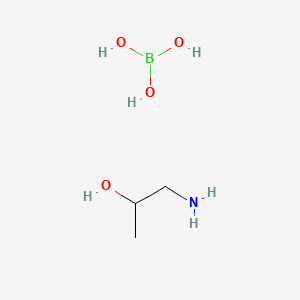
CAS 26038-90-4CAS 68003-13-4PubChem CID 161513
(2-Hydroxypropyl)ammonium dihydrogen orthoborate
- IUPAC name
- 1-aminopropan-2-ol;boric acid
- Molecular formula
- C3H12BNO4
- Molecular weight
- 136.95 g/mol
- Exact mass
- 137.0859380 Da
- Topological polar surface area
- 107.0 Ų
- Hydrogen-bond donors
- 5
- Hydrogen-bond acceptors
- 5
- Covalent units
- 2
- Defined stereocentres
- 0
Also known as
Orthoboric acid isopropanolamine saltYK5M7W95MCEINECS 247-422-31-Aminopropan-2-ol, compound with orthoboric acidRefChem:395926268-109-8Boric acid, monoisopropanolamine salt2-Hydroxypropylammonium orthoborate
5 more reported names
Isopropanolamine borateUNII-YK5M7W95MCFWGLAJMZAXEFTA-UHFFFAOYSA-NEINECS 268-109-8Boric acid--1-aminopropan-2-ol (1/1)
External database identifiers
- EPA DTXSID:DTXSID10892195
Retrieved from NIH PubChem on 2026-09-02 by checksum-valid CAS matching. Chemical properties do not replace the regulatory decision on this page.
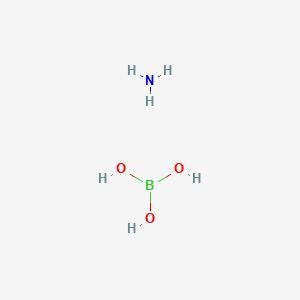
CAS 27522-09-4PubChem CID 22141722
Boric acid (H3BO3), ammonium salt (1:?)
- IUPAC name
- azane;boric acid
- Molecular formula
- BH6NO3
- Molecular weight
- 78.87 g/mol
- Exact mass
- 79.0440732 Da
- Topological polar surface area
- 61.7 Ų
- Hydrogen-bond donors
- 4
- Hydrogen-bond acceptors
- 4
- Covalent units
- 2
- Defined stereocentres
- 0
Also known as
RefChem:1080089amine borate
Retrieved from NIH PubChem on 2026-08-31 by checksum-valid CAS matching. Chemical properties do not replace the regulatory decision on this page.
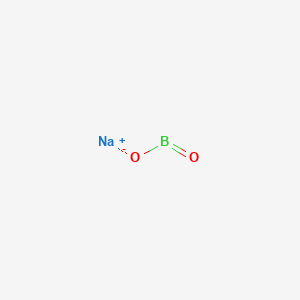
CAS 7775-19-1PubChem CID 145326
Sodium metaborate
Sodium metaborate is an inorganic sodium salt having metaborate as the counterion. It is an inorganic sodium salt and a member of borate salts. — ChEBI
- IUPAC name
- sodium oxido(oxo)borane
- Molecular formula
- BNaO2
- Molecular weight
- 65.80 g/mol
- Exact mass
- 65.9889037 Da
- Topological polar surface area
- 40.1 Ų
- Hydrogen-bond donors
- 0
- Hydrogen-bond acceptors
- 2
- Covalent units
- 2
- Defined stereocentres
- 0
Also known as
BorosoapKodalkBoric acid (HBO2), sodium saltSodium borate (NaBO2)Sodium metaborate, anhydrousBoric acid, monosodium saltMonosodium metaborateZ6Q395A23R
16 more reported names
Boric acid (HBO2), sodium salt (1:1)CHEBI:75227RefChem:887672231-891-6sodium;oxido(oxo)boraneSODIUMMETABORATESodium(1+), (metaborato-O)-Caswell No. 779AAHSDB 5045EINECS 231-891-6EPA Pesticide Chemical Code 011104sodium boranateUNII-Z6Q395A23RNaBO2EC 231-891-6SODIUM METABORATE [MI]
External database identifiers
- ChEBI:CHEBI:75227
- EPA DTXSID:DTXSID2034386
Retrieved from NIH PubChem on 2026-08-31 by checksum-valid CAS matching. Chemical properties do not replace the regulatory decision on this page.
Additional authoritative substance research
Each link searches that source for this identity. A link is a research route, not a claim that the source holds an exact record. What each source is, and its legal weight
Take this record further
Official source and scope
Imported from Commission Implementing Decision (EU) 2025/1175 (dataset version EU 2025/1175). The glossary supplies common ingredient names for the ingredient list required by Article 19(1)(g); it is not an approval or safety list.
Open official Decision