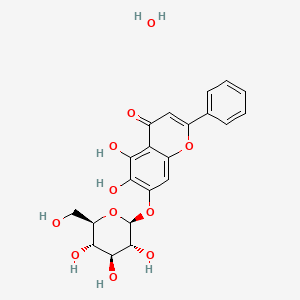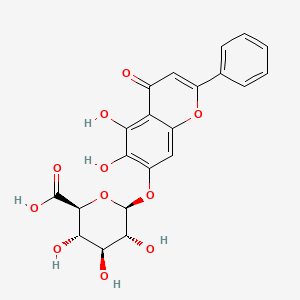
Baicalin
Baicalin is the glycosyloxyflavone which is the 7-O-glucuronide of baicalein. It is an active ingredient of Chinese herbal medicine Scutellaria baicalensis. It has a role as an antiatherosclerotic agent, an anticoronaviral agent, an EC 2.7.7.48 (RNA-directed RNA polymerase) inhibitor, a ferroptosis inhibitor, an antioxidant, an antibacterial agent, a non-steroidal anti-inflammatory drug, an antineoplastic agent, a prodrug, a neuroprotective agent, an EC 3.4.21.26 (prolyl oligopeptidase) inhibitor, a plant metabolite and a cardioprotective agent. It is a glucosiduronic acid, a dihydroxyflavone, a glycosyloxyflavone and a monosaccharide derivative. It is functionally related to a baicalein. It is a conjugate acid of a baicalin(1-). — ChEBI
- IUPAC name
- (2S,3S,4S,5R,6S)-6-(5,6-dihydroxy-4-oxo-2-phenylchromen-7-yl)oxy-3,4,5-trihydroxyoxane-2-carboxylic acid
- Molecular formula
- C21H18O11
- Molecular weight
- 446.4 g/mol
- Exact mass
- 446.08491139 Da
- XLogP3
- 1.1
- Topological polar surface area
- 183.0 Ų
- Hydrogen-bond donors
- 6
- Hydrogen-bond acceptors
- 11
- Covalent units
- 1
- Defined stereocentres
- 5
Also known as
16 more reported names
External database identifiers
- ChEBI:CHEBI:2981
- ChEMBL:CHEMBL485818
- EPA DTXSID:DTXSID701346569
- PubMed:37666112
- PubMed:32020584
- PubMed:23142347
- PubMed:23114120
- PubMed:23110126
- PubMed:23077481
- PubMed:23049867
- PubMed:23040984
- PubMed:22980875
- PubMed:22969827
- PubMed:22946442
- PubMed:22931640
Retrieved from NIH PubChem on 2026-08-31 by checksum-valid CAS matching. Chemical properties do not replace the regulatory decision on this page.