
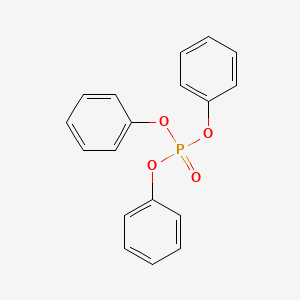
Triphenyl Phosphate
Triphenyl phosphate is an aryl phosphate resulting from the formal condensation of phosphoric acid with 3 mol eq. of phenol. It has a role as a plasticiser and a flame retardant. It is functionally related to a phenol. — ChEBI
- IUPAC name
- triphenyl phosphate
- Molecular formula
- C18H15O4P
- Molecular weight
- 326.3 g/mol
- Exact mass
- 326.07079595 Da
- XLogP3
- 4.6
- Topological polar surface area
- 44.8 Ų
- Hydrogen-bond donors
- 0
- Hydrogen-bond acceptors
- 4
- Covalent units
- 1
- Defined stereocentres
- 0
Also known as
16 more reported names
External database identifiers
- ChEBI:CHEBI:35033
- ChEMBL:CHEMBL454511
- EPA DTXSID:DTXSID1021952
- PubMed:42203055
- PubMed:42015365
- PubMed:40924570
- PubMed:40518002
- PubMed:40355721
- PubMed:40216312
- PubMed:40048564
- PubMed:39295171
- PubMed:39192017
- PubMed:38603619
- PubMed:38450882
- PubMed:38048832
Evidence from additional scientific databases
NIH PubChem PUG-View
Attributed physical-property, hazard, environmental and use annotations.
- Boiling Point: 473 °F at 11 mmHg (NTP, 1992) Source: CAMEO Chemicals
- Boiling Point: BP: 245 °C at 11 mm Hg Source: Hazardous Substances Data Bank (HSDB)
- Boiling Point: 370 °C Source: ILO-WHO International Chemical Safety Cards (ICSCs)
- Boiling Point: 473 °F at 11 mmHg Source: Occupational Safety and Health Administration (OSHA)
- Boiling Point: 776 °F Source: The National Institute for Occupational Safety and Health (NIOSH)
- Color/Form: Crystals from ligroin; prisms from alcohol; needles from diethyl ether Source: Hazardous Substances Data Bank (HSDB)
- Color/Form: Colorless, crystalline powder Source: Hazardous Substances Data Bank (HSDB)
- Color/Form: Needles Source: Hazardous Substances Data Bank (HSDB)
- Density: 1.2055 (NTP, 1992) - Denser than water; will sink Source: CAMEO Chemicals
- Density: Density: 1.2055 g/cu cm at 50 °C Source: Hazardous Substances Data Bank (HSDB)
- Density: Bulk density: 10.5 lb/gal Source: Hazardous Substances Data Bank (HSDB)
- Density: Relative density (water = 1): 1.27 Source: ILO-WHO International Chemical Safety Cards (ICSCs)
- Density: 1.2055 Source: Occupational Safety and Health Administration (OSHA)
- Density: 1.268 @ 60°C Source: PAC Chemical Database, U.S. Department of Energy
- Density: 1.29 Source: The National Institute for Occupational Safety and Health (NIOSH)
- Flash Point: 428 °F (NTP, 1992) Source: CAMEO Chemicals
- Flash Point: 220 °C Source: Haz-Map, Information on Hazardous Chemicals and Occupational Diseases
- Flash Point: 428 °F (220 °C) (Closed cup) Source: Hazardous Substances Data Bank (HSDB)
- Flash Point: 220 °C c.c. Source: ILO-WHO International Chemical Safety Cards (ICSCs)
- Flash Point: 428 °F Source: Occupational Safety and Health Administration (OSHA)
- Flash Point: 428 °F Source: The National Institute for Occupational Safety and Health (NIOSH)
- LogP: log Kow = 4.59 Source: Hazardous Substances Data Bank (HSDB)
- LogP: 4.59 Source: ILO-WHO International Chemical Safety Cards (ICSCs)
- Melting Point: 122 to 124 °F (NTP, 1992) Source: CAMEO Chemicals
- Melting Point: 49.39 °C Source: Hazardous Substances Data Bank (HSDB)
- Melting Point: 49-50 °C Source: ILO-WHO International Chemical Safety Cards (ICSCs)
- Melting Point: 122-124 °F Source: Occupational Safety and Health Administration (OSHA)
- Melting Point: 120 °F Source: The National Institute for Occupational Safety and Health (NIOSH)
- Odor: Odorless Source: Hazardous Substances Data Bank (HSDB)
- Odor: Phenol-like odor Source: Hazardous Substances Data Bank (HSDB)
- Physical Description: Triphenyl phosphate appears as colorless crystals. (NTP, 1992) Source: CAMEO Chemicals
- Physical Description: Other Solid; Dry Powder; CBI; Dry Powder; Liquid; Liquid Source: EPA Chemical Data Reporting (CDR)
- Physical Description: Colorless, crystalline powder with a phenol-like odor; [NIOSH] Source: Haz-Map, Information on Hazardous Chemicals and Occupational Diseases
- Physical Description: COLOURLESS CRYSTALLINE POWDER WITH CHARACTERISTIC ODOUR. Source: ILO-WHO International Chemical Safety Cards (ICSCs)
- Physical Description: Colorless, crystalline powder with a phenol-like odor. Source: Occupational Safety and Health Administration (OSHA)
- Physical Description: Colorless, crystalline powder with a phenol-like odor. Source: The National Institute for Occupational Safety and Health (NIOSH)
- Refractive Index: Index of refraction: 1.550 at 60 °C Source: Hazardous Substances Data Bank (HSDB)
- Solubility: Insoluble (NTP, 1992) Source: CAMEO Chemicals
- Solubility: In water, 1.9 mg/L at 25 °C Source: Hazardous Substances Data Bank (HSDB)
- Solubility: Insoluble in water Source: Hazardous Substances Data Bank (HSDB)
- Solubility: Soluble in ethanol; very soluble in ether, benzene, carbon tetrachloride, chloroform Source: Hazardous Substances Data Bank (HSDB)
- Solubility: Soluble in benzene, chloroform, ether, acetone; moderately soluble in alcohol Source: Hazardous Substances Data Bank (HSDB)
- Solubility: For more Solubility (Complete) data for Triphenyl phosphate (7 total), please visit the HSDB record page. Source: Hazardous Substances Data Bank (HSDB)
- Solubility: Solubility in water, g/100ml at 20 °C: 0.001 Source: ILO-WHO International Chemical Safety Cards (ICSCs)
- Solubility: (129 °F): 0.002% Source: The National Institute for Occupational Safety and Health (NIOSH)
- Vapor Pressure: 1 mmHg at 380.3 °F (NTP, 1992) Source: CAMEO Chemicals
- Vapor Pressure: 0.000002 [mmHg] Source: Haz-Map, Information on Hazardous Chemicals and Occupational Diseases
- Vapor Pressure: 2.00X10⁻⁶ mm Hg at 25 °C Source: Hazardous Substances Data Bank (HSDB)
- Vapor Pressure: Vapor pressure, Pa at 20 °C: 1 Source: ILO-WHO International Chemical Safety Cards (ICSCs)
- Vapor Pressure: 1 mmHg at 380 °F Source: Occupational Safety and Health Administration (OSHA)
- Vapor Pressure: 1 [mm Hg] @193.5 °C Source: PAC Chemical Database, U.S. Department of Energy
- Vapor Pressure: (380 °F): 1 mmHg Source: The National Institute for Occupational Safety and Health (NIOSH)
- Exposure Routes: The substance can be absorbed into the body by inhalation. Source: ILO-WHO International Chemical Safety Cards (ICSCs)
- Exposure Routes: inhalation, ingestion Source: The National Institute for Occupational Safety and Health (NIOSH)
- First Aid: EYES: First check the victim for contact lenses and remove if present. Flush victim's eyes with water or normal saline solution for 20 to 30 minutes while simultaneously calling a hospital or poison control center. Do not put any ointments, oils, or medication in the victim's eyes without specific instructions from a physician. IMMEDIATELY transport the victim after flushing eyes to a hospital even if no symptoms (such as redness or irritation) develop.; SKIN: IMMEDIATELY flood affected skin with water while removing and isolating all contaminated clothing. Gently wash all affected skin areas thoroughly with soap and water. IMMEDIATELY call a hospital or poison control center even if no symptoms (such as redness or irritation) develop. IMMEDIATELY transport the victim to a hospital for treatment after washing the affected areas.; INHALATION: IMMEDIATELY leave the contaminated area; take deep breaths of fresh air. IMMEDIATELY call a physician and be prepared to transport the victim to a hospital even if no symptoms (such as wheezing, coughing, shortness of breath, or burning in the mouth, throat, or chest) develop. Provide proper respiratory protection to rescuers entering an unknow Source: CAMEO Chemicals
- First Aid: (General first aid procedures); Breathing: Respiratory support; Swallow: Medical attention immediately - If this chemical has been swallowed, get medical attention immediately. Source: The National Institute for Occupational Safety and Health (NIOSH)
- Note: This chemical does not meet GHS hazard criteria for 0.6% (9 of 1488) of reports. Source: European Chemicals Agency (ECHA)
- Signal: Warning Source: European Chemicals Agency (ECHA)
- GHS Hazard Statements: H400 (83.4%): Very toxic to aquatic life [Warning Hazardous to the aquatic environment, acute hazard]; H410 (86%): Very toxic to aquatic life with long lasting effects [Warning Hazardous to the aquatic environment, long-term hazard]; H411 (18.7%): Toxic to aquatic life with long lasting effects [Hazardous to the aquatic environment, long-term hazard] Source: European Chemicals Agency (ECHA)
- Precautionary Statement Codes: P273, P391, and P501 (click each P-code to see the statement) Source: European Chemicals Agency (ECHA)
- ECHA C&L Notifications Summary: Aggregated GHS information provided per 1488 reports by companies from 25 notifications to the ECHA C&L Inventory. Each notification may be associated with multiple companies.; Reported as not meeting GHS hazard criteria per 9 of 1488 reports by companies.; There are 24 notifications provided by 1479 of 1488 reports by companies with hazard statement code(s).; Information may vary between notifications depending on impurities, additives, and other factors. The percentage value in parenthesis indicates the notified classification ratio from companies that provide hazard codes. Only hazard codes with percentage values above 10% are shown. For more detailed information, please visit ECHA C&L website. Source: European Chemicals Agency (ECHA)
- Signal: Warning Source: NITE-CMC
- GHS Hazard Statements: H400: Very toxic to aquatic life [Warning Hazardous to the aquatic environment, acute hazard]; H411: Toxic to aquatic life with long lasting effects [Hazardous to the aquatic environment, long-term hazard] Source: NITE-CMC
- Precautionary Statement Codes: P273, P391, and P501 (click each P-code to see the statement) Source: NITE-CMC
- GHS Hazard Statements: H303: May be harmful if swallowed [Warning Acute toxicity, oral]; H320: Causes eye irritation [Warning Serious eye damage/eye irritation] Source: NITE-CMC
- Precautionary Statement Codes: P264+P265, P301+P317, P305+P351+P338, and P337+P317 (click each P-code to see the statement) Source: NITE-CMC
- Signal: Warning Source: Hazardous Substances Data Bank (HSDB)
- GHS Hazard Statements: H400: Very toxic to aquatic life [Warning Hazardous to the aquatic environment, acute hazard]; H410: Very toxic to aquatic life with long lasting effects [Warning Hazardous to the aquatic environment, long-term hazard] Source: Hazardous Substances Data Bank (HSDB)
- NFPA Health Rating: 1 - Materials that, under emergency conditions, can cause significant irritation. Source: Hazardous Substances Data Bank (HSDB)
- NFPA Fire Rating: 1 - Materials that must be preheated before ignition can occur. Materials require considerable preheating, under all ambient temperature conditions, before ignition and combustion can occur. Source: Hazardous Substances Data Bank (HSDB)
- NFPA Instability Rating: 0 - Materials that in themselves are normally stable, even under fire conditions. Source: Hazardous Substances Data Bank (HSDB)
- Target Organs: Blood, peripheral nervous system Source: The National Institute for Occupational Safety and Health (NIOSH)
- Cosmetic Ingredient Review Finding(s): Safe in the present practices of use and concentration. Ingredient, concentration, and use information are available in documents discoverable at https://cir-reports.cir-safety.org Source: Cosmetic Ingredient Review (CIR)
- Toxicity Summary: IDENTIFICATION AND USE: Triphenyl phosphate (TPP) is a solid. It is used as fire-retarding agent, and a plasticizer for cellulose acetate and nitrocellulose. Triphenyl phosphate also has been found as one component of lubricating oil and hydraulic fluids. HUMAN STUDIES: It causes a delayed peripheral neuritis involving motor neurons, resulting in a flaccid paralysis, particularly of the distal muscles. No sensory disturbances. Potential symptoms of overexposure are minor changes in blood enzymes. In workers engaged in the manufacture of TPP there was some inhibition of plasma cholinesterase but no correlation of this effect with degree of exposure or with minor gastrointestinal or neuromuscular symptoms. A case of TPP allergy from spectacle frames was reported. TPP increased both 17beta-estradiol (E2) and testosterone concentrations in human H295R cells in vitro. In addition, transcription of four major steroidogenic genes was up-regulated and that of two sulfotransferase genes was down-regulated. Increase of TPP concentration in house dust was associated with a 10% increase in prolactin and a 19% decrease in sperm concentration in exposed men. ANIMAL STUDIES: Topical application o Source: Hazardous Substances Data Bank (HSDB)
- Environmental Bioconcentration: Bioconcentration factors (BCFs) of 180 to 280 have been measured in rainbow trout (Salmo gairdneri) exposed to Pydraul 50E (a hydraulic fluid containing 35% triphenyl phosphate) for 90 days in flowing water(1). A BCF range of 132 to 364 was observed for rainbow trout exposed to triphenyl phosphate in flowing water for 90 days(2). BCFs of 573 and 561 have been measured using static tests for radio-labelled triphenyl phosphate in rainbow trout and fathead minnows (Pimephales promelas), respectively(3). A bioaccumulation ratio (the rate of the initial uptake rate constant to the initial clearance rate constant) of 2,590 was determined for triphenyl phosphate in rainbow trout; however, this represents the worse-case estimate based on the total 14C content of whole fish after 24 hr exposure(4). A bioconcentration factor (BCF) for triphenyl phosphate of 250 was measured in killifish under static conditions and a BCF of 155 was measured in killifish in a flow through system(5). A BCF for triphenyl phosphate of 110 was observed in goldfish under static conditions(6). According to a classification scheme(7), this range of BCF values suggest that bioconcentration in aquatic organisms is high Source: Hazardous Substances Data Bank (HSDB)
- Environmental Fate: TERRESTRIAL FATE: Based on a classification scheme(1), a Koc range of 2,514 to 3,561(2) indicates that triphenyl phosphate is expected to have slight mobility in soil(SRC). Volatilization of triphenyl phosphate from moist soil surfaces is expected to be an important fate process(SRC) given an estimated Henry's Law constant of 3.3X10⁻⁶ atm-cu m/mole(SRC), based upon its vapor pressure, 2.00X10⁻⁶ mm Hg(3), and water solubility, 1.9 mg/L(4). However, adsorption to soil is expected to attenuate volatilization(SRC). Triphenyl phosphate is not expected to volatilize from dry soil surfaces(SRC) based upon its vapor pressure(3). Mineralization half-lives of 37 and 32 days under aerobic and anaerobic conditions, respectively, using a loamy sand(2) suggest that biodegradation may be an important environmental fate process in soil(SRC). Source: Hazardous Substances Data Bank (HSDB)
- Environmental Fate: AQUATIC FATE: Based on a classification scheme(1), a Koc range of 2,514 to 3,561(2) indicates that triphenyl phosphate is expected to adsorb to suspended solids and sediment(SRC). Volatilization from water surfaces is expected(3) based upon an estimated Henry's Law constant of 3.3X10⁻⁶ atm-cu m/mole(SRC), derived from its vapor pressure, 2.00X10⁻⁶ mm Hg(4), and water solubility, 1.9 mg/L(5). Estimated volatilization half-lives for a model river and model lake are 20 and 152 days, respectively. However, volatilization from water surfaces is expected to be attenuated by adsorption to suspended solids and sediment in the water column. The estimated volatilization half-life from a model pond is 400 days if adsorption is considered(6). According to a classification scheme(7), bioconcentration factors ranging from 132(8) to 573(9) suggest that bioconcentration in aquatic organisms is high(SRC). Biodegradation half-lives of 2-4 days in river die-away tests(10) suggest that biodegradation may be an important environmental fate process in water(SRC). Source: Hazardous Substances Data Bank (HSDB)
- Environmental Fate: ATMOSPHERIC FATE: According to a model of gas/particle partitioning of semivolatile organic compounds in the atmosphere(1), triphenyl phosphate, which has a vapor pressure of 2.00X10⁻⁶ mm Hg at 25 °C(2), will exist in both the vapor and particulate phases in the ambient atmosphere. Vapor-phase triphenyl phosphate is degraded in the atmosphere by reaction with photochemically-produced hydroxyl radicals(SRC); the half-life for this reaction in air is estimated to be 12 hours(SRC), calculated from its rate constant of 1.1X10⁻¹¹ cu cm/molecule-sec at 25 °C(SRC) that was derived using a structure estimation method(3). Particulate-phase triphenyl phosphate may be removed from the air by wet and dry deposition(SRC). Triphenyl phosphate does not absorb light at wavelengths >290 nm(4) and, therefore, is not expected to be susceptible to direct photolysis by sunlight(SRC). Source: Hazardous Substances Data Bank (HSDB)
- Consumer Uses: Lubricating agent; Intermediate; Flame retardant; Plasticizer; Hydraulic fluids Source: EPA Chemical Data Reporting (CDR)
- Industry Uses: Processing aids not otherwise specified; Other; Filler; Hydraulic fluids; Flame retardant; Plasticizer Source: EPA Chemical Data Reporting (CDR)
- Cosmetic Ingredient Review Link: CIR ingredient: Triphenyl Phosphate Source: Cosmetic Ingredient Review (CIR)
- Sources/Uses: Used as a plasticizer, fire-retardant, and substitute for camphor in celluloid; also used in lubricating oils and hydraulic fluids; [ACGIH] Source: Haz-Map, Information on Hazardous Chemicals and Occupational Diseases
- Uses: Noncombustible substitute for camphor in celluloid; rendering acetylcellulose, nitrocellulose, airplane "dope", etc., stable and fireproof; impregnating roofing paper; plasticizer in lacquers and varnishes. Source: Hazardous Substances Data Bank (HSDB)
- Uses: Fire-retarding agent, plasticizer for cellulose acetate and nitrocellulose. Source: Hazardous Substances Data Bank (HSDB)
- Uses: /Triphenyl phosphate/ has been used as a plasticizer in automobile upholstery, as a fireproofing agent, as a noncombustible substitute for camphor in celluloid, and for impregnating roofing paper. Triphenyl phosphate also has been found as one component of lubricating oil and hydraulic fluids. Source: Hazardous Substances Data Bank (HSDB)
- Uses: An early application was as a flame retardant for cellulose acetate safety film. It is also used in cellulose nitrate, various coatings, triacetate film and sheet, and rigid urethane foam. It has been used as a flame-retardant additive for engineering thermoplastics such as polyphenylene oxide-high impact polystyrene and ABS-polycarbonate blends. Source: Hazardous Substances Data Bank (HSDB)
- Uses: Plastics -> Typical concentration range in plastic materials -> 2% Source: NORMAN Suspect List Exchange
Mapped by: Existing checksum-valid CAS to unique PubChem CID match. Retrieved: 2026-08-31. Open source record
Scientific classifications and hazard annotations provide context and do not replace the market-specific regulatory decision shown above.
Additional source coverage and match status
| Source | Result | Checked |
|---|---|---|
| NIH PubChem PUG-View | Exact match | 2026-08-31 |
A recorded no-match is useful evidence that the source was checked; it is not a claim that the substance does not exist elsewhere.
Retrieved from NIH PubChem on 2026-08-31 by checksum-valid CAS matching. Chemical properties do not replace the regulatory decision on this page.