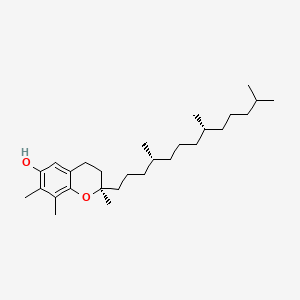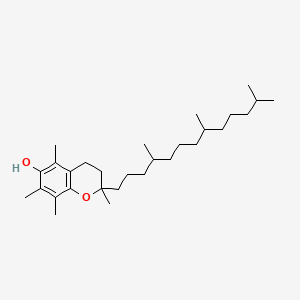
DL-alpha-Tocopherol
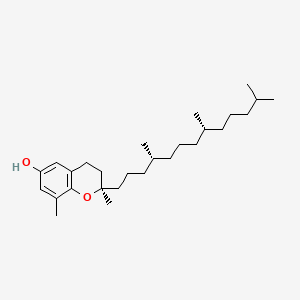
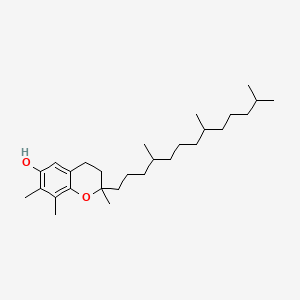
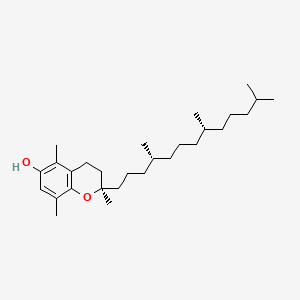
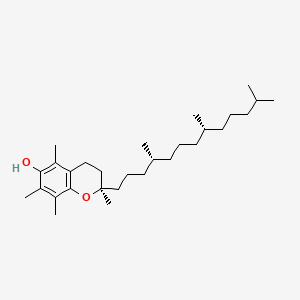
2,5,7,8-tetramethyl-2-(4,8,12-trimethyltridecyl)-3,4-dihydro-2H-1-benzopyran-6-ol is a tocopherol. — ChEBI
- IUPAC name
- 2,5,7,8-tetramethyl-2-(4,8,12-trimethyltridecyl)-3,4-dihydrochromen-6-ol
- Molecular formula
- C29H50O2
- Molecular weight
- 430.7 g/mol
- Exact mass
- 430.381080833 Da
- XLogP3
- 10.7
- Topological polar surface area
- 29.5 Ų
- Hydrogen-bond donors
- 1
- Hydrogen-bond acceptors
- 2
- Covalent units
- 1
- Defined stereocentres
- 0
Also known as
16 more reported names
External database identifiers
- ChEBI:CHEBI:93909
- ChEMBL:CHEMBL49563
- EPA DTXSID:DTXSID8021355
- PubMed:23105669
- PubMed:22590613
- PubMed:22254062
- PubMed:21994542
- PubMed:21765955
- PubMed:21753875
- PubMed:21736730
- PubMed:21371324
- PubMed:21297919
- PubMed:20805969
- PubMed:20566712
- PubMed:20559505
Evidence from additional scientific databases
EMBL-EBI ChEBI
α-tocopherol
A tocopherol that is chroman-6-ol substituted by methyl groups at positions 2, 5, 7 and 8 and a 4,8,12-trimethyltridecyl group at position 2.
- Formula
- C29H50O2
- Average mass
- 430.707 g/mol
- Monoisotopic mass
- 430.38108 Da
- Formal charge
- 0
- tocopherol — is a (CHEBI:27013)
- vitamin E — is a (CHEBI:33234)
- plant metabolite — has role (CHEBI:76924)
- food antioxidant — has role (CHEBI:77962)
- plant metabolite — has role (CHEBI:76924)
- food antioxidant — has role (CHEBI:77962)
- tocopherol — is a (CHEBI:27013)
- vitamin E — is a (CHEBI:33234)
Additional curated names
Cross-references from this source
- CAS: 10191-41-0 — ChemIDplus
- REGISTRY_NUMBER: 8176170 — Beilstein
- MANUAL_X_REF: Alpha-Tocopherol — Wikipedia
- MANUAL_X_REF: D02332 — KEGG DRUG
Mapped by: Exact CAS cross-reference in the ChEBI compound record. Source updated: 2023-05-31. Retrieved: 2026-08-31. Open source record
NIH PubChem PUG-View
Attributed physical-property, hazard, environmental and use annotations.
- Boiling Point: BP: 200-220 °C at 0.1 mmHg Source: Hazardous Substances Data Bank (HSDB)
- Color/Form: Slightly viscous, pale yellow oil Source: Hazardous Substances Data Bank (HSDB)
- Density: 0.950 at 25 °C/4 °C Source: Hazardous Substances Data Bank (HSDB)
- Melting Point: 2.5-3.5 °C Source: Hazardous Substances Data Bank (HSDB)
- Physical Description: Liquid Source: EPA Chemical Data Reporting (CDR)
- Physical Description: Slightly yellow to amber, nearly odourless, clear, viscous oil which oxidises and darkens on exposure to air or light Source: EU Food Improvement Agents
- Physical Description: Pale yellow liquid; Darkened gradually by light; [Merck Index] Source: Haz-Map, Information on Hazardous Chemicals and Occupational Diseases
- Refractive Index: [n]D/20 1,503-1,507 Source: EU Food Improvement Agents
- Refractive Index: Index of refraction: 1.5045 at 25 °C/D Source: Hazardous Substances Data Bank (HSDB)
- Solubility: Insoluble in water, freely soluble in ethanol, miscible in ether Source: EU Food Improvement Agents
- Solubility: Practically insoluble in water; freely soluble in oils, fats, acetone, alcohol, chloroform, ether, other fat solvents Source: Hazardous Substances Data Bank (HSDB)
- Carcinogen Classification: No indication of carcinogenicity to humans (not listed by IARC). Source: Toxin and Toxin Target Database (T3DB)
- Exposure Routes: Oral, Topical, Intramuscular 50 to 80% absorbed from gastrointestinal tract. Source: Toxin and Toxin Target Database (T3DB)
- Note: This chemical does not meet GHS hazard criteria for 25.2% (567 of 2247) of reports. Source: European Chemicals Agency (ECHA)
- Signal: Warning Source: European Chemicals Agency (ECHA)
- GHS Hazard Statements: H317 (74.3%): May cause an allergic skin reaction [Warning Sensitization, Skin] Source: European Chemicals Agency (ECHA)
- Precautionary Statement Codes: P261, P272, P280, P302+P352, P321, P333+P317, P362+P364, and P501 (click each P-code to see the statement) Source: European Chemicals Agency (ECHA)
- ECHA C&L Notifications Summary: Aggregated GHS information provided per 2247 reports by companies from 11 notifications to the ECHA C&L Inventory.; Reported as not meeting GHS hazard criteria per 567 of 2247 reports by companies.; There are 10 notifications provided by 1680 of 2247 reports by companies with hazard statement code(s).; Information may vary between notifications depending on impurities, additives, and other factors. The percentage value in parenthesis indicates the notified classification ratio from companies that provide hazard codes. Only hazard codes with percentage values above 10% are shown. For more detailed information, please visit ECHA C&L website. Source: European Chemicals Agency (ECHA)
- Toxicity Summary: IDENTIFICATION AND USE: dl-alpha-Tocopherol is a slightly viscous, pale yellow oil. This is a synthetic form of alpha tocopherol. The activity of natural alpha-tocopherol on an equal weight basis, is at least twice as high as the synthetic form. dl-alpha-Tocopherol is used as an antioxidant in fats and oils and in animal feed. It is also used as experimental medication and as a dietary supplement. HUMAN EXPOSURE AND TOXICITY: Of 23,908 patients patch tested, 219 (0.9%) had sunscreen coded as an allergen source. The top 3 most frequent allergens in sunscreens were benzophenone-3, dl-alpha-tocopherol, and fragrance mix. Dietary supplementation with moderate dosage synthetic dl-alpha-tocopherol acetate did not significantly prolong bleeding or platelet aggregation in healthy volunteers. dl-alpha-Tocopherol provided protection against exercise-induced oxidative injury in healthy volunteers according to several reports. In vitro experiments demonstrated general inhibition of cell proliferation by dl-alpha-tocopherol, with breast and prostate cancer cells distinctly more sensitive than erythroleukemia cells. ANIMAL STUDIES: In chicks exposed to dl-alpha-tocopherol acetate for 3-8 weeks i Source: Hazardous Substances Data Bank (HSDB)
- Toxicity Summary: Although all forms of Vitamin E exhibit antioxidant activity, it is known that the antioxidant activity of vitamin E is not sufficient to explain the vitamin's biological activity. Vitamin E's anti-atherogenic activity involves the inhibition of the oxidation of LDL and the accumulation of oxLDL in the arterial wall. It also appears to reduce oxLDL-induced apoptosis in human endothelial cells. Oxidation of LDL is a key early step in atherogenesis as it triggers a number of events which lead to the formation of atherosclerotic plaque. In addition, vitamin E inhibits protein kinase C (PKC) activity. PKC plays a role in smooth muscle cell proliferation, and, thus, the inhibition of PKC results in inhibition of smooth muscle cell proliferation, which is involved in atherogenesis. Vitamin E's antithrombotic and anticoagulant activities involves the downregulation of the expression of intracellular cell adhesion molecule(ICAM)-1 and vascular cell adhesion molecule(VCAM)-1 which lowers the adhesion of blood components to the endothelium. In addition, vitamin E upregulates the expression of cytosolic phospholipase A2 and cyclooxygenase (COX)-1 which in turn enhances the release of prostacy Source: Toxin and Toxin Target Database (T3DB)
- Environmental Bioconcentration: An estimated BCF of 39 was calculated in fish for dl-alpha-tocopherol(SRC), using an estimated log Kow of 12.2(1) and a regression-derived equation(1). According to a classification scheme(2), this BCF suggests the potential for bioconcentration in aquatic organisms is moderate(SRC), provided the compound is not metabolized by the organism(SRC). Source: Hazardous Substances Data Bank (HSDB)
- Environmental Fate: TERRESTRIAL FATE: Based on a classification scheme(1), an estimated Koc value of 2.5X10+7(SRC), determined from a structure estimation method(2), indicates that dl-alpha-tocopherol is expected to be immobile in soil(SRC). Volatilization of dl-alpha-tocopherol from moist soil surfaces is expected to be an important fate process(SRC) given an estimated Henry's Law constant of 7.9X10⁻⁵ atm-cu m/mole(SRC), using a fragment constant estimation method(2). However, adsorption to soil is expected to attenuate volatilization(SRC). dl-alpha-Tocopherol is not expected to volatilize from dry soil surfaces(SRC) based upon an estimated vapor pressure of 1.4X10⁻⁸ mm Hg at 25 °C(SRC), determined from a fragment constant method(2). Naturally occurring alpha-tocopherol was biodegraded by aerobic bacterial communities isolated from marine sediment(3). However, biodegradation data on dl-alpha-tocopherol relevant to environmental importance in soil were not available.(SRC, 2015). dl-alpha-Tocopherol has a UV absorption maxima at 294 nm(4) and, therefore, may be susceptible to direct photolysis on soil surfaces exposed to sunlight(SRC). Source: Hazardous Substances Data Bank (HSDB)
- Environmental Fate: AQUATIC FATE: Based on a classification scheme(1), an estimated Koc value of 2.5X10+7(SRC), determined from a structure estimation method(2), indicates that dl-alpha-tocopherol is expected to adsorb to suspended solids and sediment(SRC). Volatilization from water surfaces is expected(3) based upon an estimated Henry's Law constant of 7.9X10⁻⁵ atm-cu m/mole(SRC), developed using a fragment constant estimation method(2). Using this Henry's Law constant and an estimation method(3), volatilization half-lives for a model river and model lake are 29 hours and 15 days, respectively(SRC). However, volatilization from water surfaces is expected to be attenuated by adsorption to suspended solids and sediment in the water column(SRC). The estimated volatilization half-life from a model pond is >10 years if adsorption is considered(4). According to a classification scheme(5), an estimated BCF of 39(SRC), from an estimated log Kow of 12.2(2) and a regression-derived equation(2), suggests the potential for bioconcentration in aquatic organisms is moderate(SRC). Naturally occurring alpha-tocopherol was biodegraded by aerobic bacterial communities isolated from marine sediment(5). However, biodegr Source: Hazardous Substances Data Bank (HSDB)
- Environmental Fate: ATMOSPHERIC FATE: According to a model of gas/particle partitioning of semivolatile organic compounds in the atmosphere(1), dl-alpha-tocopherol, which has an estimated vapor pressure of 1.4X10⁻⁸ mm Hg at 25 °C(SRC), determined from a fragment constant method(2), will exist in both the vapor and particulate phases (in the ambient atmosphere. Vapor-phase dl-alpha-tocopherol is degraded in the atmosphere by reaction with photochemically-produced hydroxyl radicals(SRC); the half-life for this reaction in air is estimated to be 1.7 hours(SRC), calculated from its rate constant of 1.7X10⁻¹⁰ cu cm/molecule-sec at 25 °C(SRC) that was derived using a structure estimation method(2). Particulate-phase dl-alpha-tocopherol may be removed from the air by wet and dry deposition(SRC). dl-alpha-Tocopherol has a UV absorption maxima at 294 nm(3), and therefore, may be susceptible to direct photolysis by sunlight(SRC). Source: Hazardous Substances Data Bank (HSDB)
- Consumer Uses: Other; Fragrance Source: EPA Chemical Data Reporting (CDR)
- Industry Uses: Fragrance; Intermediate; Other Source: EPA Chemical Data Reporting (CDR)
- Sources/Uses: The natural form of vitamin E found in green vegetables, grains, and oils; Used in antioxidants and as a vitamin E supplement; [Merck Index] Used as an antioxidant and nutritional additive in animals feeds; [ExPub: EFSA] Permitted for use as an inert ingredient in non-food pesticide products; [EPA] Source: Haz-Map, Information on Hazardous Chemicals and Occupational Diseases
- Industrial Processes with risk of exposure: Farming (Feed Additives) [Category: Industry] Source: Haz-Map, Information on Hazardous Chemicals and Occupational Diseases
- Uses: MEDICATION Source: Hazardous Substances Data Bank (HSDB)
- Uses: All-rac-alpha-tocopherol is mainly used as an antioxidant in fats and oils and in feedingstuffs rich in oils and fats. Source: Hazardous Substances Data Bank (HSDB)
- Uses: There are several forms of vitamin E available commercially /including dl-alpha-tocopherol/. These are available as nutritional supplements or in functional and fortified foods. Source: Hazardous Substances Data Bank (HSDB)
- Uses: Laboratory chemicals; manufacture of substances Source: Hazardous Substances Data Bank (HSDB)
- Uses: Vitamin E, known for its antioxidant activities, is protective against cardiovascular disease and some forms of cancer and has also demonstrated immune-enhancing effects. It may be of limited benefit in some with asthma and rheumatoid arthritis. It may be helpful in some neurological diseases including Alzheimer's, some eye disorders including cataracts, and diabetes and premenstrual syndrome. It may also help protect skin from ultraviolet irradiation although claims that it reverses skin aging, enhances male fertility and exercise performance are poorly supported. It may help relieve some muscle cramps. Source: Toxin and Toxin Target Database (T3DB)
Mapped by: Existing checksum-valid CAS to unique PubChem CID match. Retrieved: 2026-08-31. Open source record
Scientific classifications and hazard annotations provide context and do not replace the market-specific regulatory decision shown above.
Additional source coverage and match status
| Source | Result | Checked |
|---|---|---|
| EMBL-EBI ChEBI | Exact match | 2026-08-31 |
| NIH PubChem PUG-View | Exact match | 2026-08-31 |
A recorded no-match is useful evidence that the source was checked; it is not a claim that the substance does not exist elsewhere.
Retrieved from NIH PubChem on 2026-08-31 by checksum-valid CAS matching. Chemical properties do not replace the regulatory decision on this page.