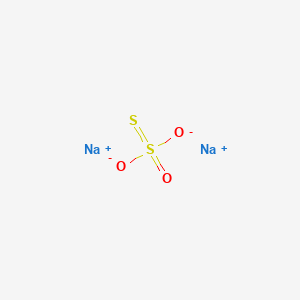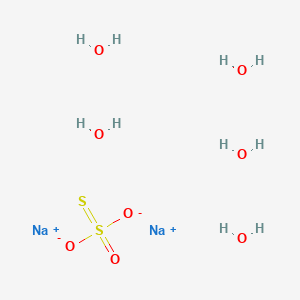
Sodium Thiosulfate Pentahydrate
Sodium thiosulfate pentahydrate is a hydrate consisting of sodium thiosulfate with 5 mol eq. of water. It has a role as a nephroprotective agent, an antifungal drug and an antidote to cyanide poisoning. It contains a sodium thiosulfate. — ChEBI
- IUPAC name
- disodium;dioxido-oxo-sulfanylidene-lambda6-sulfane;pentahydrate
- Molecular formula
- H10Na2O8S2
- Molecular weight
- 248.19 g/mol
- Exact mass
- 247.96124818 Da
- Topological polar surface area
- 109.0 Ų
- Hydrogen-bond donors
- 5
- Hydrogen-bond acceptors
- 9
- Covalent units
- 8
- Defined stereocentres
- 0
Also known as
16 more reported names
External database identifiers
- ChEBI:CHEBI:32150
- ChEMBL:CHEMBL2096650
- EPA DTXSID:DTXSID6044197
Evidence from additional scientific databases
EMBL-EBI ChEBI
sodium thiosulfate pentahydrate
A hydrate consisting of sodium thiosulfate with 5 mol eq. of water.
- Formula
- 5H2O.2Na.O3S2
- Average mass
- 248.186 g/mol
- Monoisotopic mass
- 247.96125 Da
- Formal charge
- 0
- hydrate — is a (CHEBI:35505)
- antidote to cyanide poisoning — has role (CHEBI:90749)
- nephroprotective agent — has role (CHEBI:76595)
- antifungal drug — has role (CHEBI:86327)
- sodium thiosulfate — has part (CHEBI:132112)
- antidote to cyanide poisoning — has role (CHEBI:90749)
- nephroprotective agent — has role (CHEBI:76595)
- antifungal drug — has role (CHEBI:86327)
- hydrate — is a (CHEBI:35505)
Additional curated names
Cross-references from this source
- CAS: 10102-17-7 — KEGG COMPOUND
- CAS: 10102-17-7 — ChemIDplus
- MANUAL_X_REF: D01091 — KEGG DRUG
- MANUAL_X_REF: DBSALT002505 — DrugBank
Mapped by: Exact CAS cross-reference in the ChEBI compound record. Source updated: 2024-05-17. Retrieved: 2026-08-31. Open source record
NIH PubChem PUG-View
Attributed physical-property, hazard, environmental and use annotations.
- Density: 1.69 @25 °C Source: PAC Chemical Database, U.S. Department of Energy
- Melting Point: 48 °C Source: PAC Chemical Database, U.S. Department of Energy
- Physical Description: Large Crystals; Dry Powder; Other Solid Source: EPA Chemical Data Reporting (CDR)
- Physical Description: Odorless solid; Deliquesces slightly in moist air; [Merck Index] Colorless odorless crystalline solid; [Sigma-Aldrich MSDS] Source: Haz-Map, Information on Hazardous Chemicals and Occupational Diseases
- Note: This chemical does not meet GHS hazard criteria for 98.6% (277 of 281) of all reports. Source: European Chemicals Agency (ECHA)
- GHS Hazard Statements: Not Classified; Reported as not meeting GHS hazard criteria by 277 of 281 companies (only 1.4% companies provided GHS information). For more detailed information, please visit ECHA C&L website. Source: European Chemicals Agency (ECHA)
- ECHA C&L Notifications Summary: Aggregated GHS information provided per 281 reports by companies from 6 notifications to the ECHA C&L Inventory.; Reported as not meeting GHS hazard criteria per 277 of 281 reports by companies.; There are 4 notifications provided by 4 of 281 reports by companies with hazard statement code(s).; Information may vary between notifications depending on impurities, additives, and other factors. The percentage value in parenthesis indicates the notified classification ratio from companies that provide hazard codes. Only hazard codes with percentage values above 10% are shown. For more detailed information, please visit ECHA C&L website. Source: European Chemicals Agency (ECHA)
- Consumer Uses: Not Known or Reasonably Ascertainable Source: EPA Chemical Data Reporting (CDR)
- Industry Uses: Laboratory chemicals; Reducing agent; Not Known or Reasonably Ascertainable; Cleaning agent; Dehydrating agent (desiccant); Processing aids not otherwise specified; Tanning agents not otherwise specified Source: EPA Chemical Data Reporting (CDR)
- Sources/Uses: Used to remove chlorine from solutions; to bleach paper, bone, straw, and ivory; as a fixer in photography; to extract silver from ores; as mordant in dyeing and printing textiles; in leather manufacturing; in pharmaceutical production (antioxidant), and as an antidote for cyanide poisoning; [Merck Index] Permitted for use as an inert ingredient in non-food pesticide products; [EPA] Source: Haz-Map, Information on Hazardous Chemicals and Occupational Diseases
- Industrial Processes with risk of exposure: Pulp and Paper Processing [Category: Industry]; Leather Tanning and Processing [Category: Industry]; Photographic Processing [Category: Other]; Textiles (Printing, Dyeing, or Finishing) [Category: Industry]; Metal Extraction and Refining [Category: Industry] Source: Haz-Map, Information on Hazardous Chemicals and Occupational Diseases
Mapped by: Existing checksum-valid CAS to unique PubChem CID match. Retrieved: 2026-08-31. Open source record
Scientific classifications and hazard annotations provide context and do not replace the market-specific regulatory decision shown above.
Additional source coverage and match status
| Source | Result | Checked |
|---|---|---|
| EMBL-EBI ChEBI | Exact match | 2026-08-31 |
| NIH PubChem PUG-View | Exact match | 2026-08-31 |
A recorded no-match is useful evidence that the source was checked; it is not a claim that the substance does not exist elsewhere.
Retrieved from NIH PubChem on 2026-08-31 by checksum-valid CAS matching. Chemical properties do not replace the regulatory decision on this page.