
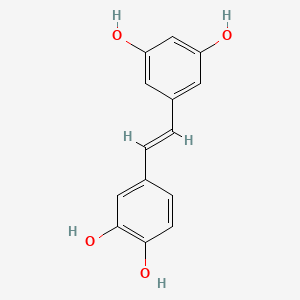
Piceatannol
Piceatannol is a stilbenol that is trans-stilbene in which one of the phenyl groups is substituted by hydroxy groups at positions 3 and 4, while the other phenyl group is substituted by hydroxy groups at positions 3 and 5. It has a role as a geroprotector, a hypoglycemic agent, an antineoplastic agent, a protein kinase inhibitor, a tyrosine kinase inhibitor, an apoptosis inducer and a plant metabolite. It is a polyphenol, a member of catechols, a member of resorcinols and a stilbenol. It derives from a hydride of a trans-stilbene. — ChEBI
- IUPAC name
- 4-[(E)-2-(3,5-dihydroxyphenyl)ethenyl]benzene-1,2-diol
- Molecular formula
- C14H12O4
- Molecular weight
- 244.24 g/mol
- Exact mass
- 244.07355886 Da
- XLogP3
- 2.9
- Topological polar surface area
- 80.9 Ų
- Hydrogen-bond donors
- 4
- Hydrogen-bond acceptors
- 4
- Covalent units
- 1
- Defined stereocentres
- 0
Also known as
16 more reported names
External database identifiers
- ChEBI:CHEBI:28814
- ChEBI:CHEBI:92460
- ChEMBL:CHEMBL69863
- EPA DTXSID:DTXSID6040587
- PubMed:39004823
- PubMed:34216621
- PubMed:33763461
- PubMed:32446839
- PubMed:31496657
- PubMed:31323227
- PubMed:30940561
- PubMed:29933105
- PubMed:28279696
- PubMed:26341291
- PubMed:26303405
- PubMed:25815690
Evidence from additional scientific databases
EMBL-EBI ChEBI
piceatannol
A stilbenol that is trans-stilbene in which one of the phenyl groups is substituted by hydroxy groups at positions 3 and 4, while the other phenyl group is substituted by hydroxy groups at positions 3 and 5.
- Formula
- C14H12O4
- Average mass
- 244.246 g/mol
- Monoisotopic mass
- 244.07356 Da
- Formal charge
- 0
- resorcinols — is a (CHEBI:33572)
- catechols — is a (CHEBI:33566)
- polyphenol — is a (CHEBI:26195)
- stilbenol — is a (CHEBI:36027)
- geroprotector — has role (CHEBI:176497)
- antineoplastic agent — has role (CHEBI:35610)
- plant metabolite — has role (CHEBI:76924)
- hypoglycemic agent — has role (CHEBI:35526)
- apoptosis inducer — has role (CHEBI:68495)
- protein kinase inhibitor — has role (CHEBI:37699)
- tyrosine kinase inhibitor — has role (CHEBI:38637)
- trans-stilbene — has parent hydride (CHEBI:36007)
- geroprotector — has role (CHEBI:176497)
- antineoplastic agent — has role (CHEBI:35610)
- plant metabolite — has role (CHEBI:76924)
- hypoglycemic agent — has role (CHEBI:35526)
- apoptosis inducer — has role (CHEBI:68495)
- protein kinase inhibitor — has role (CHEBI:37699)
- tyrosine kinase inhibitor — has role (CHEBI:38637)
- resorcinols — is a (CHEBI:33572)
- catechols — is a (CHEBI:33566)
- polyphenol — is a (CHEBI:26195)
- stilbenol — is a (CHEBI:36027)
- 10425214 Source: PubMed
- 10641182 Source: PubMed
- 11696049 Source: PubMed
- 12044809 Source: PubMed
- 15134373 Source: PubMed
- 16455243 Source: PubMed
- 17409035 Source: PubMed
- 17698806 Source: PubMed
- 18381677 Source: PubMed
- 19237510 Source: PubMed
- 19258424 Source: PubMed
- 19487074 Source: PubMed
- 19527681 Source: PubMed
- 20584749 Source: PubMed
- 23185430 Source: PubMed
- 23426871 Source: PubMed
- 23713607 Source: PubMed
- 23892029 Source: PubMed
- 24470348 Source: PubMed
- 24551719 Source: PubMed
- 24610083 Source: PubMed
- 24625210 Source: PubMed
- 24919577 Source: PubMed
- 25218158 Source: PubMed
Additional curated names
Cross-references from this source
- CAS: 10083-24-6 — ChemIDplus
- CAS: 10083-24-6 — KEGG COMPOUND
- REGISTRY_NUMBER: 1879860 — Reaxys
- REGISTRY_NUMBER: 1879860 — Beilstein
- MANUAL_X_REF: C00002895 — KNApSAcK
- MANUAL_X_REF: C05901 — KEGG COMPOUND
- MANUAL_X_REF: DB08399 — DrugBank
- MANUAL_X_REF: HMDB0004215 — HMDB
- MANUAL_X_REF: LMPK13090006 — LIPID MAPS
- MANUAL_X_REF: Piceatannol — Wikipedia
- MANUAL_X_REF: PIT — PDBeChem
Mapped by: Exact CAS cross-reference in the ChEBI compound record. Source updated: 2024-10-11. Retrieved: 2026-08-31. Open source record
NIH PubChem PUG-View
Attributed physical-property, hazard, environmental and use annotations.
- Physical Description: Solid Source: Human Metabolome Database (HMDB)
- Note: This chemical does not meet GHS hazard criteria for 50% (1 of 2) of reports. Source: European Chemicals Agency (ECHA)
- Signal: Warning Source: European Chemicals Agency (ECHA)
- GHS Hazard Statements: H302+H312+H332 (50%): Harmful if swallowed, in contact with skin or if inhaled [Warning Acute toxicity, oral; acute toxicity, dermal; acute toxicity, inhalation]; H302 (50%): Harmful if swallowed [Warning Acute toxicity, oral]; H312 (50%): Harmful in contact with skin [Warning Acute toxicity, dermal]; H332 (50%): Harmful if inhaled [Warning Acute toxicity, inhalation] Source: European Chemicals Agency (ECHA)
- Precautionary Statement Codes: P261, P264, P270, P271, P280, P301+P317, P302+P352, P304+P340, P317, P321, P330, P362+P364, and P501 (click each P-code to see the statement) Source: European Chemicals Agency (ECHA)
- ECHA C&L Notifications Summary: Aggregated GHS information provided per 2 reports by companies from 2 notifications to the ECHA C&L Inventory. Each notification may be associated with multiple companies.; Reported as not meeting GHS hazard criteria per 1 of 2 reports by companies.; There is 1 notification provided by 1 of 2 reports by companies with hazard statement code(s).; Information may vary between notifications depending on impurities, additives, and other factors. The percentage value in parenthesis indicates the notified classification ratio from companies that provide hazard codes. Only hazard codes with percentage values above 10% are shown. For more detailed information, please visit ECHA C&L website. Source: European Chemicals Agency (ECHA)
Mapped by: Existing checksum-valid CAS to unique PubChem CID match. Retrieved: 2026-08-31. Open source record
Scientific classifications and hazard annotations provide context and do not replace the market-specific regulatory decision shown above.
Additional source coverage and match status
| Source | Result | Checked |
|---|---|---|
| EMBL-EBI ChEBI | Exact match | 2026-08-31 |
| NIH PubChem PUG-View | Exact match | 2026-08-31 |
A recorded no-match is useful evidence that the source was checked; it is not a claim that the substance does not exist elsewhere.
Retrieved from NIH PubChem on 2026-08-31 by checksum-valid CAS matching. Chemical properties do not replace the regulatory decision on this page.