
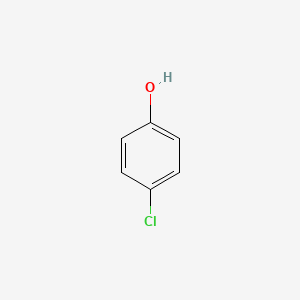
4-Chlorophenol
4-chlorophenol is a monochlorophenol substituted at the pare position by a chlorine atom. — ChEBI
- IUPAC name
- 4-chlorophenol
- Molecular formula
- C6H5ClO
- Molecular weight
- 128.55 g/mol
- Exact mass
- 128.0028925 Da
- XLogP3
- 2.4
- Topological polar surface area
- 20.2 Ų
- Hydrogen-bond donors
- 1
- Hydrogen-bond acceptors
- 1
- Covalent units
- 1
- Defined stereocentres
- 0
Also known as
16 more reported names
External database identifiers
- ChEBI:CHEBI:28078
- ChEMBL:CHEMBL57053
- EPA DTXSID:DTXSID1021871
- PubMed:39855580
- PubMed:27029555
- PubMed:23063061
- PubMed:23054732
- PubMed:23054731
- PubMed:23032780
- PubMed:23016294
- PubMed:23002629
- PubMed:22988634
- PubMed:22941905
- PubMed:22924545
- PubMed:22894114
Evidence from additional scientific databases
EMBL-EBI ChEBI
4-chlorophenol
A monochlorophenol substituted at the pare position by a chlorine atom.
- Formula
- C6H5ClO
- Average mass
- 128.558 g/mol
- Monoisotopic mass
- 128.00289 Da
- Formal charge
- 0
- monochlorophenol — is a (CHEBI:38857)
- monochlorophenol — is a (CHEBI:38857)
- 10848923 Source: PubMed
- 11527738 Source: PubMed
- 1271403 Source: PubMed
- 15857133 Source: PubMed
- 16279782 Source: PubMed
- 16789751 Source: PubMed
- 17300161 Source: PubMed
- 18412324 Source: PubMed
- 19056282 Source: PubMed
- 23571415 Source: PubMed
- 24279624 Source: PubMed
- 24390833 Source: PubMed
- 24473310 Source: PubMed
- 24583212 Source: PubMed
- 24725749 Source: PubMed
- 24762698 Source: PubMed
- 24794625 Source: PubMed
- 24926596 Source: PubMed
- 26642767 Source: PubMed
- 27073055 Source: PubMed
- 31202993 Source: PubMed
- 31401536 Source: PubMed
- 3172126 Source: PubMed
- 6802973 Source: PubMed
Additional curated names
Cross-references from this source
- CAS: 106-48-9 — KEGG COMPOUND
- CAS: 106-48-9 — ChemIDplus
- CAS: 106-48-9 — NIST Chemistry WebBook
- REGISTRY_NUMBER: 2902 — Gmelin
- REGISTRY_NUMBER: 507004 — Reaxys
- MANUAL_X_REF: 4CH — PDBeChem
- MANUAL_X_REF: C02124 — KEGG COMPOUND
- MANUAL_X_REF: c0295 — UM-BBD
- MANUAL_X_REF: CPD-10870 — MetaCyc
- MANUAL_X_REF: D00149 — KEGG DRUG
- MANUAL_X_REF: LSM-2913 — LINCS
Mapped by: Exact CAS cross-reference in the ChEBI compound record. Source updated: 2024-06-18. Retrieved: 2026-08-31. Open source record
NIH PubChem PUG-View
Attributed physical-property, hazard, environmental and use annotations.
- Boiling Point: 428 °F at 760 mmHg (NTP, 1992) Source: CAMEO Chemicals
- Boiling Point: 220 °C Source: Hazardous Substances Data Bank (HSDB)
- Boiling Point: 220 °C Source: ILO-WHO International Chemical Safety Cards (ICSCs)
- Boiling Point: 220 °C @760 [mm Hg] Source: PAC Chemical Database, U.S. Department of Energy
- Color/Form: Needle like, white to straw-colored crystals Source: Hazardous Substances Data Bank (HSDB)
- Color/Form: White crystals (yellow or pink when impure) Source: Hazardous Substances Data Bank (HSDB)
- Color/Form: Yellow solid Source: Hazardous Substances Data Bank (HSDB)
- Density: 1.31 at 68 °F (USCG, 1999) - Denser than water; will sink Source: CAMEO Chemicals
- Density: 1.2238 at 78 °C/4 °C Source: Hazardous Substances Data Bank (HSDB)
- Density: Density/Specific gravity: 1.2651 at 40 °C/4 °C Source: Hazardous Substances Data Bank (HSDB)
- Density: 1.3 g/cm³ Source: ILO-WHO International Chemical Safety Cards (ICSCs)
- Density: Relative density of the vapour/air-mixture at 20 °C (air = 1): 1.00 Source: ILO-WHO International Chemical Safety Cards (ICSCs)
- Density: 1.224 @ 78°C Source: PAC Chemical Database, U.S. Department of Energy
- Dissociation Constants: pKa = 9.41 Source: Hazardous Substances Data Bank (HSDB)
- Flash Point: 250 °F (NTP, 1992) Source: CAMEO Chemicals
- Flash Point: 121 °C Source: Haz-Map, Information on Hazardous Chemicals and Occupational Diseases
- Flash Point: 121 °C (250 °F) CLOSED CUP Source: Hazardous Substances Data Bank (HSDB)
- Flash Point: 121 °C c.c. Source: ILO-WHO International Chemical Safety Cards (ICSCs)
- LogP: log Kow = 2.39 Source: Hazardous Substances Data Bank (HSDB)
- LogP: 2.39 Source: ILO-WHO International Chemical Safety Cards (ICSCs)
- Melting Point: 109.8 to 110.7 °F (NTP, 1992) Source: CAMEO Chemicals
- Melting Point: 42.8 °C Source: Hazardous Substances Data Bank (HSDB)
- Melting Point: 43 °C Source: ILO-WHO International Chemical Safety Cards (ICSCs)
- Melting Point: 42.8 °C Source: PAC Chemical Database, U.S. Department of Energy
- Odor: Characeteristic phenolic odor Source: Hazardous Substances Data Bank (HSDB)
- Odor: Unpleasant, penetrating odor Source: Hazardous Substances Data Bank (HSDB)
- Odor: Chlorophenolic odor Source: Hazardous Substances Data Bank (HSDB)
- Physical Description: P-chlorophenol appears as white crystals with a strong phenol odor. Slightly soluble to soluble in water, depending on the isomer, and denser than water. Noncombustible. Used as an intermediate in organic synthesis of dyes and drugs. Source: CAMEO Chemicals
- Physical Description: White solid; Yellow or pink if not pure; Unpleasant, penetrating odor; [Hawley] Off-white crystalline powder; [MSDSonline] Source: Haz-Map, Information on Hazardous Chemicals and Occupational Diseases
- Physical Description: COLOURLESS-TO-YELLOW CRYSTALS WITH CHARACTERISTIC ODOUR. Source: ILO-WHO International Chemical Safety Cards (ICSCs)
- Refractive Index: Index of refraction: 1.5419 at 55 °C/D; 1.5579 at 40 °C/D Source: Hazardous Substances Data Bank (HSDB)
- Solubility: 10 to 50 mg/mL at 59 °F (NTP, 1992) Source: CAMEO Chemicals
- Solubility: 2.71 PARTS SOL IN 100 PARTS WATER @ 20 °C Source: Hazardous Substances Data Bank (HSDB)
- Solubility: Very sol in alc, glycerin, ether, chloroform, fixed and volatile oils; sparingly sol in liquid petroleum Source: Hazardous Substances Data Bank (HSDB)
- Solubility: Very sol in ethanol, benzene, ethyl ether; soluble in alkali Source: Hazardous Substances Data Bank (HSDB)
- Solubility: Soluble in aqueous alkali, oxygenated and aromatic solvents Source: Hazardous Substances Data Bank (HSDB)
- Solubility: In water, 2.40X10+4 mg/L at 25 °C Source: Hazardous Substances Data Bank (HSDB)
- Solubility: Solubility in water, g/100ml at 20 °C: 2.7 Source: ILO-WHO International Chemical Safety Cards (ICSCs)
- Vapor Pressure: 0.1 mmHg at 68 °F (NTP, 1992) Source: CAMEO Chemicals
- Vapor Pressure: 0.08 [mmHg] Source: Haz-Map, Information on Hazardous Chemicals and Occupational Diseases
- Vapor Pressure: VP: 1 mm at 49.8 °C Source: Hazardous Substances Data Bank (HSDB)
- Vapor Pressure: 8.7X10⁻² mm Hg at 25 °C Source: Hazardous Substances Data Bank (HSDB)
- Vapor Pressure: Vapor pressure, Pa at 20 °C: 13 Source: ILO-WHO International Chemical Safety Cards (ICSCs)
- Vapor Pressure: 0.75 [mm Hg] @45 °C Source: PAC Chemical Database, U.S. Department of Energy
- Viscosity: 5 cP at 50 °C Source: Hazardous Substances Data Bank (HSDB)
- pH: 1% solution is acidic to litmus Source: Hazardous Substances Data Bank (HSDB)
- Carcinogen Classification: No indication of carcinogenicity (not listed by IARC). (L135) Source: Toxin and Toxin Target Database (T3DB)
- Exposure Routes: The substance can be absorbed into the body by inhalation of its aerosol, through the skin and by ingestion. Source: ILO-WHO International Chemical Safety Cards (ICSCs)
- Exposure Routes: Inhalation (L159) ; oral (L159) ; dermal (L159) Source: Toxin and Toxin Target Database (T3DB)
- First Aid: EYES: First check the victim for contact lenses and remove if present. Flush victim's eyes with water or normal saline solution for 20 to 30 minutes while simultaneously calling a hospital or poison control center. Do not put any ointments, oils, or medication in the victim's eyes without specific instructions from a physician. IMMEDIATELY transport the victim after flushing eyes to a hospital even if no symptoms (such as redness or irritation) develop.; SKIN: IMMEDIATELY flood affected skin with water while removing and isolating all contaminated clothing. Gently wash all affected skin areas thoroughly with soap and water. IMMEDIATELY call a hospital or poison control center even if no symptoms (such as redness or irritation) develop. IMMEDIATELY transport the victim to a hospital for treatment after washing the affected areas.; INHALATION: IMMEDIATELY leave the contaminated area; take deep breaths of fresh air. If symptoms (such as wheezing, coughing, shortness of breath, or burning in the mouth, throat, or chest) develop, call a physician and be prepared to transport the victim to a hospital. Provide proper respiratory protection to rescuers entering an unknown atmosphere. Whene Source: CAMEO Chemicals
- Signal: Warning Source: Regulation (EC) No 1272/2008 of the European Parliament and of the Council
- GHS Hazard Statements: H302: Harmful if swallowed [Warning Acute toxicity, oral]; H312: Harmful in contact with skin [Warning Acute toxicity, dermal]; H332: Harmful if inhaled [Warning Acute toxicity, inhalation]; H411: Toxic to aquatic life with long lasting effects [Hazardous to the aquatic environment, long-term hazard] Source: Regulation (EC) No 1272/2008 of the European Parliament and of the Council
- Precautionary Statement Codes: P261, P264, P270, P271, P273, P280, P301+P317, P302+P352, P304+P340, P317, P321, P330, P362+P364, P391, and P501 (click each P-code to see the statement) Source: Regulation (EC) No 1272/2008 of the European Parliament and of the Council
- Signal: Danger Source: European Chemicals Agency (ECHA)
- GHS Hazard Statements: H290 (38.9%): May be corrosive to metals [Warning Corrosive to Metals]; H301 (59.7%): Toxic if swallowed [Danger Acute toxicity, oral]; H302 (40.6%): Harmful if swallowed [Warning Acute toxicity, oral]; H312 (97.5%): Harmful in contact with skin [Warning Acute toxicity, dermal]; H314 (59.4%): Causes severe skin burns and eye damage [Danger Skin corrosion/irritation]; H318 (59.4%): Causes serious eye damage [Danger Serious eye damage/eye irritation]; H332 (99.3%): Harmful if inhaled [Warning Acute toxicity, inhalation]; H411 (99.6%): Toxic to aquatic life with long lasting effects [Hazardous to the aquatic environment, long-term hazard] Source: European Chemicals Agency (ECHA)
- Precautionary Statement Codes: P234, P260, P261, P264, P264+P265, P270, P271, P273, P280, P301+P316, P301+P317, P301+P330+P331, P302+P352, P302+P361+P354, P304+P340, P305+P354+P338, P316, P317, P321, P330, P362+P364, P363, P390, P391, P405, P406, and P501 (click each P-code to see the statement) Source: European Chemicals Agency (ECHA)
- ECHA C&L Notifications Summary: Aggregated GHS information provided per 283 reports by companies from 14 notifications to the ECHA C&L Inventory. Each notification may be associated with multiple companies.; Information may vary between notifications depending on impurities, additives, and other factors. The percentage value in parenthesis indicates the notified classification ratio from companies that provide hazard codes. Only hazard codes with percentage values above 10% are shown. For more detailed information, please visit ECHA C&L website. Source: European Chemicals Agency (ECHA)
- Signal: Danger Source: NITE-CMC
- GHS Hazard Statements: H302: Harmful if swallowed [Warning Acute toxicity, oral]; H312: Harmful in contact with skin [Warning Acute toxicity, dermal]; H314: Causes severe skin burns and eye damage [Danger Skin corrosion/irritation]; H318: Causes serious eye damage [Danger Serious eye damage/eye irritation]; H332: Harmful if inhaled [Warning Acute toxicity, inhalation]; H361: Suspected of damaging fertility or the unborn child [Warning Reproductive toxicity]; H370: Causes damage to organs [Danger Specific target organ toxicity, single exposure]; H372: Causes damage to organs through prolonged or repeated exposure [Danger Specific target organ toxicity, repeated exposure]; H373: May causes damage to organs through prolonged or repeated exposure [Warning Specific target organ toxicity, repeated exposure] Source: NITE-CMC
- Precautionary Statement Codes: P203, P260, P261, P264, P264+P265, P270, P271, P280, P301+P317, P301+P330+P331, P302+P352, P302+P361+P354, P304+P340, P305+P354+P338, P308+P316, P316, P317, P318, P319, P321, P330, P362+P364, P363, P405, and P501 (click each P-code to see the statement) Source: NITE-CMC
- GHS Hazard Statements: H401: Toxic to aquatic life [Hazardous to the aquatic environment, acute hazard]; H411: Toxic to aquatic life with long lasting effects [Hazardous to the aquatic environment, long-term hazard] Source: NITE-CMC
- Precautionary Statement Codes: P273, P391, and P501 (click each P-code to see the statement) Source: NITE-CMC
- Health Effects: 4-chlorophenol is corrosive to epithelial tissue. It produce effects ranging from slight hyperemia to severe corrosion when applied to the corneas. Acute inhalation exposure may lead to hemorrhage in the lungs and tachypnea. Oral exposure to 2-chlorophenol can produce a variety of neurological effects, including tremors, myoclonic convulsions, a hunched posture, dyspnea, collapse, and coma (L159). Source: Toxin and Toxin Target Database (T3DB)
- NFPA Health Rating: 4 - Materials that, under emergency conditions, can be lethal. Source: Hazardous Substances Data Bank (HSDB)
- NFPA Fire Rating: 1 - Materials that must be preheated before ignition can occur. Materials require considerable preheating, under all ambient temperature conditions, before ignition and combustion can occur. Source: Hazardous Substances Data Bank (HSDB)
- NFPA Instability Rating: 0 - Materials that in themselves are normally stable, even under fire conditions. Source: Hazardous Substances Data Bank (HSDB)
- Toxicity Summary: 4-chlorophenol works as a weak uncoupler of oxidative phosphorylation and inhibitors of cellular respiration. The ability of chlorophenols to uncouple oxidative phosphorylation increases with increasing chlorination. In fact, studies indicate a concentration-dependent triphasic effect of chlorophenols on phosphorylation and cellular respiration. At low concentrations, uncoupling produces stimulation of the resting state respiration as a result of increased adenosine triphosphatase (ATPase) activity in the absence of a phosphate acceptor.Inhibition of active respiration is also observed. At moderate concentrations, resting respiration is neither stimulated nor inhibited. Significant inhibition of respiration, associated with a breakdown of the electron transport process and decreased ATPase activity, occurs at very high concentrations. Uncoupling activity has been attributed to a protonophoric effect (a disruption of the energy gradient across the mitochondrial membrane resulting from distribution of chlorophenols in the phospholipid bilayer of the membrane), whereas inhibition of cellular respiration has been attributed to a direct action on intracellular proteins (L159). Source: Toxin and Toxin Target Database (T3DB)
- Environmental Bioconcentration: BCFs of 6.0 to 18 for a test concn of 40 ppb and BCFs of 11 to 52 for test concn of 4 ppb was determined for 4-chlorophenol in carp and 42 days exposure(1). The BCF of 4-chlorophenol in goldfish ranged from 10 to 15(2,3). According to a classification scheme(4), these BCF's suggest the potential for bioconcentration in aquatic organisms is low(SRC). Source: Hazardous Substances Data Bank (HSDB)
- Environmental Fate: TERRESTRIAL FATE: Based on a classification scheme(1), an experimental Koc value range of 70 to 485.6(2-4), indicates that 4-chlorophenol is expected to have high to moderate mobility in soil(SRC). The pKa of 4-chlorophenol is 9.41(5), indicating that this compound will partially exist in the anion form in the environment and anions generally do not adsorb more strongly to soils containing organic carbon and clay than their neutral counterparts(6). Volatilization of 4-chlorophenol from moist soil surfaces is not expected to be an important fate process(SRC) given an estimated Henry's Law constant of 6.3X10⁻⁷ atm-cu m/mole for the neutral species(SRC) derived from its vapor pressure, 8.90X10⁻² mm Hg(7), and water solubility, 2.40X10+4 mg/L(8). 4-Chlorophenol is not expected to volatilize from dry soil surfaces(SRC) based upon a vapor pressure of 8.2X10⁻² mm Hg(7). 4-Chlorophenol reached 2% of its theoretical BOD using activated sludge in the Japanese MITI test(9) while complete degradation was reported within 3 days in acclimated sludges(10,11). 4-Chlorophenol degraded in clay and silt loams soils from 84-100% in 3-16 days(12-14) and 22.2% and 35% in 1 and 10 weeks, respectively, in Source: Hazardous Substances Data Bank (HSDB)
- Environmental Fate: AQUATIC FATE: Based on a classification scheme(1), an experimental Koc value range of 70 to 485.6(2-4), indicates that 4-chlorophenol may exhibit low to moderate absorption to suspended solids and sediment(SRC). Volatilization from water surfaces is not expected(5) based upon an estimated Henry's Law constant of 6.3X10⁻⁷ atm-cu m/mole for the neutral species(SRC) derived from its vapor pressure, 8.90X10⁻² mm Hg(6), and water solubility, 2.40X10+4 mg/L(7). According to a classification scheme(8), a BCF range of 6.0-18(6,9, 10) suggests the potential for bioconcentration in aquatic organisms is low(SRC). 4-Chlorophenol undergoes flash-induced aquatic photolysis in both aerated and non-aerated solns(11) and photolytic oxidation by UV/ozone(12). Biodegradation of 4-chlorophenol in water varies depending on the conditions. Complete removals have been reported in water after 13 days for acclimated water(13) and 30 days in farm stream sediment(14), 44% degradation after 5 days(15) and 33% after 25 days in non-acclimated water(13). These data suggest that biodegradation will vary depending on the conditions(SRC). Since the pKa of 4-chlorophenol is 9.41(16), it will exist in water and sedim Source: Hazardous Substances Data Bank (HSDB)
- Environmental Fate: ATMOSPHERIC FATE: According to a model of gas/particle partitioning of semivolatile organic compounds in the atmosphere(1), 4-chlorophenol, which has a vapor pressure of 8.90X10⁻² mm Hg at 25 °C(2), is expected to exist solely as a vapor in the ambient atmosphere. Vapor-phase 4-chlorophenol is degraded in the atmosphere by reaction with photochemically-produced hydroxyl radicals(SRC); the half-life for this reaction in air is estimated to be 3.3 days(SRC), calculated from its rate constant of 9.9X10⁻¹² cu cm/molecule-sec at 25 °C(SRC) that was derived using a structure estimation method(3). The quantum yield for the disappearance of 4-chlorophenol was 0.25 when it was irradiated at 296 nm in aqueous solution at pH 1-13; products of photolysis included hydroquinone(4). Source: Hazardous Substances Data Bank (HSDB)
- Sources/Uses: Used as a chemical intermediate for pesticides, dyestuffs, and pharmaceuticals; Also used as a denaturant for alcohol, selective solvent in refining mineral oils, antiseptic, soil sterilant, adhesion promoting agent, and local antibacterial agent in root canal therapy; [HSDB] Source: Haz-Map, Information on Hazardous Chemicals and Occupational Diseases
- Industrial Processes with risk of exposure: Working with Glues and Adhesives [Category: Other]; Using Disinfectants or Biocides [Category: Clean]; Farming (Pesticides) [Category: Industry] Source: Haz-Map, Information on Hazardous Chemicals and Occupational Diseases
- Uses: CHEM INT FOR THE ACARICIDE, OVEX, RODENTICIDE, PHOSACETIN, PHARMACEUTICALS; DENATURANT FOR ALCOHOL; SELECTIVE SOLVENT IN REFINING MINERAL OILS Source: Hazardous Substances Data Bank (HSDB)
- Uses: Intermediate in synthesis of dyes and drugs; denaturant for alcohol; selective solvent in refining mineral oil Source: Hazardous Substances Data Bank (HSDB)
- Uses: To produce 2,4-dichlorophenol, and a germicide, 4-chlorophenol-o-cresol. Source: Hazardous Substances Data Bank (HSDB)
- Uses: In the synthesis of derivatives of quinizarin, anthraquinone dyes; in the synthesis of the biocide 2-benzyl-4-chlorophenol; in the synthesis of the fungicides dichlorophen and triadimefon; in the synthesis of the cholesterol-reducing drug ethyl-alpha,alpha-dimethyl-4-chlorophenoxy acetate Source: Hazardous Substances Data Bank (HSDB)
- Uses: For more Uses (Complete) data for 4-CHLOROPHENOL (11 total), please visit the HSDB record page. Source: Hazardous Substances Data Bank (HSDB)
- Uses: Use (kg; approx.) in Germany (2009): >10; Consumption (g per capita; approx.) in Germany (2009): 0.000122; Calculated removal (%): 77 Source: NORMAN Suspect List Exchange
- Uses: Breathing in contaminated air; drinking contaminated water; dermal and eye exposure (L159). Source: Toxin and Toxin Target Database (T3DB)
Mapped by: Existing checksum-valid CAS to unique PubChem CID match. Retrieved: 2026-08-31. Open source record
Scientific classifications and hazard annotations provide context and do not replace the market-specific regulatory decision shown above.
Additional source coverage and match status
| Source | Result | Checked |
|---|---|---|
| EMBL-EBI ChEBI | Exact match | 2026-08-31 |
| NIH PubChem PUG-View | Exact match | 2026-08-31 |
A recorded no-match is useful evidence that the source was checked; it is not a claim that the substance does not exist elsewhere.
Retrieved from NIH PubChem on 2026-08-31 by checksum-valid CAS matching. Chemical properties do not replace the regulatory decision on this page.