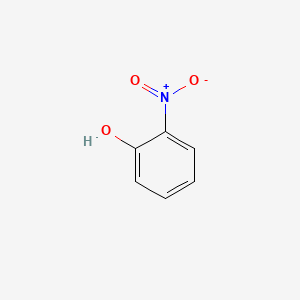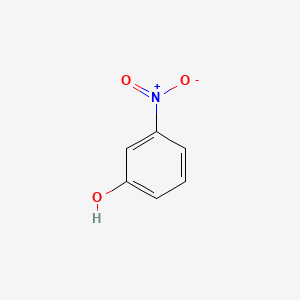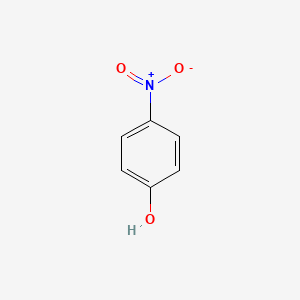
4-Nitrophenol
4-nitrophenol is a member of the class of 4-nitrophenols that is phenol in which the hydrogen that is para to the hydroxy group has been replaced by a nitro group. It has a role as a mouse metabolite and a human xenobiotic metabolite. It is a conjugate acid of a 4-nitrophenolate. — ChEBI
- IUPAC name
- 4-nitrophenol
- Molecular formula
- C6H5NO3
- Molecular weight
- 139.11 g/mol
- Exact mass
- 139.026943022 Da
- XLogP3
- 1.9
- Topological polar surface area
- 66.1 Ų
- Hydrogen-bond donors
- 1
- Hydrogen-bond acceptors
- 3
- Covalent units
- 1
- Defined stereocentres
- 0
Also known as
16 more reported names
External database identifiers
- ChEBI:CHEBI:16836
- ChEMBL:CHEMBL14130
- EPA DTXSID:DTXSID0021834
- PubMed:23121940
- PubMed:23058976
- PubMed:23057066
- PubMed:23035435
- PubMed:23030394
- PubMed:23023220
- PubMed:23019107
- PubMed:23019106
- PubMed:23012501
- PubMed:22990347
- PubMed:22989640
- PubMed:22988627
Evidence from additional scientific databases
EMBL-EBI ChEBI
4-nitrophenol
A member of the class of 4-nitrophenols that is phenol in which the hydrogen that is para to the hydroxy group has been replaced by a nitro group.
- Formula
- C6H5NO3
- Average mass
- 139.110 g/mol
- Monoisotopic mass
- 139.02694 Da
- Formal charge
- 0
- 4-nitrophenols — is a (CHEBI:88306)
- mouse metabolite — has role (CHEBI:75771)
- human xenobiotic metabolite — has role (CHEBI:76967)
- mouse metabolite — has role (CHEBI:75771)
- human xenobiotic metabolite — has role (CHEBI:76967)
- 4-nitrophenols — is a (CHEBI:88306)
- 4-nitrophenolate — is conjugate acid of (CHEBI:57917)
- 19365648 Source: PubMed
Additional curated names
Cross-references from this source
- CAS: 100-02-7 — ChemIDplus
- CAS: 100-02-7 — KEGG COMPOUND
- CAS: 100-02-7 — NIST Chemistry WebBook
- REGISTRY_NUMBER: 1281877 — Reaxys
- REGISTRY_NUMBER: 3311 — Gmelin
- MANUAL_X_REF: 4-Nitrophenol — Wikipedia
- MANUAL_X_REF: c0086 — UM-BBD
- MANUAL_X_REF: C00870 — KEGG COMPOUND
- MANUAL_X_REF: DB04417 — DrugBank
- MANUAL_X_REF: HMDB0001232 — HMDB
- MANUAL_X_REF: NPO — PDBeChem
- MANUAL_X_REF: P-NITROPHENOL — MetaCyc
Mapped by: Exact CAS cross-reference in the ChEBI compound record. Source updated: 2018-03-13. Retrieved: 2026-08-31. Open source record
NIH PubChem PUG-View
Attributed physical-property, hazard, environmental and use annotations.
- Autoignition Temperature: 490 °C Source: ILO-WHO International Chemical Safety Cards (ICSCs)
- Boiling Point: 534 °F at 760 mmHg (Decomposes) (NTP, 1992) Source: CAMEO Chemicals
- Boiling Point: 279 °C Source: DrugBank
- Boiling Point: 279 °C (Decomposes) Source: Hazardous Substances Data Bank (HSDB)
- Boiling Point: 534 °F Source: Occupational Safety and Health Administration (OSHA)
- Color/Form: Colorless to slightly yellow crystals Source: Hazardous Substances Data Bank (HSDB)
- Color/Form: YELLOW TO BROWN SOLID Source: Hazardous Substances Data Bank (HSDB)
- Density: 1.48 at 68 °F (USCG, 1999) - Denser than water; will sink Source: CAMEO Chemicals
- Density: 1.479 g/cu cm at 20 °C Source: Hazardous Substances Data Bank (HSDB)
- Density: 1.5 g/cm³ Source: ILO-WHO International Chemical Safety Cards (ICSCs)
- Density: 1.48 Source: Occupational Safety and Health Administration (OSHA)
- Density: 1.479 @ 20°C Source: PAC Chemical Database, U.S. Department of Energy
- pKa: 7.15 (at 25 °C) Source: DrugBank
- Dissociation Constants: pka = 7.15 at 25 °C Source: Hazardous Substances Data Bank (HSDB)
- Flash Point: 377 °F (NTP, 1992) Source: CAMEO Chemicals
- Flash Point: 377 °F Source: Haz-Map, Information on Hazardous Chemicals and Occupational Diseases
- Flash Point: 169 °C Source: ILO-WHO International Chemical Safety Cards (ICSCs)
- Flash Point: 377 °F Source: Occupational Safety and Health Administration (OSHA)
- LogP: 1.91 Source: DrugBank
- LogP: log Kow = 1.91 Source: Hazardous Substances Data Bank (HSDB)
- LogP: 1.91 Source: Human Metabolome Database (HMDB)
- LogP: 1.91 Source: ILO-WHO International Chemical Safety Cards (ICSCs)
- Melting Point: 235 to 239 °F (Sublimes) (NTP, 1992) Source: CAMEO Chemicals
- Melting Point: 113.8 °C Source: DrugBank
- Melting Point: 113-114 °C Source: Hazardous Substances Data Bank (HSDB)
- Melting Point: 113.8 °C Source: Human Metabolome Database (HMDB)
- Melting Point: 111-116 °C Source: ILO-WHO International Chemical Safety Cards (ICSCs)
- Melting Point: 235-239 °F (sublimes) Source: Occupational Safety and Health Administration (OSHA)
- Melting Point: 113.6 °C Source: PAC Chemical Database, U.S. Department of Energy
- Odor: Odorless Source: Hazardous Substances Data Bank (HSDB)
- Physical Description: 4-nitrophenol appears as a white to light yellow crystalline solid. Contact may severely irritate skin and eyes. Poisonous by ingestion and moderately toxic by skin contact. Source: CAMEO Chemicals
- Physical Description: Colorless to slightly yellow crystals; [HSDB] Source: Haz-Map, Information on Hazardous Chemicals and Occupational Diseases
- Physical Description: Solid Source: Human Metabolome Database (HMDB)
- Physical Description: COLOURLESS-TO-PALE-YELLOW CRYSTALS. Source: ILO-WHO International Chemical Safety Cards (ICSCs)
- Physical Description: A white to light yellow crystalline solid. Source: Occupational Safety and Health Administration (OSHA)
- Solubility: less than 0.1 mg/mL at 70 °F (NTP, 1992) Source: CAMEO Chemicals
- Solubility: 11600 mg/L (at 20 °C) Source: DrugBank
- Solubility: Solubility in water, 269,000 mg/L at 90 °C Source: Hazardous Substances Data Bank (HSDB)
- Solubility: Freely soluble in alcohol, chloroform, ether; soluble in solution of fixed alkali hydroxides and carbonates Source: Hazardous Substances Data Bank (HSDB)
- Solubility: Very soluble in ethanol, ether, and acetone Source: Hazardous Substances Data Bank (HSDB)
- Solubility: In water, 32.8 g/L at 40 °C Source: Hazardous Substances Data Bank (HSDB)
- Solubility: In water, 10,000 mg/L at 15 °C; 16,000 ng/L at 25 °C Source: Hazardous Substances Data Bank (HSDB)
- Solubility: In water, 15,600 mg/L at 25 °C Source: Hazardous Substances Data Bank (HSDB)
- Solubility: 11.6 mg/mL Source: Human Metabolome Database (HMDB)
- Solubility: Solubility in water, g/100ml at 20 °C: 1.24 Source: ILO-WHO International Chemical Safety Cards (ICSCs)
- Vapor Pressure: 1 mmHg at 68 °F ; 18.7 mmHg at 367 °F; 2.2 mmHg at 295 °F (NTP, 1992) Source: CAMEO Chemicals
- Vapor Pressure: 0.0000979 [mmHg] Source: Haz-Map, Information on Hazardous Chemicals and Occupational Diseases
- Vapor Pressure: 9.79X10⁻⁵ mm Hg at 20 °C; 5X10⁻⁴ mm Hg at 25 °C /Extrapolated/ Source: Hazardous Substances Data Bank (HSDB)
- Vapor Pressure: Vapor pressure, Pa at 20 °C: 0.0032 Source: ILO-WHO International Chemical Safety Cards (ICSCs)
- Vapor Pressure: 1 mmHg Source: Occupational Safety and Health Administration (OSHA)
- Substance: p-Nitrophenol Source: NTP Technical Reports
- NTP Technical Report: TR-417: Toxicology and Carcinogenesis Studies of p-Nitrophenol (CASRN 100-02-7) in Swiss-Webster Mice (Dermal Studies) (1993 ) Source: NTP Technical Reports
- Peer Review Date: 07/09/91 Source: NTP Technical Reports
- Conclusion for Male Rat: Chemical Not Tested in Species/Sex Source: NTP Technical Reports
- Conclusion for Female Rat: Chemical Not Tested in Species/Sex Source: NTP Technical Reports
- Conclusion for Male Mice: No Evidence Source: NTP Technical Reports
- Conclusion for Female Mice: No Evidence Source: NTP Technical Reports
- Summary: Under the conditions of these 18-month dermal studiesthere was no evidence of carcinogenic activity in male or female Swiss-Webster micereceiving 40, 80, or 160 mg/kg p-nitrophenol. Source: NTP Technical Reports
- Carcinogen Classification: No indication of carcinogenicity to humans (not listed by IARC). Source: Toxin and Toxin Target Database (T3DB)
- Exposure Routes: The substance can be absorbed into the body by inhalation, through the skin and by ingestion. Source: ILO-WHO International Chemical Safety Cards (ICSCs)
- Exposure Routes: Oral (L1661) ; inhalation (L1661) ; dermal (L1661) Source: Toxin and Toxin Target Database (T3DB)
- First Aid: EYES: First check the victim for contact lenses and remove if present. Flush victim's eyes with water or normal saline solution for 20 to 30 minutes while simultaneously calling a hospital or poison control center. Do not put any ointments, oils, or medication in the victim's eyes without specific instructions from a physician. IMMEDIATELY transport the victim after flushing eyes to a hospital even if no symptoms (such as redness or irritation) develop.; SKIN: IMMEDIATELY flood affected skin with water while removing and isolating all contaminated clothing. Gently wash all affected skin areas thoroughly with soap and water. IMMEDIATELY call a hospital or poison control center even if no symptoms (such as redness or irritation) develop. IMMEDIATELY transport the victim to a hospital for treatment after washing the affected areas.; INHALATION: IMMEDIATELY leave the contaminated area; take deep breaths of fresh air. If symptoms (such as wheezing, coughing, shortness of breath, or burning in the mouth, throat, or chest) develop, call a physician and be prepared to transport the victim to a hospital. Provide proper respiratory protection to rescuers entering an unknown atmosphere. Whene Source: CAMEO Chemicals
- Signal: Warning Source: Regulation (EC) No 1272/2008 of the European Parliament and of the Council
- GHS Hazard Statements: H302: Harmful if swallowed [Warning Acute toxicity, oral]; H312: Harmful in contact with skin [Warning Acute toxicity, dermal]; H332: Harmful if inhaled [Warning Acute toxicity, inhalation]; H373 **: May causes damage to organs through prolonged or repeated exposure [Warning Specific target organ toxicity, repeated exposure] Source: Regulation (EC) No 1272/2008 of the European Parliament and of the Council
- Precautionary Statement Codes: P260, P261, P264, P270, P271, P280, P301+P317, P302+P352, P304+P340, P317, P319, P321, P330, P362+P364, and P501 (click each P-code to see the statement) Source: Regulation (EC) No 1272/2008 of the European Parliament and of the Council
- Signal: Danger Source: European Chemicals Agency (ECHA)
- GHS Hazard Statements: H301 (77.6%): Toxic if swallowed [Danger Acute toxicity, oral]; H302 (22.4%): Harmful if swallowed [Warning Acute toxicity, oral]; H312+H332 (42.3%): Harmful in contact with skin or if inhaled [Warning Acute toxicity, dermal; acute toxicity, inhalation]; H312 (99.6%): Harmful in contact with skin [Warning Acute toxicity, dermal]; H332 (99.6%): Harmful if inhaled [Warning Acute toxicity, inhalation]; H373 (99.2%): May causes damage to organs through prolonged or repeated exposure [Warning Specific target organ toxicity, repeated exposure]; H412 (42.3%): Harmful to aquatic life with long lasting effects [Hazardous to the aquatic environment, long-term hazard] Source: European Chemicals Agency (ECHA)
- Precautionary Statement Codes: P260, P261, P264, P270, P271, P273, P280, P301+P316, P301+P317, P302+P352, P304+P340, P317, P319, P321, P330, P362+P364, P405, and P501 (click each P-code to see the statement) Source: European Chemicals Agency (ECHA)
- ECHA C&L Notifications Summary: Aggregated GHS information provided per 246 reports by companies from 22 notifications to the ECHA C&L Inventory. Each notification may be associated with multiple companies.; Information may vary between notifications depending on impurities, additives, and other factors. The percentage value in parenthesis indicates the notified classification ratio from companies that provide hazard codes. Only hazard codes with percentage values above 10% are shown. For more detailed information, please visit ECHA C&L website. Source: European Chemicals Agency (ECHA)
- Signal: Danger Source: NITE-CMC
- GHS Hazard Statements: H301: Toxic if swallowed [Danger Acute toxicity, oral]; H312: Harmful in contact with skin [Warning Acute toxicity, dermal]; H318: Causes serious eye damage [Danger Serious eye damage/eye irritation]; H336: May cause drowsiness or dizziness [Warning Specific target organ toxicity, single exposure; Narcotic effects]; H370: Causes damage to organs [Danger Specific target organ toxicity, single exposure]; H372: Causes damage to organs through prolonged or repeated exposure [Danger Specific target organ toxicity, repeated exposure]; H373: May causes damage to organs through prolonged or repeated exposure [Warning Specific target organ toxicity, repeated exposure] Source: NITE-CMC
- Precautionary Statement Codes: P260, P261, P264, P264+P265, P270, P271, P280, P301+P316, P302+P352, P304+P340, P305+P354+P338, P308+P316, P317, P319, P321, P330, P362+P364, P403+P233, P405, and P501 (click each P-code to see the statement) Source: NITE-CMC
- GHS Hazard Statements: H401: Toxic to aquatic life [Hazardous to the aquatic environment, acute hazard]; H411: Toxic to aquatic life with long lasting effects [Hazardous to the aquatic environment, long-term hazard] Source: NITE-CMC
- Precautionary Statement Codes: P273, P391, and P501 (click each P-code to see the statement) Source: NITE-CMC
- Health Effects: Nitrophenols may cause methemoglobinemia. This is a disorder in which there is an abnormally high level of methemoglobin in the blood, resulting in a decrease in the amount of oxygen that can be carried to the tissues and organs. (L1661, L1613) Source: Toxin and Toxin Target Database (T3DB)
- Toxicity Summary: The nitrite in nitrophenols causes the autocatalytic oxidation of oxyhemoglobin to hydrogen peroxide and methemoglobin. This elevation of methemoglobin levels is a condition known as methemoglobinemia, and is characterized by tissue hypoxia, as methemoglobin cannot bind oxygen. (A2450, L1613) Source: Toxin and Toxin Target Database (T3DB)
- Environmental Bioconcentration: BCF values of 2.5 to 7.8 were measured for carp (Carprinus carpio) exposed to 0.02 ppm and 0.2 ppm 4-nitrophenol over a 6-8 week incubation period(1). The BCF value of 4-nitrophenol was reported as 79 in fathead minnows(2) and 58 in golden orfe(3). According to a classification scheme(4), these BCF values suggest bioconcentration in aquatic organisms is low to moderate. Source: Hazardous Substances Data Bank (HSDB)
- Environmental Fate: TERRESTRIAL FATE: Based on a classification scheme(1), a median literature Koc value of 234 (log Koc = 2.37) reported for 4-nitrophenol(2) indicates that 4-nitrophenol is expected to have moderate mobility in soil(SRC). However, measured Koc values range from 16(3) to over 500(4) suggesting a range of very high mobility to low mobility(SRC). The pKa of 4-nitrophenol is 7.15(5), indicating that this compound will exist partially in anion form in the environment and anions generally do not adsorb more strongly to soils containing organic carbon and clay than their neutral counterparts(6). The available experimental data suggests 4-nitrophenol may be more mobile in anionic form(SRC). Volatilization of 4-nitrophenol from moist soil surfaces is not expected to be an important fate process(SRC) given a Henry's Law constant of 1.28X10⁻⁸ atm-cu m/mole(7). 4-Nitrophenol is not expected to volatilize from dry soil surfaces(SRC) based upon a vapor pressure of 9.79X10⁻⁵ mm Hg at 20 °C(8). The biodegradation half-life of 4-nitrophenol in an acidic soil was reported as 2.5 days and the biodegradation half-life in a basic soil was reported as 10.2 days(9). However, a large number of biodegradatio Source: Hazardous Substances Data Bank (HSDB)
- Environmental Fate: AQUATIC FATE: Based on a classification scheme(1), a median literature Koc value of 234(2) indicates that 4-nitrophenol may undergo some adsorption to suspended solids and sediment in water(SRC). Measured Koc values range from 16(3) to over 500(4) suggesting a range of adsorption potential with sediment(SRC). The pKa of 4-nitropehnol is 7.15(5), indicating that this compound will exist partially in anion form in the environment and anions generally do not adsorb more strongly than their neutral counterparts(6). Volatilization from water surfaces is not expected(7) based upon the Henry's Law constant of 1.28X10⁻⁸ atm-cu m/mole at 20 °C(8). According to a classification scheme(9), BCF values in the range of 2.5(10) to 79(11) in fish suggest bioconcentration in aquatic organisms will be low to moderate. 4-Nitrophenol is not expected to undergo hydrolysis in the environment due to the lack of hydrolyzable functional groups(7). When 4-nitrophenol in water was exposed to sunlight, the half-life was 5.7, 6.7, and 13.7 days at pH 5, 7, and 9, respectively(12). The biodegradation half-life of 4-nitrophenol was reported as 18 hours and 6.8 days in aerobic and anaerobic waters, respectively(1 Source: Hazardous Substances Data Bank (HSDB)
- Environmental Fate: ATMOSPHERIC FATE: According to a model of gas/particle partitioning of semivolatile organic compounds in the atmosphere(1), 4-nitrophenol, which has a vapor pressure of 9.79X10⁻⁵ mm Hg at 20 °C(2), will exist in both the vapor and particulate phases in the ambient atmosphere. An urban monitoring study in Rome Italy found the concentration to be higher in the particulate-phase compared to the vapor-phase(3). Vapor-phase 4-nitrophenol is degraded in the atmosphere by reaction with photochemically-produced hydroxyl radicals(SRC); the half-life for this reaction in air is estimated to be 3.7 days(SRC), calculated from its rate constant of 4.3X10⁻¹² cu cm/molecule-sec at 25 °C(SRC) that was derived using a structure estimation method(4). Particulate-phase 4-nitrophenol may be removed from the air by wet and dry deposition(SRC). Vapor-phase 4-nitrophenol is also removed from the ambient atmosphere through dissolution into cloud water with subsequent precipitation(5). 4-Nitrophenol absorbs UV light strongly above 290 nm(6) suggesting the compound is susceptible to direct photolysis in sunlight(SRC). 4-Nitrophenol adsorbed to silica gel was 39% mineralized when exposed to light greater tha Source: Hazardous Substances Data Bank (HSDB)
- Uses: 4-Nitrophenol is used to manufacture drugs (e.g., acetaminophen), fungicides, methyl and ethyl parathion insecticides, and dyes and to darken leather. Source: EPA Hazardous Air Pollutants
- Sources/Uses: Used as an intermediate for insecticides, fungicides, bactericides, and dyes; used as a leather treatment agent; [HSDB] Used to produce dyes, paints, rubber chemicals, and fungicides; [ATSDR ToxProfiles] Source: Haz-Map, Information on Hazardous Chemicals and Occupational Diseases
- Industrial Processes with risk of exposure: Leather Tanning and Processing [Category: Industry] Source: Haz-Map, Information on Hazardous Chemicals and Occupational Diseases
- Uses: For 4-nitrophenol (USEPA/OPP Pesticide Code: 056301) there are 0 labels match. /SRP: Not registered for current use in the U.S., but approved pesticide uses may change periodically and so federal, state and local authorities must be consulted for currently approved uses./ Source: Hazardous Substances Data Bank (HSDB)
- Uses: Manufacture of pharmaceuticals, fungicides, dyes. Indicator in 0.1% alcohol solution. pH: 5.6 colorless, 7.6 yellow. Source: Hazardous Substances Data Bank (HSDB)
- Uses: CHEM INTERMEDIATE FOR THE INSECTICIDES METHYL PARATHION & ETHYL PARATHION, AZO & SULFUR DYES, N-ACETYL-P-AMINOPHENOL; CHEM INTERMEDIATE FOR LEATHER PRESERVATIVES Source: Hazardous Substances Data Bank (HSDB)
- Uses: As substrate for analysis of UDP-glucuronyl transferase Source: Hazardous Substances Data Bank (HSDB)
- Uses: For more Uses (Complete) data for 4-NITROPHENOL (6 total), please visit the HSDB record page. Source: Hazardous Substances Data Bank (HSDB)
- Uses: Synthetic Polymer MALDI Matrix Compounds Source: NIST Synthetic Polymer MALDI Recipes Database
- Uses: 4-Nitrophenol is used mainly to make fungicides and dyes, and to darken leather. It is also used in the synthesis of drugs such as paracetamol, phenetidine, and acetophenetidine. (L1661, L1662) Source: Toxin and Toxin Target Database (T3DB)
Mapped by: Existing checksum-valid CAS to unique PubChem CID match. Retrieved: 2026-08-31. Open source record
Scientific classifications and hazard annotations provide context and do not replace the market-specific regulatory decision shown above.
Additional source coverage and match status
| Source | Result | Checked |
|---|---|---|
| EMBL-EBI ChEBI | Exact match | 2026-08-31 |
| NIH PubChem PUG-View | Exact match | 2026-08-31 |
A recorded no-match is useful evidence that the source was checked; it is not a claim that the substance does not exist elsewhere.
Retrieved from NIH PubChem on 2026-08-31 by checksum-valid CAS matching. Chemical properties do not replace the regulatory decision on this page.