Official EU label nameGlossary entry 15968

MANGANESE CITRATE

This record confirms an official common ingredient name for EU cosmetic product labelling. It does not by itself confirm that the substance is permitted, unrestricted or safe.

Global evidence snapshot

The resolved identity has matching regulatory evidence in 0 of 13 indexed market datasets: 0 country records and 0 EU Annex records. Every result and evidence gap is listed below.

0 markets with evidence
Markets checked
13
Markets with evidence
0
Evidence gaps
13
Resolved identifiers
2

A missing local match is not permission, approval or proof of safety. It means no strong identity match was resolved in that indexed dataset.

Resolved substance identity

CAS:10024-66-5
EC:233-027-3
Ingredient index records:
MANGANESE CITRATE
Cosmetic functions: SKIN CONDITIONING

1,2,3-Propanetricarboxylic acid, 2-hydroxy-, manganese salt (1:?); Citric acid, manganese salt

1 matched or reported name
MANGANESE CITRATE

Regulatory evidence in all 13 markets

Open each matched record for its scope, concentration, conditions, warnings and official source version.

Swipe or scroll horizontally to see dataset coverage and next actions.

MarketResultRecordsDatasetMeaning / next action
European Union
EU
No local match0
Complete annex dataset
Regulation (EC) 1223/2009 consolidated to 1 May 2026
No annex match only means that these five annexes did not return a match; CosIng identity data and other EU obligations still need review.
Great Britain
GB
No local match0
Complete consolidated annex dataset
GB retained Regulation 1223/2009 schedules, effective 15 August 2026
No annex match is not approval and does not cover Northern Ireland, which follows the applicable EU framework.
Canada
CA
No local match0
Complete Hotlist snapshot
Health Canada Cosmetic Ingredient Hotlist, 13 August 2025
The Hotlist is an administrative compliance tool, not an exhaustive safety approval list.
New Zealand
NZ
No local match0
Complete schedules dataset
Cosmetic Products Group Standard schedules effective 1 January 2026
The searchable spreadsheet is an aid; the legal Group Standard and incorporated notices remain authoritative.
ASEAN
ASEAN
No local match0
Complete regional annex dataset
ASEAN Cosmetic Directive annexes 2026-1, 22 June 2026
Regional annex coverage does not replace member-state implementation dates, notifications or national deviations.
China
CN
No local match0
Complete prohibited catalogues plus official-source workflow
NMPA 2021 banned catalogues plus dynamic IECIC List I/List II system current since 2025
IECIC listing is not blanket approval; absence may require the new cosmetic ingredient route, and restrictions are checked separately.
Japan
JP
No local match0
Complete Standards appendices dataset
MHLW Standards for Cosmetics official English source and Japanese amendments checked for the imported snapshot
The Japanese text and subsequent notices are canonical; no local match is not a product-compliance conclusion.
South Korea
KR
No local match0
Complete current appendix dataset
MFDS Notice 2026-19, effective 18 March 2026
Korean source wording is canonical and other positive lists/notices may still apply to the formulation.
United States
US
No local match0
Complete enumerated federal ingredient rules
eCFR Title 21 issue date 27 August 2026
FDA has no general approved-cosmetic-ingredient catalogue; absence from these sections is not approval or proof of safety.
Australia
AU
No local match0
Complete cosmetic-relevant Poisons Standard subset plus official workflow
Therapeutic Goods (Poisons Standard—June 2026) Instrument 2026
An AICIS Inventory match is not cosmetic approval; no Inventory match can indicate a new, exempted, reported or confidential introduction.
Brazil
BR
No local match0
Complete prohibited dataset plus current restricted-list workflow
ANVISA RDC 1.029/2026 and RDC 1.030/2026, published 15 June 2026
RDC 1.030/2026 amends rather than replaces the prohibited baseline, and the second restricted-list revision was still under consultation in July 2026.
India
IN
No local match0
Complete current Part 2 dataset plus official workflow for Parts 1, 3 and 4
Cosmetics Rules 2020 plus current BIS IS 4707 parts (1:2020, 2:2025, 3:2025, 4:2022)
The standards are separate controlled publications; absence from a locally indexed excerpt is not permission.
Saudi Arabia
SA
No local match0
Complete official list index
SFDA live prohibited/restricted lists, snapshot 30 August 2026
No list match is not permission; Gulf/SFDA product, claim, notification and technical requirements still apply.
No market rows match this filter.

Chemical identity and properties

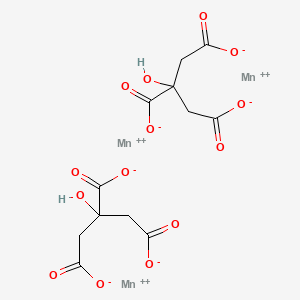
PubChem 2D chemical structure for CAS 10024-66-5
CAS 10024-66-5PubChem CID 9937209

Manganese Citrate

IUPAC name
bis(2-hydroxypropane-1,2,3-tricarboxylate);tris(manganese(2+))
Molecular formula
C12H10Mn3O14
Molecular weight
543.01 g/mol
Exact mass
542.821184 Da
Topological polar surface area
281.0 Ų
Hydrogen-bond donors
2
Hydrogen-bond acceptors
14
Covalent units
5
Defined stereocentres
0

Also known as

Trimanganese dicitrateManganese citrate anhydrous74NE0422XHEINECS 233-193-7Citric acid, manganese salt1,2,3-Propanetricarboxylic acid, 2-hydroxy-, manganese saltMANGANESE CITRATE [FCC]HSDB 2147
16 more reported names
MANGANESE CITRATE [WHO-DD]Citric acid, manganese(3+) salt (1:1)manganese(3+) ion 2-hydroxypropane-1,2,3-tricarboxylateManganese citric acid1,2,3-Propanetricarboxylic acid, 2-hydroxy-, manganese(3+) saltRefChem:809845MANGANESE CITRATE [INCI]1,2,3Propanetricarboxylic acid, 2hydroxy, manganese(3+) saltManganese(II) citrateUNII-74NE0422XH1,2,3-Propanetricarboxylic acid, 2-hydroxy-, manganese(2+) salt (2:3)2-hydroxypropane-1,2,3-tricarboxylate;manganese(2+)MANGANESECITRATEDECAHYDRATEOAVRWNUUOUXDFH-UHFFFAOYSA-HDB-251517Manganese(II) 2-hydroxypropane-1,2,3-tricarboxylate
External database identifiers

Evidence from additional scientific databases

NIH PubChem PUG-View
Exact identifier match9937209

Attributed physical-property, hazard, environmental and use annotations.

  • GHS Hazard Statements: Not Classified; Reported as not meeting GHS hazard criteria by 1 of 1 companies. For more detailed information, please visit ECHA C&L website. Source: European Chemicals Agency (ECHA)
  • Health Effects: Manganese mainly affects the nervous system and may cause behavioral changes and other nervous system effects, which include movements that may become slow and clumsy. This combination of symptoms when sufficiently severe is referred to as Source: Toxin and Toxin Target Database (T3DB)
  • Cosmetic Ingredient Review Finding(s): Safe in the present practices of use and concentration. Ingredient, concentration, and use information are available in documents discoverable at https://cir-reports.cir-safety.org Source: Cosmetic Ingredient Review (CIR)
  • Toxicity Summary: Manganese is a cellular toxicant that can impair transport systems, enzyme activities, and receptor functions. It primarily targets the central nervous system, particularily the globus pallidus of the basal ganglia. It is believed that the manganese ion, Mn(II), enhances the autoxidation or turnover of various intracellular catecholamines, leading to increased production of free radicals, reactive oxygen species, and other cytotoxic metabolites, along with a depletion of cellular antioxidant defense mechanisms, leading to oxidative damage and selective destruction of dopaminergic neurons. In addition to dopamine, manganese is thought to perturbations other neurotransmitters, such as GABA and glutamate. In order to produce oxidative damage, manganese must first overwhelm the antioxidant enzyme manganese superoxide dismutase. The neurotoxicity of Mn(II) has also been linked to its ability to substitute for Ca(II) under physiological conditions. It can enter mitochondria via the calcium uniporter and inhibit mitochondrial oxidative phosphorylation. It may also inhibit the efflux of Ca(II), which can result in a loss of mitochondrial membrane integrity. Mn(II) has been shown to inhibit Source: Toxin and Toxin Target Database (T3DB)

Mapped by: Existing checksum-valid CAS to unique PubChem CID match. Retrieved: 2026-08-31. Open source record

Scientific classifications and hazard annotations provide context and do not replace the market-specific regulatory decision shown above.

Additional source coverage and match status
SourceResultChecked
EMBL-EBI ChEBINo exact record2026-08-31
NIH PubChem PUG-ViewExact match2026-08-31

A recorded no-match is useful evidence that the source was checked; it is not a claim that the substance does not exist elsewhere.

Retrieved from NIH PubChem on 2026-08-31 by checksum-valid CAS matching. Chemical properties do not replace the regulatory decision on this page.

Additional authoritative substance research

These source-specific lookups can add hazard, toxicology, identity and assessment context. A link is a research route, not a claim that the source contains an exact record.

Cosmetic Ingredient Review safety assessments

Expert Panel conclusions, assessed ingredient groups, use conditions, dates and report documents

Independent expert review considered by FDA; not a government approval or binding market rule

Research this identity

FDA Global Substance Registration System

UNII identifiers, preferred names, substance types, codes and public substance relationships

Identity registry only; UNII availability does not imply FDA review or approval

Research this identity

ILO/WHO International Chemical Safety Cards

Hazards, symptoms, first aid, storage, incompatibilities and physical properties for covered chemicals

International occupational chemical-safety reference; not cosmetic-use approval

Research this identity

Japan NITE-CHRIP

Chemical identity, Japanese and foreign legal lists, GHS hazards and exposure-related information

Chemical-management evidence; cosmetic status remains governed by the applicable MHLW standard and market rules

Research this identity

NIOSH Pocket Guide to Chemical Hazards

REL, PEL, IDLH, properties, exposure routes, symptoms, target organs, first aid and measurement methods for covered workplace chemicals

US occupational-health guidance and limits; not a cosmetic ingredient decision

Research this identity

OECD eChemPortal

Gateway to authority-owned physical-property, fate, ecotoxicity, toxicity, exposure and GHS records

Discovery gateway; each linked authority remains responsible for its data

Research this identity

US EPA CompTox CTX APIs

DTXSID identity, experimental and predicted properties, toxicity, bioactivity, exposure and environmental data

Scientific and computational evidence; predictions must remain labelled and do not determine cosmetic legality

Research this identity

Continue the compliance check

1. Confirm identity

Match the supplier specification, CAS/EC identifiers and composition to this official label name. Similar wording is not proof of chemical equivalence.

2. Review restrictions

Check every exact Annex record shown above, plus CMR, nanomaterial, SCCS and later-amendment requirements that may apply.

3. Verify the formula

Evaluate concentration, product type, purity, warnings, claims and each target market before making a compliance decision.

Screen in a formulaOpen standalone comparison

Official source and scope

Imported from Commission Implementing Decision (EU) 2025/1175 (dataset version EU 2025/1175). The glossary supplies common ingredient names for the ingredient list required by Article 19(1)(g); it is not an approval or safety list.

Open official Decision