
Official EU label nameGlossary entry 13213
HYDROXYCITRONELLAL
This record confirms an official common ingredient name for EU cosmetic product labelling. It does not by itself confirm that the substance is permitted, unrestricted or safe.
Global evidence snapshot
The resolved identity has matching regulatory evidence in 5 of 13 indexed market datasets: 4 country records and 1 EU Annex records. Every result and evidence gap is listed below.
Markets checked
13
Markets with evidence
5
Evidence gaps
8
Resolved identifiers
2
Resolved substance identity
CAS:107-75-5
EC:203-518-7
Ingredient index records:
HYDROXYCITRONELLAL
Cosmetic functions: PERFUMING
7-Hydroxycitronellal
Inventory restriction note: III/72
5 matched or reported names
HYDROXYCITRONELLALHydroxycitronellalHydroxycitronellal (7-hydroxycitronellal)7-Hydroxycitronellal Hydroxycitronellal (CAS No. 107-75-5)7-Hydroxycitronellal
Regulatory evidence in all 13 markets
Open each matched record for its scope, concentration, conditions, warnings and official source version.
Swipe or scroll horizontally to see dataset coverage and next actions.
| Market | Result | Records | Dataset | Meaning / next action |
|---|---|---|---|---|
| European Union EU | Restricted | 1Open record 1 | Complete annex dataset Regulation (EC) 1223/2009 consolidated to 1 May 2026 | Review every linked record and exact conditions. |
| Great Britain GB | Restricted | 1Open record 1 | Complete consolidated annex dataset GB retained Regulation 1223/2009 schedules, effective 15 August 2026 | Review every linked record and exact conditions. |
| Canada CA | No local match | 0 | Complete Hotlist snapshot Health Canada Cosmetic Ingredient Hotlist, 13 August 2025 | The Hotlist is an administrative compliance tool, not an exhaustive safety approval list. |
| New Zealand NZ | Restricted | 1Open record 1 | Complete schedules dataset Cosmetic Products Group Standard schedules effective 1 January 2026 | Review every linked record and exact conditions. |
| ASEAN ASEAN | No local match | 0 | Complete regional annex dataset ASEAN Cosmetic Directive annexes 2026-1, 22 June 2026 | Regional annex coverage does not replace member-state implementation dates, notifications or national deviations. |
| China CN | No local match | 0 | Complete prohibited catalogues plus official-source workflow NMPA 2021 banned catalogues plus dynamic IECIC List I/List II system current since 2025 | IECIC listing is not blanket approval; absence may require the new cosmetic ingredient route, and restrictions are checked separately. |
| Japan JP | No local match | 0 | Complete Standards appendices dataset MHLW Standards for Cosmetics official English source and Japanese amendments checked for the imported snapshot | The Japanese text and subsequent notices are canonical; no local match is not a product-compliance conclusion. |
| South Korea KR | No local match | 0 | Complete current appendix dataset MFDS Notice 2026-19, effective 18 March 2026 | Korean source wording is canonical and other positive lists/notices may still apply to the formulation. |
| United States US | No local match | 0 | Complete enumerated federal ingredient rules eCFR Title 21 issue date 27 August 2026 | FDA has no general approved-cosmetic-ingredient catalogue; absence from these sections is not approval or proof of safety. |
| Australia AU | No local match | 0 | Complete cosmetic-relevant Poisons Standard subset plus official workflow Therapeutic Goods (Poisons Standard—June 2026) Instrument 2026 | An AICIS Inventory match is not cosmetic approval; no Inventory match can indicate a new, exempted, reported or confidential introduction. |
| Brazil BR | No local match | 0 | Complete prohibited dataset plus current restricted-list workflow ANVISA RDC 1.029/2026 and RDC 1.030/2026, published 15 June 2026 | RDC 1.030/2026 amends rather than replaces the prohibited baseline, and the second restricted-list revision was still under consultation in July 2026. |
| India IN | Restricted | 1Open record 1 | Complete current Part 2 dataset plus official workflow for Parts 1, 3 and 4 Cosmetics Rules 2020 plus current BIS IS 4707 parts (1:2020, 2:2025, 3:2025, 4:2022) | Review every linked record and exact conditions. |
| Saudi Arabia SA | Restricted | 1Open record 1 | Complete official list index SFDA live prohibited/restricted lists, snapshot 30 August 2026 | Review every linked record and exact conditions. |
No market rows match this filter.
Matching market records and conditions
Great Britain
GB retained Regulation 1223/2009 schedules, effective 15 August 2026New Zealand
Cosmetic Products Group Standard schedules effective 1 January 2026India
Cosmetics Rules 2020 plus current BIS IS 4707 parts (1:2020, 2:2025, 3:2025, 4:2022)Saudi Arabia
SFDA live prohibited/restricted lists, snapshot 30 August 2026Exact Annex II–VI evidence
Annex IIIentry 72
Open full regulatory recordHYDROXYCITRONELLAL
Product scope: (a) Oral products (b) Other products
Maximum concentration: (b) 1,0 %
Restrictions: (a) (b) The presence of the substance must be indicated in the list of ingredients referred to in Article 19(1)(g) when its concentration exceeds: — 0,001 % in leave-on products — 0,01 % in rinse-off products
Chemical identity and properties
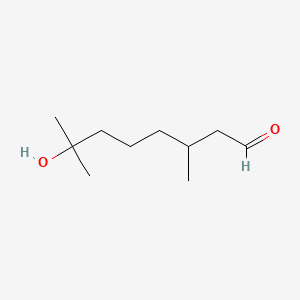
CAS 107-75-5PubChem CID 7888
Hydroxycitronellal
Hydroxycitronellal is the tertiary alcohol arising from addition of water across the C=C double bond of citronellal. It has a role as a fragrance and an allergen. It is functionally related to a citronellal. — ChEBI
- IUPAC name
- 7-hydroxy-3,7-dimethyloctanal
- Molecular formula
- C10H20O2
- Molecular weight
- 172.26 g/mol
- Exact mass
- 172.146329876 Da
- XLogP3
- 1.6
- Topological polar surface area
- 37.3 Ų
- Hydrogen-bond donors
- 1
- Hydrogen-bond acceptors
- 2
- Covalent units
- 1
- Defined stereocentres
- 0
Also known as
7-Hydroxycitronellal3,7-Dimethyl-7-hydroxyoctanalCitronellal hydratePhixiaCyclaliaCyclosiaLaurineFixol
16 more reported names
Lilyl aldehydeMuguettine principleOctanal, 7-hydroxy-3,7-dimethyl-Musuettine principleOxydihydrocitronellalhydroxy citronellal1-OCTANAL, 3,7-DIMETHYL-7-HYDROXY-FEMA No. 25838SQ0VA4YURCHEBI:534593,7-dimethyl-7-hydroxyoctan-1-alNSC-406740MuguetMusuetRefChem:147154203-518-7
External database identifiers
- ChEBI:CHEBI:53459
- ChEMBL:CHEMBL3186027
- EPA DTXSID:DTXSID6042232
- PubMed:31958493
- PubMed:29108680
- PubMed:26795242
- PubMed:25724174
- PubMed:22606039
- PubMed:21661358
- PubMed:21461388
- PubMed:21392029
- PubMed:20795681
- PubMed:20491607
- PubMed:19305786
- PubMed:19243479
Evidence from additional scientific databases
EMBL-EBI ChEBI
Exact identifier matchCHEBI:53459
hydroxycitronellal
The tertiary alcohol arising from addition of water across the C=C double bond of citronellal.
- Formula
- C10H20O2
- Average mass
- 172.268 g/mol
- Monoisotopic mass
- 172.14633 Da
- Formal charge
- 0
- tertiary alcohol — is a (CHEBI:26878)
- allergen — has role (CHEBI:50904)
- fragrance — has role (CHEBI:48318)
- citronellal — has functional parent (CHEBI:47856)
- allergen — has role (CHEBI:50904)
- fragrance — has role (CHEBI:48318)
- tertiary alcohol — is a (CHEBI:26878)
- 12786728 Source: PubMed
- 14678209 Source: PubMed
- 17598033 Source: PubMed
- 17936526 Source: PubMed
- 19243479 Source: PubMed
- 20495907 Source: PubMed
- 20795681 Source: PubMed
- 21392029 Source: PubMed
- 2808836 Source: PubMed
- 3264801 Source: PubMed
- 455972 Source: PubMed
- 467024 Source: PubMed
- 8681536 Source: PubMed
- 8735869 Source: PubMed
- 8879930 Source: PubMed
Additional curated names
7-hydroxy-3,7-dimethyloctanal3,7-dimethyl-7-hydroxyoctan-1-al3,7-Dimethyl-7-hydroxyoctanal7-hydroxycitronellalCitronellal hydratehydroxy citronellal
Cross-references from this source
- CAS: 107-75-5 — ChemIDplus
- CAS: 107-75-5 — NIST Chemistry WebBook
- REGISTRY_NUMBER: 1721290 — Reaxys
- MANUAL_X_REF: HMDB0031739 — HMDB
Mapped by: Exact CAS cross-reference in the ChEBI compound record. Source updated: 2014-05-12. Retrieved: 2026-08-31. Open source record
NIH PubChem PUG-View
Exact identifier match7888
Attributed physical-property, hazard, environmental and use annotations.
- Boiling Point: 241.00 °C. @ 760.00 mm Hg Source: Human Metabolome Database (HMDB)
- Boiling Point: 241 °C; 94-96 °C (1 mm Hg) Source: Joint FAO/WHO Expert Committee on Food Additives (JECFA)
- Density: 0.918-0.923 Source: Joint FAO/WHO Expert Committee on Food Additives (JECFA)
- Physical Description: Liquid; Dry Powder; Liquid; CBI Source: EPA Chemical Data Reporting (CDR)
- Physical Description: Liquid; [Sigma-Aldrich MSDS] Source: Haz-Map, Information on Hazardous Chemicals and Occupational Diseases
- Physical Description: colourless liquid with sweet floral lily-like odour Source: Joint FAO/WHO Expert Committee on Food Additives (JECFA)
- Refractive Index: 1.447-1.450 Source: Joint FAO/WHO Expert Committee on Food Additives (JECFA)
- Solubility: slightly Source: Human Metabolome Database (HMDB)
- Solubility: slightly soluble in water; soluble in alcohol, propylene glycol, and oils; insoluble in glycerol Source: Joint FAO/WHO Expert Committee on Food Additives (JECFA)
- Solubility: 1 ml in 1 ml 50% alcohol (in ethanol) Source: Joint FAO/WHO Expert Committee on Food Additives (JECFA)
- Note: This chemical does not meet GHS hazard criteria for < 0.1% (1 of 2046) of reports. Source: European Chemicals Agency (ECHA)
- Signal: Warning Source: European Chemicals Agency (ECHA)
- GHS Hazard Statements: H317 (> 99.9%): May cause an allergic skin reaction [Warning Sensitization, Skin]; H319 (> 99.9%): Causes serious eye irritation [Warning Serious eye damage/eye irritation] Source: European Chemicals Agency (ECHA)
- Precautionary Statement Codes: P261, P264+P265, P272, P280, P302+P352, P305+P351+P338, P321, P333+P317, P337+P317, P362+P364, and P501 (click each P-code to see the statement) Source: European Chemicals Agency (ECHA)
- ECHA C&L Notifications Summary: Aggregated GHS information provided per 2046 reports by companies from 10 notifications to the ECHA C&L Inventory. Each notification may be associated with multiple companies.; Reported as not meeting GHS hazard criteria per 1 of 2046 reports by companies.; There are 9 notifications provided by 2045 of 2046 reports by companies with hazard statement code(s).; Information may vary between notifications depending on impurities, additives, and other factors. The percentage value in parenthesis indicates the notified classification ratio from companies that provide hazard codes. Only hazard codes with percentage values above 10% are shown. For more detailed information, please visit ECHA C&L website. Source: European Chemicals Agency (ECHA)
- Signal: Warning Source: NITE-CMC
- GHS Hazard Statements: H317: May cause an allergic skin reaction [Warning Sensitization, Skin]; H319: Causes serious eye irritation [Warning Serious eye damage/eye irritation]; H335: May cause respiratory irritation [Warning Specific target organ toxicity, single exposure; Respiratory tract irritation]; H402: Harmful to aquatic life [Hazardous to the aquatic environment, acute hazard] Source: NITE-CMC
- Precautionary Statement Codes: P261, P264+P265, P271, P272, P273, P280, P302+P352, P304+P340, P305+P351+P338, P319, P321, P333+P317, P337+P317, P362+P364, P403+P233, P405, and P501 (click each P-code to see the statement) Source: NITE-CMC
- Signal: Warning Source: Hazardous Chemical Information System (HCIS), Safe Work Australia
- GHS Hazard Statements: H317: May cause an allergic skin reaction [Warning Sensitization, Skin]; H319: Causes serious eye irritation [Warning Serious eye damage/eye irritation] Source: Hazardous Chemical Information System (HCIS), Safe Work Australia
- Precautionary Statement Codes: P261, P264+P265, P272, P280, P302+P352, P305+P351+P338, P321, P333+P317, P337+P317, P362+P364, and P501 (click each P-code to see the statement) Source: Hazardous Chemical Information System (HCIS), Safe Work Australia
- Consumer Uses: Fragrance Source: EPA Chemical Data Reporting (CDR)
- Industry Uses: Fragrance Source: EPA Chemical Data Reporting (CDR)
- Sources/Uses: Permitted for use as an inert ingredient in non-food pesticide products; [EPA] Used as a fragrance; [EC: SCCNFP] Used as flavoring agent or adjuvant; [FDA] Source: Haz-Map, Information on Hazardous Chemicals and Occupational Diseases
Mapped by: Existing checksum-valid CAS to unique PubChem CID match. Retrieved: 2026-08-31. Open source record
Scientific classifications and hazard annotations provide context and do not replace the market-specific regulatory decision shown above.
Additional source coverage and match status
| Source | Result | Checked |
|---|---|---|
| EMBL-EBI ChEBI | Exact match | 2026-08-31 |
| NIH PubChem PUG-View | Exact match | 2026-08-31 |
A recorded no-match is useful evidence that the source was checked; it is not a claim that the substance does not exist elsewhere.
Retrieved from NIH PubChem on 2026-09-02 by checksum-valid CAS matching. Chemical properties do not replace the regulatory decision on this page.
Additional authoritative substance research
Each link searches that source for this identity. A link is a research route, not a claim that the source holds an exact record. What each source is, and its legal weight
Take this record further
Official source and scope
Imported from Commission Implementing Decision (EU) 2025/1175 (dataset version EU 2025/1175). The glossary supplies common ingredient names for the ingredient list required by Article 19(1)(g); it is not an approval or safety list.
Open official Decision