
Official EU label nameGlossary entry 10473
FERULIC ACID
This record confirms an official common ingredient name for EU cosmetic product labelling. It does not by itself confirm that the substance is permitted, unrestricted or safe.
Global evidence snapshot
The resolved identity has matching regulatory evidence in 1 of 13 indexed market datasets: 1 country records and 0 EU Annex records. Every result and evidence gap is listed below.
Markets checked
13
Markets with evidence
1
Evidence gaps
12
Resolved identifiers
2
Resolved substance identity
CAS:1135-24-6
EC:214-490-0
Ingredient index records:
2 matched or reported names
FERULIC ACIDFerulic acid
Regulatory evidence in all 13 markets
Open each matched record for its scope, concentration, conditions, warnings and official source version.
Swipe or scroll horizontally to see dataset coverage and next actions.
| Market | Result | Records | Dataset | Meaning / next action |
|---|---|---|---|---|
| European Union EU | No local match | 0 | Complete annex dataset Regulation (EC) 1223/2009 consolidated to 1 May 2026 | No annex match only means that these five annexes did not return a match; CosIng identity data and other EU obligations still need review. |
| Great Britain GB | No local match | 0 | Complete consolidated annex dataset GB retained Regulation 1223/2009 schedules, effective 15 August 2026 | No annex match is not approval and does not cover Northern Ireland, which follows the applicable EU framework. |
| Canada CA | No local match | 0 | Complete Hotlist snapshot Health Canada Cosmetic Ingredient Hotlist, 13 August 2025 | The Hotlist is an administrative compliance tool, not an exhaustive safety approval list. |
| New Zealand NZ | No local match | 0 | Complete schedules dataset Cosmetic Products Group Standard schedules effective 1 January 2026 | The searchable spreadsheet is an aid; the legal Group Standard and incorporated notices remain authoritative. |
| ASEAN ASEAN | No local match | 0 | Complete regional annex dataset ASEAN Cosmetic Directive annexes 2026-1, 22 June 2026 | Regional annex coverage does not replace member-state implementation dates, notifications or national deviations. |
| China CN | No local match | 0 | Complete prohibited catalogues plus official-source workflow NMPA 2021 banned catalogues plus dynamic IECIC List I/List II system current since 2025 | IECIC listing is not blanket approval; absence may require the new cosmetic ingredient route, and restrictions are checked separately. |
| Japan JP | Restricted | 1Open record 1 | Complete Standards appendices dataset MHLW Standards for Cosmetics official English source and Japanese amendments checked for the imported snapshot | Review every linked record and exact conditions. |
| South Korea KR | No local match | 0 | Complete current appendix dataset MFDS Notice 2026-19, effective 18 March 2026 | Korean source wording is canonical and other positive lists/notices may still apply to the formulation. |
| United States US | No local match | 0 | Complete enumerated federal ingredient rules eCFR Title 21 issue date 27 August 2026 | FDA has no general approved-cosmetic-ingredient catalogue; absence from these sections is not approval or proof of safety. |
| Australia AU | No local match | 0 | Complete cosmetic-relevant Poisons Standard subset plus official workflow Therapeutic Goods (Poisons Standard—June 2026) Instrument 2026 | An AICIS Inventory match is not cosmetic approval; no Inventory match can indicate a new, exempted, reported or confidential introduction. |
| Brazil BR | No local match | 0 | Complete prohibited dataset plus current restricted-list workflow ANVISA RDC 1.029/2026 and RDC 1.030/2026, published 15 June 2026 | RDC 1.030/2026 amends rather than replaces the prohibited baseline, and the second restricted-list revision was still under consultation in July 2026. |
| India IN | No local match | 0 | Complete current Part 2 dataset plus official workflow for Parts 1, 3 and 4 Cosmetics Rules 2020 plus current BIS IS 4707 parts (1:2020, 2:2025, 3:2025, 4:2022) | The standards are separate controlled publications; absence from a locally indexed excerpt is not permission. |
| Saudi Arabia SA | No local match | 0 | Complete official list index SFDA live prohibited/restricted lists, snapshot 30 August 2026 | No list match is not permission; Gulf/SFDA product, claim, notification and technical requirements still apply. |
No market rows match this filter.
Matching market records and conditions
Chemical identity and properties
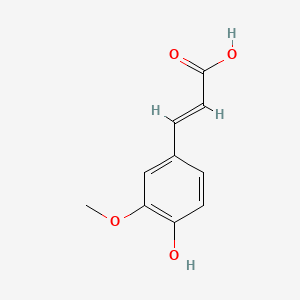
CAS 1135-24-6PubChem CID 445858
Ferulic Acid
Ferulic acid is a member of the class of ferulic acids that is cinnamic acid substituted by a methoxy and a hydroxy group at positions 3 and 4 of the phenyl ring. It has a role as an antioxidant, a neuroprotective agent and a plant metabolite. — ChEBI
- IUPAC name
- (E)-3-(4-hydroxy-3-methoxyphenyl)prop-2-enoic acid
- Molecular formula
- C10H10O4
- Molecular weight
- 194.18 g/mol
- Exact mass
- 194.05790880 Da
- XLogP3
- 1.5
- Topological polar surface area
- 66.8 Ų
- Hydrogen-bond donors
- 2
- Hydrogen-bond acceptors
- 4
- Covalent units
- 1
- Defined stereocentres
- 0
Also known as
4-Hydroxy-3-methoxycinnamic acid3-(4-Hydroxy-3-methoxyphenyl)acrylic acidConiferic acid3-(4-Hydroxy-3-methoxyphenyl)-2-propenoic acid3-methoxy-4-hydroxycinnamic acid2-Propenoic acid, 3-(4-hydroxy-3-methoxyphenyl)-AVM951ZWSTNSC-2821
16 more reported names
NSC-51986NSC-674320CHEBI:17620ferulic acid, (E)-RefChem:5829ferulic acid, monosodium salt214-490-0805-535-0trans-Ferulic Acid537-98-4(E)-Ferulic acidtrans-4-Hydroxy-3-methoxycinnamic acid(2E)-3-(4-hydroxy-3-methoxyphenyl)prop-2-enoic acid(E)-3-(4-hydroxy-3-methoxyphenyl)acrylic acidferulaic acidFerulic acid, trans-
External database identifiers
- ChEBI:CHEBI:17620
- ChEBI:CHEBI:193350
- ChEMBL:CHEMBL32749
- EPA DTXSID:DTXSID70892035
- PubMed:24358168
- PubMed:23800587
- PubMed:21763500
- PubMed:18952420
- PubMed:15229801
- PubMed:12076751
- PubMed:9561563
Evidence from additional scientific databases
NIH PubChem PUG-View
Exact identifier match445858
Attributed physical-property, hazard, environmental and use annotations.
- Dissociation Constants: pKa = 4.58 Source: Hazardous Substances Data Bank (HSDB)
- LogP: log Kow = 1.51 Source: Hazardous Substances Data Bank (HSDB)
- LogP: 1.51 Source: Human Metabolome Database (HMDB)
- Melting Point: 168 - 171 °C Source: Human Metabolome Database (HMDB)
- Physical Description: cis-Form is a yellow liquid; trans-Form is a solid; [Merck Index] trans-Isomer: Tan powder; [Alfa Aesar MSDS] Source: Haz-Map, Information on Hazardous Chemicals and Occupational Diseases
- Physical Description: Tan powder; [Alfa Aesar MSDS] Source: Haz-Map, Information on Hazardous Chemicals and Occupational Diseases
- Physical Description: Solid Source: Human Metabolome Database (HMDB)
- Vapor Pressure: 0.00000269 [mmHg] Source: Haz-Map, Information on Hazardous Chemicals and Occupational Diseases
- Note: This chemical does not meet GHS hazard criteria for 2.4% (8 of 329) of reports. Source: European Chemicals Agency (ECHA)
- Signal: Warning Source: European Chemicals Agency (ECHA)
- GHS Hazard Statements: H315 (97.6%): Causes skin irritation [Warning Skin corrosion/irritation]; H319 (97.6%): Causes serious eye irritation [Warning Serious eye damage/eye irritation]; H335 (97.6%): May cause respiratory irritation [Warning Specific target organ toxicity, single exposure; Respiratory tract irritation] Source: European Chemicals Agency (ECHA)
- Precautionary Statement Codes: P261, P264, P264+P265, P271, P280, P302+P352, P304+P340, P305+P351+P338, P319, P321, P332+P317, P337+P317, P362+P364, P403+P233, P405, and P501 (click each P-code to see the statement) Source: European Chemicals Agency (ECHA)
- ECHA C&L Notifications Summary: Aggregated GHS information provided per 329 reports by companies from 8 notifications to the ECHA C&L Inventory. Each notification may be associated with multiple companies.; Reported as not meeting GHS hazard criteria per 8 of 329 reports by companies.; There are 7 notifications provided by 321 of 329 reports by companies with hazard statement code(s).; Information may vary between notifications depending on impurities, additives, and other factors. The percentage value in parenthesis indicates the notified classification ratio from companies that provide hazard codes. Only hazard codes with percentage values above 10% are shown. For more detailed information, please visit ECHA C&L website. Source: European Chemicals Agency (ECHA)
- Note: This chemical does not meet GHS hazard criteria for 1% (1 of 105) of reports. Source: European Chemicals Agency (ECHA)
- GHS Hazard Statements: H315 (99%): Causes skin irritation [Warning Skin corrosion/irritation]; H319 (99%): Causes serious eye irritation [Warning Serious eye damage/eye irritation]; H335 (98.1%): May cause respiratory irritation [Warning Specific target organ toxicity, single exposure; Respiratory tract irritation] Source: European Chemicals Agency (ECHA)
- ECHA C&L Notifications Summary: Aggregated GHS information provided per 105 reports by companies from 10 notifications to the ECHA C&L Inventory. Each notification may be associated with multiple companies.; Reported as not meeting GHS hazard criteria per 1 of 105 reports by companies.; There are 9 notifications provided by 104 of 105 reports by companies with hazard statement code(s).; Information may vary between notifications depending on impurities, additives, and other factors. The percentage value in parenthesis indicates the notified classification ratio from companies that provide hazard codes. Only hazard codes with percentage values above 10% are shown. For more detailed information, please visit ECHA C&L website. Source: European Chemicals Agency (ECHA)
- GHS Hazard Statements: H317 (100%): May cause an allergic skin reaction [Warning Sensitization, Skin] Source: European Chemicals Agency (ECHA)
- Precautionary Statement Codes: P261, P272, P280, P302+P352, P321, P333+P317, P362+P364, and P501 (click each P-code to see the statement) Source: European Chemicals Agency (ECHA)
- ECHA C&L Notifications Summary: The GHS information provided by 1 company from 1 notification to the ECHA C&L Inventory. Source: European Chemicals Agency (ECHA)
- Environmental Bioconcentration: An estimated BCF of 3.2 was calculated in fish for ferulic acid, using a measured log Kow of 1.51 (1) and a regression-derived equation (2). According to a classification scheme(3), this BCF suggests the potential for bioconcentration in aquatic organism is low(SRC), provided the compound is not metabolized by the organism(SRC). Source: Hazardous Substances Data Bank (HSDB)
- Environmental Fate: TERRESTRIAL FATE: Based on a classification scheme(1), an estimated Koc value of 57(SRC), determined from a log Kow of 1.51(2) and a regression-derived equation(3), indicates that ferulic acid is expected to have high mobility in soil(SRC). The pKa of ferulic acid is 4.58(4), indicating that this compound will almost entirely exist in the anion form. In the environment, anions generally do not adsorb more strongly to soils containing organic carbon and clay than their neutral counterparts(5). Volatilization of ferulic acid from moist soil surfaces is not expected to be an important fate process(SRC) given the anionic nature of ferulic acid in the environment. Ferulic acid is not expected to volatilize from dry soil surfaces(SRC) based upon an estimated vapor pressure of 2.7X10⁻⁶ mm Hg(SRC), determined from a fragment constant method(6). Under neutral and acidic conditions in soil, ferulic acid is expected to undergo rapid aerobic biodegradation(7)(8). Under alkaline conditions in soil, ferulic acid is not expected to undergo rapid aerobic biodegradation(8). Source: Hazardous Substances Data Bank (HSDB)
- Environmental Fate: AQUATIC FATE: Based on a classification scheme(1), an estimated Koc value of 57(SRC), determined from a log Kow of 1.51(2) and a regression-derived equation(3), indicates that ferulic acid is not expected to adsorb to suspended solids and sediment(SRC). A pKa of 4.58(4) indicates ferulic acid will exist almost entirely in the anion form at pH values of 5 to 9, and therefore volatilization from water surfaces/moist soil is not expected to be an important fate process(5). According to a classification scheme(6), an estimated BCF of 3.2(SRC), from its log Kow of 1.51(2) and a regression-derived equation(7), suggests the potential for bioconcentration in aquatic organisms is low(SRC). Ferulic acid is expected to biodegrade rapidly in water under anaerobic conditions(8). Source: Hazardous Substances Data Bank (HSDB)
- Environmental Fate: ATMOSPHERIC FATE: According to a model of gas/particle partitioning of semivolatile organic compounds in the atmosphere(1), ferulic acid, which has a an estimated vapor pressure of 2.7X10⁻⁶ mm Hg at 25 °C(SRC), determined from a fragment constant method(2), will exist in both the vapor and particulate phases. Vapor-phase ferulic acid is degraded in the atmosphere by reaction with photochemically-produced hydroxyl radicals(SRC); the half-life for this reaction in air is estimated to be 8 hours(SRC), calculated from its rate constant of 4.8X10⁻¹¹ cu cm/molecule-sec at 25 °C(SRC), derived using a structure estimation method(3). Particulate-phase ferulic acid may be removed from the air by wet or dry deposition(SRC). Ferulic acid contains a chromophore that absorbs light at wavelengths >290 nm(4) and therefore may be susceptible to direct photolysis by sunlight(SRC). Source: Hazardous Substances Data Bank (HSDB)
- Sources/Uses: Found in small amounts in many plants; Used as a food preservative; [Merck Index] Source: Haz-Map, Information on Hazardous Chemicals and Occupational Diseases
- Sources/Uses: Widely distributed in plants; [Alfa Aesar MSDS] Source: Haz-Map, Information on Hazardous Chemicals and Occupational Diseases
- Uses: Food preservative Source: Hazardous Substances Data Bank (HSDB)
- Uses: /Ferulic acid was one of several compounds identified in/ ... a survey of 624 commercially available supplements targeted towards bodybuilding athletes... Source: Hazardous Substances Data Bank (HSDB)
- Uses: Synthetic Polymer MALDI Matrix Compounds Source: NIST Synthetic Polymer MALDI Recipes Database
Mapped by: Existing checksum-valid CAS to unique PubChem CID match. Retrieved: 2026-08-31. Open source record
Scientific classifications and hazard annotations provide context and do not replace the market-specific regulatory decision shown above.
Additional source coverage and match status
| Source | Result | Checked |
|---|---|---|
| NIH PubChem PUG-View | Exact match | 2026-08-31 |
A recorded no-match is useful evidence that the source was checked; it is not a claim that the substance does not exist elsewhere.
Retrieved from NIH PubChem on 2026-09-02 by checksum-valid CAS matching. Chemical properties do not replace the regulatory decision on this page.
Additional authoritative substance research
Each link searches that source for this identity. A link is a research route, not a claim that the source holds an exact record. What each source is, and its legal weight
Take this record further
Official source and scope
Imported from Commission Implementing Decision (EU) 2025/1175 (dataset version EU 2025/1175). The glossary supplies common ingredient names for the ingredient list required by Article 19(1)(g); it is not an approval or safety list.
Open official Decision