
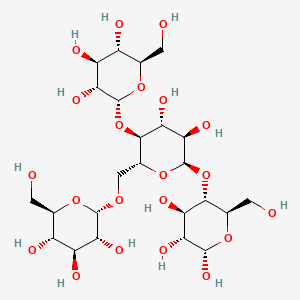
CAS 9005-79-2PubChem CID 439177
Glycogen
Glycogen is a metabolite found in or produced by Escherichia coli (strain K12, MG1655). — E. coli Metabolome Database (ECMDB)
- IUPAC name
- (2S,3R,4S,5S,6R)-2-[[(2R,3S,4R,5R,6R)-4,5-dihydroxy-3-[(2R,3R,4S,5S,6R)-3,4,5-trihydroxy-6-(hydroxymethyl)oxan-2-yl]oxy-6-[(2R,3S,4R,5R,6S)-4,5,6-trihydroxy-2-(hydroxymethyl)oxan-3-yl]oxyoxan-2-yl]methoxy]-6-(hydroxymethyl)oxane-3,4,5-triol
- Molecular formula
- C24H42O21
- Molecular weight
- 666.6 g/mol
- Exact mass
- 666.22185834 Da
- XLogP3
- -8.5
- Topological polar surface area
- 348.0 Ų
- Hydrogen-bond donors
- 14
- Hydrogen-bond acceptors
- 21
- Covalent units
- 1
- Defined stereocentres
- 20
Also known as
PhytoglycogenLyoglycogen232-683-8309GSC92U1CHEBI:28087GlycogenumGlyTouCan:G99991IURefChem:7488
8 more reported names
Glycogen from oysterGLYCOGEN FROM BOVINE LIVERGlycogen, MusselBYSGBSNPRWKUQH-UJDJLXLFSA-NEBC-616033TS-08059alpha-D-Glucopyranosyl-(1->4)-[alpha-D-glucopyranosyl-(1->6)]-alpha-D-glucopyranosyl-(1->4)-alpha-D-glucopyranoseI+/--D-Glucopyranose, O-I+/--D-glucopyranosyl-(1a4)-O-[I+/--D-glucopyranosyl-(1a6)]-O-I+/--D-glucopyranosyl-(1a4)-
External database identifiers
Retrieved from NIH PubChem on 2026-08-31 by checksum-valid CAS matching. Chemical properties do not replace the regulatory decision on this page.