
CAS 90-64-2PubChem CID 1292
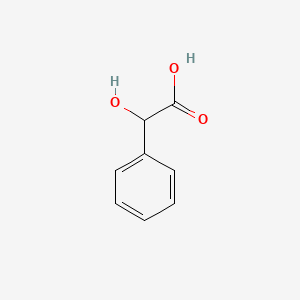
Mandelic Acid
Mandelic acid is a 2-hydroxy monocarboxylic acid that is acetic acid in which two of the methyl hydrogens are substituted by phenyl and hydroxyl groups. It has a role as an antibacterial agent and a human xenobiotic metabolite. It is a member of benzenes and a 2-hydroxy monocarboxylic acid. It is functionally related to an acetic acid. It is a conjugate acid of a mandelate. — ChEBI
- IUPAC name
- 2-hydroxy-2-phenylacetic acid
- Molecular formula
- C8H8O3
- Molecular weight
- 152.15 g/mol
- Exact mass
- 152.047344113 Da
- XLogP3
- 0.6
- Topological polar surface area
- 57.5 Ų
- Hydrogen-bond donors
- 2
- Hydrogen-bond acceptors
- 3
- Covalent units
- 1
- Defined stereocentres
- 0
Also known as
dl-Mandelic acidPhenylglycolic acidParamandelic acidAmygdalic acidUromalineRacemic mandelic acidPhenylhydroxyacetic acid(RS)-Mandelic acid
16 more reported names
alpha-Hydroxyphenylacetic acidAcido mandelicoKyselina mandlovaBenzeneacetic acid, alpha-hydroxy-alpha-Hydroxybenzeneacetic acidNSC-7925NH496X0UJXCHEBI:35825RefChem:5982202-007-6611-72-3Almond acid2-Phenylglycolic acidp-Mandelic acidHydroxy(phenyl)acetic acid(+/-)-alpha-Hydroxyphenylacetic acid
External database identifiers
- ChEBI:CHEBI:35825
- ChEMBL:CHEMBL1609
- EPA DTXSID:DTXSID6023234
- PubMed:23035445
- PubMed:22996609
- PubMed:22953206
- PubMed:22807393
- PubMed:22788361
- PubMed:22750350
- PubMed:22731931
- PubMed:22615547
- PubMed:22595994
- PubMed:22591993
- PubMed:22586240
- PubMed:22554263
Retrieved from NIH PubChem on 2026-09-02 by checksum-valid CAS matching. Chemical properties do not replace the regulatory decision on this page.