
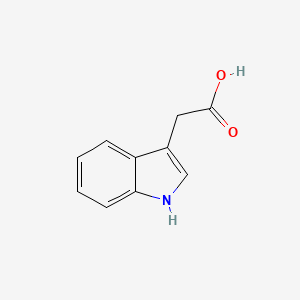
CAS 87-51-4PubChem CID 802
Indole-3-Acetic Acid
Indole-3-acetic acid is a monocarboxylic acid that is acetic acid in which one of the methyl hydrogens has been replaced by a 1H-indol-3-yl group. It has a role as an auxin, a plant hormone, a mouse metabolite, a plant metabolite and a human metabolite. It is a member of indole-3-acetic acids and a monocarboxylic acid. It is a conjugate acid of an indole-3-acetate. — ChEBI
- IUPAC name
- 2-(1H-indol-3-yl)acetic acid
- Molecular formula
- C10H9NO2
- Molecular weight
- 175.18 g/mol
- Exact mass
- 175.063328530 Da
- XLogP3
- 1.4
- Topological polar surface area
- 53.1 Ų
- Hydrogen-bond donors
- 2
- Hydrogen-bond acceptors
- 2
- Covalent units
- 1
- Defined stereocentres
- 0
Also known as
3-Indoleacetic acidindoleacetic acidHeteroauxin1H-Indole-3-acetic acid1H-indol-3-ylacetic acidRhizopinRhizopon A3-Indolylacetic acid
16 more reported names
3-Iaa3-(Carboxymethyl)indolebeta-Indoleacetic acidbeta-Indolylacetic acidIndolyl-3-acetic acidindole acetic acidKyselina 3-indolyloctova2-(indol-3-yl)ethanoic acid(indol-3-yl)acetic acidNSC-37876U1S09C61LCHEBI:16411IES cpdRefChem:790975201-748-2Indol-3-ylacetic acid
External database identifiers
- ChEBI:CHEBI:16411
- ChEMBL:CHEMBL82411
- EPA DTXSID:DTXSID5020738
- PubMed:40947077
- PubMed:38555004
- PubMed:30639138
- PubMed:30324315
- PubMed:29968805
- PubMed:24467709
- PubMed:23087694
- PubMed:23077481
- PubMed:23074908
- PubMed:23016493
- PubMed:22992509
- PubMed:22989740
Retrieved from NIH PubChem on 2026-08-31 by checksum-valid CAS matching. Chemical properties do not replace the regulatory decision on this page.