
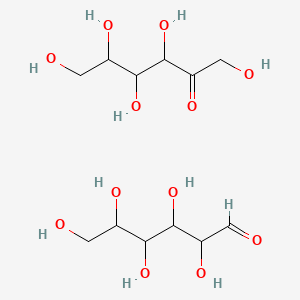
CAS 8013-17-0PubChem CID 21924868
Invert Sugar
Invert sugar is obtained from sugar cane when this is treated with dilute acid or with the invertase enzyme. It is formed by an equal amount of glucose and fructose. It differentiates from sugar cane in the rotation of the polarized light, which in the case of invert sugar it is to the left (levorotatory). Invert sugar is FDA approved since 1988 as a safe substance (GRAS). — DrugBank
- IUPAC name
- 2,3,4,5,6-pentahydroxyhexanal;1,3,4,5,6-pentahydroxyhexan-2-one
- Molecular formula
- C12H24O12
- Molecular weight
- 360.31 g/mol
- Exact mass
- 360.12677620 Da
- Topological polar surface area
- 236.0 Ų
- Hydrogen-bond donors
- 10
- Hydrogen-bond acceptors
- 12
- Covalent units
- 2
- Defined stereocentres
- 0
Also known as
InvertoseHS 500Corn invert sugarMaize Inver SugarMaize invert sugarCorn invert sugar syrupRefChem:884303232-393-1
16 more reported names
C0171CaloroseED959S6ACYInsubetaInverdexInvertogenNulomolineSugar, InvertTravertTravert 10% in plastic containerInvertose ,Saccharide hydrolysatesugar invertSugar,invertPJVXUVWGSCCGHT-UHFFFAOYSA-NHMS5087I04
Retrieved from NIH PubChem on 2026-08-31 by checksum-valid CAS matching. Chemical properties do not replace the regulatory decision on this page.