
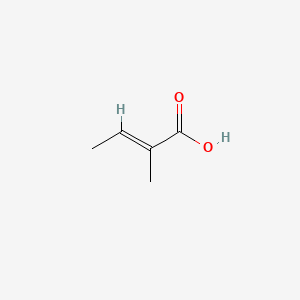
CAS 80-59-1PubChem CID 125468
Tiglic acid
Tiglic acid, [corrosive solid] appears as a white lustrous flaked solid with a fruity or spicy odor. About the same density as water and slightly soluble in water. May burn if heated to high temperatures. May severely irritate skin, eyes, lungs or mucous membranes. — CAMEO Chemicals
- IUPAC name
- (E)-2-methylbut-2-enoic acid
- Molecular formula
- C5H8O2
- Molecular weight
- 100.12 g/mol
- Exact mass
- 100.052429494 Da
- XLogP3
- 1.0
- Topological polar surface area
- 37.3 Ų
- Hydrogen-bond donors
- 1
- Hydrogen-bond acceptors
- 2
- Covalent units
- 1
- Defined stereocentres
- 0
Also known as
Tiglinic acidtrans-2,3-Dimethylacrylic acidtrans-2-Methyl-2-butenoic acidtrans-2-Methylcrotonic acid(E)-2,3-Dimethylacrylic acid(E)-2-Methyl-2-butenoic acid(E)-2-Methylcrotonic acid2-Butenoic acid, 2-methyl-, (2E)-
16 more reported names
Crotonic acid, 2-methyl-, (E)-2-Butenoic acid, 2-methyl-, (E)-2,3-Dimethylacrylic acid, (E)-FEMA No. 3599trans-alpha,beta-Dimethylacrylic acid2-methyl-2E-butenoic acidI5792N03HCNSC-8999NSC-44235CHEBI:9592RefChem:25822(e)-alpha-methylcrotonic acid201-295-0Cevadic acid2-Methyl-2-butenoic acid2-methylbut-2-enoic acid
External database identifiers
- ChEBI:CHEBI:36432
- ChEBI:CHEBI:9592
- ChEMBL:CHEMBL52416
- EPA DTXSID:DTXSID80883257
- PubMed:21220428
Retrieved from NIH PubChem on 2026-08-31 by checksum-valid CAS matching. Chemical properties do not replace the regulatory decision on this page.