
CAS 79-20-9PubChem CID 6584
Methyl Acetate
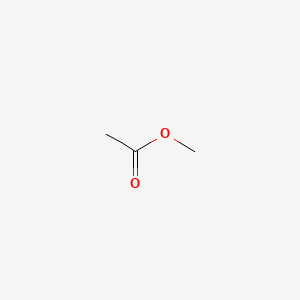
Methyl acetate is an acetate ester resulting from the formal condensation of acetic acid with methanol. A low-boiling (57 C) colourless, flammable liquid, it is used as a solvent for many resins and oils. It has a role as a fragrance, a polar aprotic solvent and an EC 3.4.19.3 (pyroglutamyl-peptidase I) inhibitor. It is a volatile organic compound, a methyl ester and an acetate ester. — ChEBI
- IUPAC name
- methyl acetate
- Molecular formula
- C3H6O2
- Molecular weight
- 74.08 g/mol
- Exact mass
- 74.036779430 Da
- XLogP3
- 0.2
- Topological polar surface area
- 26.3 Ų
- Hydrogen-bond donors
- 0
- Hydrogen-bond acceptors
- 2
- Covalent units
- 1
- Defined stereocentres
- 0
Also known as
DevotonTeretonMethyl ethanoateAcetic acid, methyl esterAcetic acid methyl esterMethylacetatMethylacetaatAcetate de methyle
16 more reported names
Methyl acetic esterOctan metyluMetile (acetato di)Methyle (acetate de)Methylester kiseliny octoveEthyl ester of monoacetic acidFEMA No. 2676Methyl ester of acetic acidW684QT396FNSC-405071CHEBI:77700RefChem:157767201-185-2HSDB 95Methylacetat [German]CH3COOCH3
External database identifiers
- ChEBI:CHEBI:77700
- ChEMBL:CHEMBL14079
- EPA DTXSID:DTXSID4021767
- PubMed:33358762
- PubMed:22984940
- PubMed:22944406
- PubMed:22869894
- PubMed:22851350
- PubMed:22719606
- PubMed:22666671
- PubMed:22666186
- PubMed:22662198
- PubMed:22649938
- PubMed:22618813
- PubMed:22611358
Retrieved from NIH PubChem on 2026-08-31 by checksum-valid CAS matching. Chemical properties do not replace the regulatory decision on this page.