
CAS 65-86-1PubChem CID 967
Orotic Acid
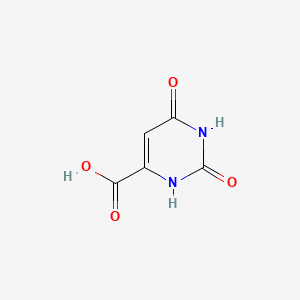
Orotic acid is a pyrimidinemonocarboxylic acid that is uracil bearing a carboxy substituent at position C-6. It has a role as a metabolite, a mouse metabolite and an Escherichia coli metabolite. It is functionally related to a uracil. It is a conjugate acid of an orotate. — ChEBI
- IUPAC name
- 2,4-dioxo-1H-pyrimidine-6-carboxylic acid
- Molecular formula
- C5H4N2O4
- Molecular weight
- 156.10 g/mol
- Exact mass
- 156.01710661 Da
- XLogP3
- -1.4
- Topological polar surface area
- 95.5 Ų
- Hydrogen-bond donors
- 3
- Hydrogen-bond acceptors
- 4
- Covalent units
- 1
- Defined stereocentres
- 0
Also known as
6-CarboxyuracilOropurOrodinOrotylVitamin B13OrotoninWhey factorOrotonsan
16 more reported names
Animal galactose factorUracil-6-carboxylic acid6-Uracilcarboxylic acidMolkensaeureOrotsaeureAcido oroticoUracil-6-carbosaeureAcide orotique2,6-Dihydroxy-4-pyrimidinecarboxylic acid4-Pyrimidinecarboxylic acid, 1,2,3,6-tetrahydro-2,6-dioxo-Acidum oroticum1,2,3,6-tetrahydro-2,6-dioxo-4-Pyrimidinecarboxylic acidAcidum oroticum [Latin]1,2,3,6-Tetrahydro-2,6-dioxo-4-pyrimidecarboxylic acidAI3-25478Orotsaure
External database identifiers
- ChEBI:CHEBI:16742
- ChEMBL:CHEMBL1235017
- EPA DTXSID:DTXSID0025814
- PubMed:22980203
- PubMed:22955356
- PubMed:22863860
- PubMed:22707164
- PubMed:22701608
- PubMed:22692683
- PubMed:22679441
- PubMed:22649640
- PubMed:22642083
- PubMed:22634191
- PubMed:22629805
- PubMed:22611376
Retrieved from NIH PubChem on 2026-08-31 by checksum-valid CAS matching. Chemical properties do not replace the regulatory decision on this page.