
CAS 629-70-9PubChem CID 12393
Cetyl Acetate
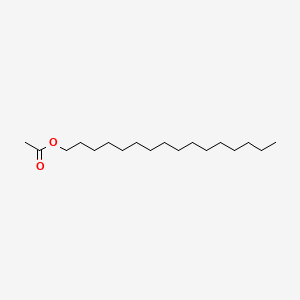
Palmityl acetate is an acetate ester derived from hexadecan-1-ol (palmityl alcohol); used as an emollient, masking agent and skin conditioner; pheromone constituent present in various species of mouse, arachnid and insect. It has a role as a pheromone, an epitope and a cosmetic. It is functionally related to a hexadecan-1-ol. — ChEBI
- IUPAC name
- hexadecyl acetate
- Molecular formula
- C18H36O2
- Molecular weight
- 284.5 g/mol
- Exact mass
- 284.271530387 Da
- XLogP3
- 7.7
- Topological polar surface area
- 26.3 Ų
- Hydrogen-bond donors
- 0
- Hydrogen-bond acceptors
- 2
- Covalent units
- 1
- Defined stereocentres
- 0
Also known as
Palmityl acetate1-Hexadecanol, acetate1-Acetoxyhexadecanen-Hexadecyl ethanoateHexadecanol acetateAcetic acid, hexadecyl esterENT 1025NSC 8492
16 more reported names
1-Hexadecanol, 1-acetateEINECS 211-103-7AI3-01025NSC-8492BRN 1782695PELEMOL CACHEBI:1461854Q43814HXS4-02-00-00171 (Beilstein Handbook Reference)1AcetoxyhexadecanenHexadecyl ethanoate1Hexadecanol, acetate1Hexadecanol, 1acetateRefChem:575375CETYL ACETATE [INCI]211-103-7
External database identifiers
- ChEBI:CHEBI:146185
- ChEMBL:CHEMBL137354
- EPA DTXSID:DTXSID2052312
- PubMed:24234526
- PubMed:21573864
- PubMed:20334597
- PubMed:19579045
- PubMed:19257880
- PubMed:18657559
- PubMed:18648495
- PubMed:18515819
- PubMed:17251176
- PubMed:16249880
- PubMed:11504036
- PubMed:11504024
Retrieved from NIH PubChem on 2026-08-31 by checksum-valid CAS matching. Chemical properties do not replace the regulatory decision on this page.