
CAS 623-05-2PubChem CID 125
4-Hydroxybenzyl Alcohol
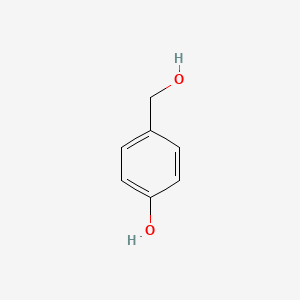
P-hydroxybenzyl alcohol is a member of the class of benzyl alcohols that is benzyl alcohol substituted by a hydroxy group at position 4. It has been isolated from Arcangelisia gusanlung. It has a role as a plant metabolite. It is a member of benzyl alcohols and a member of phenols. — ChEBI
- IUPAC name
- 4-(hydroxymethyl)phenol
- Molecular formula
- C7H8O2
- Molecular weight
- 124.14 g/mol
- Exact mass
- 124.052429494 Da
- XLogP3
- 0.2
- Topological polar surface area
- 40.5 Ų
- Hydrogen-bond donors
- 2
- Hydrogen-bond acceptors
- 2
- Covalent units
- 1
- Defined stereocentres
- 0
Also known as
p-Hydroxybenzyl alcoholp-Methylolphenol4-Hydroxybenzenemethanol4-MethylolphenolBenzenemethanol, 4-hydroxy-p-(Hydroxymethyl)phenolGastrodigeninalpha-Hydroxy-p-cresol
16 more reported names
Parahydroxybenzyl Alcohol(4-Hydroxyphenyl)methanol1A3AH1FP1Bhydroxybenzyl alcoholNSC-227926FEMA NO. 3987CHEBI:674104-methylol phenolRefChem:524010CHEBI:24679210-768-04-HydroxybenzylalcoholBenzyl alcohol, p-hydroxy-p-hydroxy benzyl alcohol.alpha.-Hydroxy-p-cresolEINECS 210-768-0
External database identifiers
- ChEBI:CHEBI:67410
- ChEMBL:CHEMBL202132
- EPA DTXSID:DTXSID8073920
- PubMed:30273962
- PubMed:22470321
- PubMed:22257859
- PubMed:22155394
- PubMed:21995752
- PubMed:21966246
- PubMed:21886599
- PubMed:21886556
- PubMed:21765922
- PubMed:21765637
- PubMed:21740583
- PubMed:21582945
Retrieved from NIH PubChem on 2026-08-31 by checksum-valid CAS matching. Chemical properties do not replace the regulatory decision on this page.