
CAS 611-59-6PubChem CID 4687
Paraxanthine
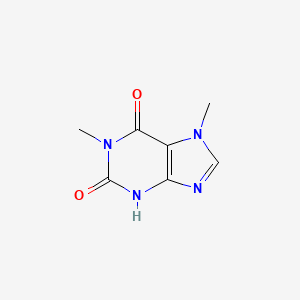
1,7-dimethylxanthine is a dimethylxanthine having the two methyl groups located at positions 1 and 7. It is a metabolite of caffeine and theobromine in animals. It has a role as a central nervous system stimulant, a mouse metabolite, a human xenobiotic metabolite and a human blood serum metabolite. — ChEBI
- IUPAC name
- 1,7-dimethyl-3H-purine-2,6-dione
- Molecular formula
- C7H8N4O2
- Molecular weight
- 180.16 g/mol
- Exact mass
- 180.06472551 Da
- XLogP3
- -0.2
- Topological polar surface area
- 67.2 Ų
- Hydrogen-bond donors
- 1
- Hydrogen-bond acceptors
- 3
- Covalent units
- 1
- Defined stereocentres
- 0
Also known as
1,7-Dimethylxanthinep-Xanthine1H-Purine-2,6-dione, 3,7-dihydro-1,7-dimethyl-1,7-dimethyl-2,3,6,7-tetrahydro-1H-purine-2,6-dione1,7-Dimethyl-3,7-dihydro-1H-purine-2,6-dioneNSC-400018Q3565Y41V7CHEBI:25858
16 more reported names
RefChem:417792210-271-91,7-Dimethyl-1H-purine-2,6(3H,7H)-dione3,7-Dihydro-1,7-dimethyl-1H-purine-2,6-dioneXanthine, 1,7-dimethyl-Caffeine Impurity FCaffeine EP Impurity F1,7-dimethyl-XanthineCHEMBL1158EINECS 210-271-9NSC 400018BRN 0197907UNII-Q3565Y41V7PXT1,7-Dimethyl-1H-purine-2,6-dioneParaxanthine(72%)
External database identifiers
- ChEBI:CHEBI:25858
- ChEMBL:CHEMBL1158
- EPA DTXSID:DTXSID2052281
- PubMed:31132250
- PubMed:22941669
- PubMed:22751681
- PubMed:22701600
- PubMed:22563483
- PubMed:22554278
- PubMed:22483397
- PubMed:22423996
- PubMed:22420682
- PubMed:22348079
- PubMed:22235437
- PubMed:22189672
Retrieved from NIH PubChem on 2026-08-31 by checksum-valid CAS matching. Chemical properties do not replace the regulatory decision on this page.