
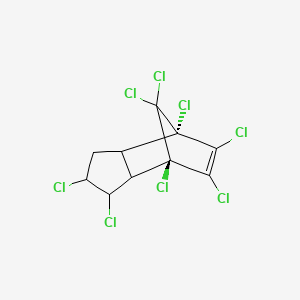
Chlordane
Chlordane is a manufactured chemical that was used as a pesticide in the United States from 1948 to 1988. Technical chlordane is not a single chemical, but is actually a mixture of pure chlordane mixed with many related chemicals. It doesn't occur naturally in the environment. It is a thick liquid whose color ranges from colorless to amber. Chlordane has a mild, irritating smell. Some of its trade names are Octachlor and Velsicol 1068. Until 1983, chlordane was used as a pesticide on crops like corn and citrus and on home lawns and gardens. Because of concern about damage to the environment and harm to human health, the Environmental Protection Agency (EPA) banned all uses of chlordane in 1983 except to control termites. In 1988, EPA banned all uses. — Agency for Toxic Substances and Disease Registry (ATSDR)
- IUPAC name
- (1R,7S)-1,3,4,7,8,9,10,10-octachlorotricyclo[5.2.1.02,6]dec-8-ene
- Molecular formula
- C10H6Cl8
- Molecular weight
- 409.8 g/mol
- Exact mass
- 409.791872 Da
- XLogP3
- 4.9
- Topological polar surface area
- 0.0 Ų
- Hydrogen-bond donors
- 0
- Hydrogen-bond acceptors
- 0
- Covalent units
- 1
- Defined stereocentres
- 2
Also known as
16 more reported names
Retrieved from NIH PubChem on 2026-09-02 by checksum-valid CAS matching. Chemical properties do not replace the regulatory decision on this page.