
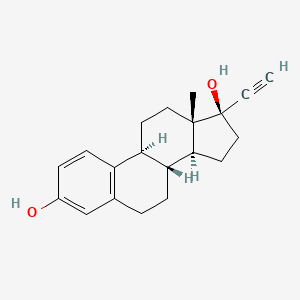
CAS 57-63-6PubChem CID 5991
Ethinylestradiol
17alpha-ethynylestradiol is a 3-hydroxy steroid that is estradiol substituted by a ethynyl group at position 17. It is a xenoestrogen synthesized from estradiol and has been shown to exhibit high estrogenic potency on oral administration. It has a role as a xenoestrogen. It is a 3-hydroxy steroid, a 17-hydroxy steroid and a terminal acetylenic compound. It is functionally related to a 17beta-estradiol and an estradiol. — ChEBI
- IUPAC name
- (8R,9S,13S,14S,17R)-17-ethynyl-13-methyl-7,8,9,11,12,14,15,16-octahydro-6H-cyclopenta[a]phenanthrene-3,17-diol
- Molecular formula
- C20H24O2
- Molecular weight
- 296.4 g/mol
- Exact mass
- 296.177630004 Da
- XLogP3
- 3.7
- Topological polar surface area
- 40.5 Ų
- Hydrogen-bond donors
- 2
- Hydrogen-bond acceptors
- 2
- Covalent units
- 1
- Defined stereocentres
- 5
Also known as
ethinyl estradiolEthynylestradiolEthynyl estradiolEthinyloestradiolEstinyl17-EthinylestradiolGinestreneLynoral
16 more reported names
17alpha-EthynylestradiolProgynon CEtinoestrylAmenoronDyloformEstigynEthidolEticyclinEticyclolEtinestrolFeminoneInestraLinoralMenolynNovestrolOradiol
External database identifiers
Retrieved from NIH PubChem on 2026-09-02 by checksum-valid CAS matching. Chemical properties do not replace the regulatory decision on this page.