
CAS 53-43-0PubChem CID 5881
Dehydroepiandrosterone
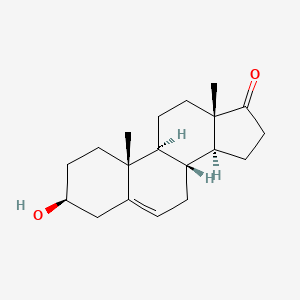
Dehydroepiandrosterone is an androstanoid that is androst-5-ene substituted by a beta-hydroxy group at position 3 and an oxo group at position 17. It is a naturally occurring steroid hormone produced by the adrenal glands. It has a role as an androgen, a mouse metabolite and a human metabolite. It is a 3beta-hydroxy-Delta(5)-steroid, a 17-oxo steroid and an androstanoid. — ChEBI
- IUPAC name
- (3S,8R,9S,10R,13S,14S)-3-hydroxy-10,13-dimethyl-1,2,3,4,7,8,9,11,12,14,15,16-dodecahydrocyclopenta[a]phenanthren-17-one
- Molecular formula
- C19H28O2
- Molecular weight
- 288.4 g/mol
- Exact mass
- 288.208930132 Da
- XLogP3
- 3.2
- Topological polar surface area
- 37.3 Ų
- Hydrogen-bond donors
- 1
- Hydrogen-bond acceptors
- 2
- Covalent units
- 1
- Defined stereocentres
- 6
Also known as
DHEAPRASTERONEDehydroisoandrosteroneAndrostenoloneDiandron3beta-hydroxyandrost-5-en-17-one17-HormoforinIntrarosa
16 more reported names
Prasterona3-beta-Hydroxy-5-androsten-17-onePrasteronumVaginorm5,6-DehydroisoandrosteroneBiolaifEM-760NSC-9896Androst-5-en-17-one, 3-hydroxy-, (3beta)-NSC9896459AG36T1BCHEBI:28689FidelinPrasteraNatrol dheaEnzymatic therapy
External database identifiers
- ChEBI:CHEBI:28689
- ChEMBL:CHEMBL90593
- EPA DTXSID:DTXSID4020379
- PubMed:23105433
- PubMed:23087149
- PubMed:23021477
- PubMed:23001207
- PubMed:22991188
- PubMed:22985672
- PubMed:22975513
- PubMed:22951290
- PubMed:22936264
- PubMed:22916165
- PubMed:22912365
- PubMed:22905785
Retrieved from NIH PubChem on 2026-09-02 by checksum-valid CAS matching. Chemical properties do not replace the regulatory decision on this page.