
CAS 516-06-3PubChem CID 1182
DL-valine
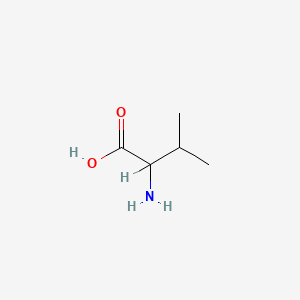
Valine is a branched-chain amino acid that consists of glycine in which one of the hydrogens attached to the alpha-carbon is substituted by an isopropyl group. It has a role as a plant metabolite and a Daphnia magna metabolite. It is a branched-chain amino acid and an alpha-amino acid. It contains an isopropyl group. It is a conjugate base of a valinium. It is a conjugate acid of a valinate. — ChEBI
- IUPAC name
- 2-amino-3-methylbutanoic acid
- Molecular formula
- C5H11NO2
- Molecular weight
- 117.15 g/mol
- Exact mass
- 117.078978594 Da
- XLogP3
- -2.3
- Topological polar surface area
- 63.3 Ų
- Hydrogen-bond donors
- 2
- Hydrogen-bond acceptors
- 3
- Covalent units
- 1
- Defined stereocentres
- 0
Also known as
Valine, DL-FEMA No. 3444D,L-VALINENSC 9755CCRIS 86044CA13A832HNSC-9755EINECS 208-220-0
16 more reported names
D,L-VALINE [FHFI]AI3-18308Valine, DLRefChem:5899872Aminoisovaleric acid, DLalphaAminoisovaleric acid, DL2Amino3methylbutyric acid, DL2Amino3methylbutanoic acid, DL208-220-02-Amino-3-methylbutanoic acid (VAN)H-DL-Val-OH2-Amino-3-methylbutanoic acid, DL-DL-.alpha.-Aminoisovaleric acidHY-W012889(+/-)-2-AMINOISOVALERIC ACIDAS-11670
External database identifiers
- ChEBI:CHEBI:27266
- ChEMBL:CHEMBL11257
- EPA DTXSID:DTXSID70859522
- PubMed:22441188
- PubMed:22408663
- PubMed:22393298
- PubMed:22369691
- PubMed:22331998
- PubMed:22327513
- PubMed:22306479
- PubMed:22216094
- PubMed:22199582
- PubMed:22137999
- PubMed:22065415
- PubMed:22048449
Retrieved from NIH PubChem on 2026-08-31 by checksum-valid CAS matching. Chemical properties do not replace the regulatory decision on this page.