
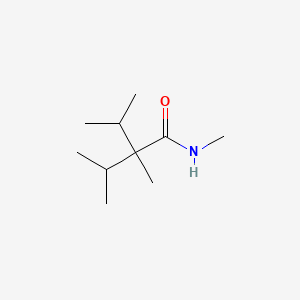
CAS 51115-67-4PubChem CID 65300
Methyl diisopropyl propionamide
N,2,3-Trimethyl-2-(1-methylethyl)butanamide is a fatty amide. — ChEBI
- IUPAC name
- N,2,3-trimethyl-2-propan-2-ylbutanamide
- Molecular formula
- C10H21NO
- Molecular weight
- 171.28 g/mol
- Exact mass
- 171.162314293 Da
- XLogP3
- 2.5
- Topological polar surface area
- 29.1 Ų
- Hydrogen-bond donors
- 1
- Hydrogen-bond acceptors
- 1
- Covalent units
- 1
- Defined stereocentres
- 0
Also known as
2-Isopropyl-N,2,3-trimethylbutanamide2-Isopropyl-N,2,3-trimethylbutyramideWS-23N,2,3-Trimethyl-2-isopropylbutanamideN,2,3-Trimethyl-2-(1-methylethyl)butanamideTrimethyl isopropyl butanamideButanamide, N,2,3-trimethyl-2-(1-methylethyl)-N,2,3-trimethyl-2-(propan-2-yl)butanamide
16 more reported names
FEMA NO. 38046QOP5A9489WS 23EINECS 256-974-42-ISOPROPYL-N,2,3-TRIMETHYLBUTYRAMIDE [FHFI]TRIMETHYL ISOPROPYL BUTANAMIDE [MI]RefChem:817726METHYL DIISOPROPYL PROPIONAMIDE [INCI]256-974-4N,2,3-Trimethyl-2-isopropylbutamideUNII-6QOP5A9489GTPL2474FEMA 3804CS-0154976n,2,3-trimethyl-2-(1-methylethyl)-butanamide2-isopropyl-N,2,3-trimethyl-butanamide
External database identifiers
- ChEBI:CHEBI:169004
- EPA DTXSID:DTXSID40199124
- PubMed:20112497
- PubMed:14757700
Retrieved from NIH PubChem on 2026-08-31 by checksum-valid CAS matching. Chemical properties do not replace the regulatory decision on this page.