
CAS 479-18-5PubChem CID 3182
Diprophylline
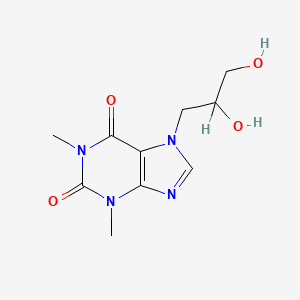
Dyphylline is an oxopurine that is theophylline bearing a 2,3-dihydroxypropyl group at the 7 position. It has broncho- and vasodilator properties, and is used in the treatment of asthma, cardiac dyspnea, and bronchitis. It is also an ingredient in preparations that have been promoted for coughs. It has a role as a bronchodilator agent, a vasodilator agent, an EC 3.1.4.* (phosphoric diester hydrolase) inhibitor and a muscle relaxant. It is an oxopurine and a member of propane-1,2-diols. — ChEBI
- IUPAC name
- 7-(2,3-dihydroxypropyl)-1,3-dimethylpurine-2,6-dione
- Molecular formula
- C10H14N4O4
- Molecular weight
- 254.24 g/mol
- Exact mass
- 254.10150494 Da
- XLogP3
- -1.8
- Topological polar surface area
- 98.9 Ų
- Hydrogen-bond donors
- 2
- Hydrogen-bond acceptors
- 5
- Covalent units
- 1
- Defined stereocentres
- 0
Also known as
dyphylline7-(2,3-Dihydroxypropyl)theophyllineDiphyllineGlyphyllineCorphyllinNeutrafillinaNeutraphyllineNeutroxantina
16 more reported names
ProtheophyllineSynthophyllineGlyfyllinGlyphyllinHyphyllineNeophyllinHidroxiteofillinaAstrophyllinCoronarinHiphyllinNeophyllineNeotilinaNeutrafilPurifilinSilbephyllineSolufilin
External database identifiers
- ChEBI:CHEBI:4728
- ChEMBL:CHEMBL1752
- EPA DTXSID:DTXSID6022975
- PubMed:22662200
- PubMed:22321288
- PubMed:22245221
- PubMed:22113078
- PubMed:22008146
- PubMed:21515350
- PubMed:21042488
- PubMed:20638213
- PubMed:20026047
- PubMed:19778159
- PubMed:19755002
- PubMed:19737588
Retrieved from NIH PubChem on 2026-08-31 by checksum-valid CAS matching. Chemical properties do not replace the regulatory decision on this page.