
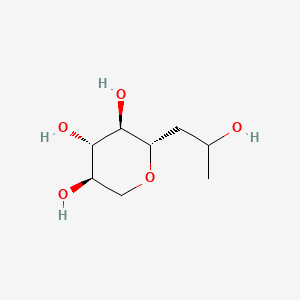
CAS 439685-79-7PubChem CID 16666733
C-beta-D-xylopyranoside-2-hydroxypropane
Hydroxypropyl tetrahydropyrantriol has been used in trials studying the basic science of Aging. — DrugBank
- IUPAC name
- (2S,3R,4S,5R)-2-(2-hydroxypropyl)oxane-3,4,5-triol
- Molecular formula
- C8H16O5
- Molecular weight
- 192.21 g/mol
- Exact mass
- 192.09977361 Da
- XLogP3
- -1.8
- Topological polar surface area
- 90.2 Ų
- Hydrogen-bond donors
- 4
- Hydrogen-bond acceptors
- 5
- Covalent units
- 1
- Defined stereocentres
- 4
Also known as
Hydroxypropyl tetrahydropyrantriolPro-xylane (pharmaceutical)4U3GMG1OT1ER4017ER-4017C-xylosideRefChem:789560Airface BosEin deep wrinkle serum
16 more reported names
Pro-xylaneMexoryl SBB(2S,3R,4S,5R)-2-(2-hydroxypropyl)tetrahydro-2H-pyran-3,4,5-triolC-|A-D-Xylopyranoside-2-hydroxypropaneUNII-4U3GMG1OT1Hydroxypropyl TetrahyclropyantiolL-Gluco-octitol, 1,5-anhydro-6,8-dideoxy-, (7XI)-WLZ2819KOGFZZYPPGQZFZ-QVAPDBTGSA-NAC-37496DA-57170TS-08006HY-108036CS-0027204Pro-xylane (Hydroxypropyl tetrahydropyrantriol)(2S,3R,4S,5R)-2-(2-hydroxypropyl)oxane-3
External database identifiers
- ChEMBL:CHEMBL479843
- EPA DTXSID:DTXSID10196004
Retrieved from NIH PubChem on 2026-08-31 by checksum-valid CAS matching. Chemical properties do not replace the regulatory decision on this page.