
CAS 4362-22-5PubChem CID 97785
1,3-Dioxolane, 2-(1-phenylethyl)-
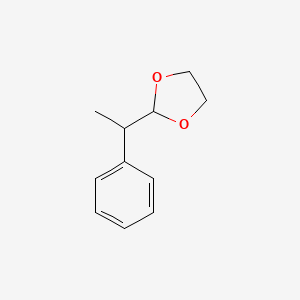
2-(1-phenylethyl)-1,3-dioxolane is a dioxolane that is 1,3-dioxolane substituted by a 1-phenylethyl group at position 2. It has a role as a metabolite. It is a member of benzenes, a dioxolane and a cyclic acetal. It derives from a hydride of a 1,3-dioxolane. — ChEBI
- IUPAC name
- 2-(1-phenylethyl)-1,3-dioxolane
- Molecular formula
- C11H14O2
- Molecular weight
- 178.23 g/mol
- Exact mass
- 178.099379685 Da
- XLogP3
- 2.2
- Topological polar surface area
- 18.5 Ų
- Hydrogen-bond donors
- 0
- Hydrogen-bond acceptors
- 2
- Covalent units
- 1
- Defined stereocentres
- 0
Also known as
2-phenylpropanal ethylene acetalG7I4277EKNEINECS 224-449-9NSC 39437NSC-394371,3-Dioxolane, 2-(alpha-methylbenzyl)-AI3-31829CHEBI:87596
11 more reported names
2-(1-PHENYLETHYL)DIOXOLANERefChem:414877224-449-9UNII-G7I4277EKN1, 2-(1-phenylethyl)-1, 2-(.alpha.-methylbenzyl)-1,1-Ethylenedioxy-2-phenylpropane2-(1-Phenylethyl)-1,3-dioxolane #1,3-Dioxolane, 2-(.alpha.-methylbenzyl)-2-phenyl propionaldehyde ethylene glycol acetal2-PHENYLPROPANAL ETHYLENE GLYCOL ACETAL
External database identifiers
- ChEBI:CHEBI:87596
- EPA DTXSID:DTXSID10863380
Retrieved from NIH PubChem on 2026-08-31 by checksum-valid CAS matching. Chemical properties do not replace the regulatory decision on this page.