
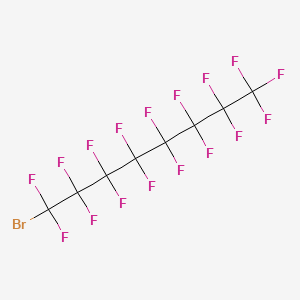
CAS 423-55-2PubChem CID 9873
Perfluorooctyl bromide
Perflubron is a haloalkane that is perfluorooctane in which a fluorine attached to one of the terminal carbons has been replaced by a bromine. It has a role as a radioopaque medium and a blood substitute. It is a perfluorinated compound, a haloalkane and an organobromine compound. It derives from a hydride of an octane. — ChEBI
- IUPAC name
- 1-bromo-1,1,2,2,3,3,4,4,5,5,6,6,7,7,8,8,8-heptadecafluorooctane
- Molecular formula
- C8BrF17
- Molecular weight
- 498.96 g/mol
- Exact mass
- 497.89119 Da
- XLogP3
- 6.9
- Topological polar surface area
- 0.0 Ų
- Hydrogen-bond donors
- 0
- Hydrogen-bond acceptors
- 17
- Covalent units
- 1
- Defined stereocentres
- 0
Also known as
Perflubron1-Bromoperfluorooctane1-BromoheptadecafluorooctanePerfluoroctyl bromidePerfluorooctylbromidePFOBN-perfluorooctyl bromideperfluorocaprylyl bromide
16 more reported names
OCTANE, 1-BROMOHEPTADECAFLUORO-Q1D0Q7R4D9Octane, 1-bromo-1,1,2,2,3,3,4,4,5,5,6,6,7,7,8,8,8-heptadecafluoro-CHEBI:38803perfluoroctylbromideperflubronumperfluorooctyliodideRefChem:57599L-1913V08CX01207-028-4Perfluoro-n-octyl BromideLiquiVentIMAGENTHeptadecafluoro-n-octyl BromideImagent GI
External database identifiers
- ChEBI:CHEBI:38803
- ChEMBL:CHEMBL1200866
- EPA DTXSID:DTXSID5046560
- PubMed:22652356
- PubMed:22575831
- PubMed:22568624
- PubMed:22518190
- PubMed:22506124
- PubMed:22393289
- PubMed:22354241
- PubMed:22114491
- PubMed:22028868
- PubMed:21990342
- PubMed:21953998
- PubMed:21876799
Retrieved from NIH PubChem on 2026-08-31 by checksum-valid CAS matching. Chemical properties do not replace the regulatory decision on this page.