
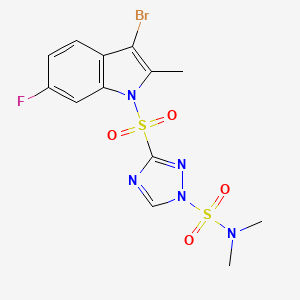
Amisulbrom
Amisulbrom is a member of the class of bromoindoles that is 3-bromo-6-fluoro-2-methylindole substituted at position 1 by a 1-(dimethylsulfamyl)-1,2,4-triazole-3-sulfonyl group. A fungicide for use on potatoes to control late blight (Phytophthora infestans) and downy mildew [Plasmopara viticola). It has a low mammalian toxicity but it is considered to be a reproduction toxicant, is moderately toxic to birds and honey bees but poses a greater risk to aquatic species and earthworms. It has a role as a mitochondrial cytochrome-bc1 complex inhibitor and an antifungal agrochemical. It is a sulfonamide, a member of triazoles, an organofluorine compound, a member of sulfamides, a bromoindole, a sulfonamide fungicide and a triazole fungicide. — ChEBI
- IUPAC name
- 3-(3-bromo-6-fluoro-2-methylindol-1-yl)sulfonyl-N,N-dimethyl-1,2,4-triazole-1-sulfonamide
- Molecular formula
- C13H13BrFN5O4S2
- Molecular weight
- 466.3 g/mol
- Exact mass
- 464.95764 Da
- XLogP3
- 2.4
- Topological polar surface area
- 124.0 Ų
- Hydrogen-bond donors
- 0
- Hydrogen-bond acceptors
- 8
- Covalent units
- 1
- Defined stereocentres
- 0
Also known as
16 more reported names
External database identifiers
- ChEBI:CHEBI:81846
- EPA DTXSID:DTXSID0058063
Retrieved from NIH PubChem on 2026-08-31 by checksum-valid CAS matching. Chemical properties do not replace the regulatory decision on this page.