
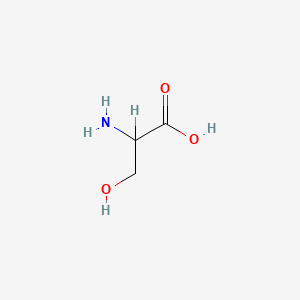
CAS 302-84-1PubChem CID 617
DL-Serine
Serine is an alpha-amino acid that is alanine substituted at position 3 by a hydroxy group. It has a role as a fundamental metabolite. It is a polar amino acid and an alpha-amino acid. It contains a hydroxymethyl group. It is a conjugate base of a serinium. It is a conjugate acid of a serinate. It is a tautomer of a serine zwitterion. — ChEBI
- IUPAC name
- 2-amino-3-hydroxypropanoic acid
- Molecular formula
- C3H7NO3
- Molecular weight
- 105.09 g/mol
- Exact mass
- 105.042593085 Da
- XLogP3
- -3.1
- Topological polar surface area
- 83.6 Ų
- Hydrogen-bond donors
- 3
- Hydrogen-bond acceptors
- 4
- Covalent units
- 1
- Defined stereocentres
- 0
Also known as
Serine, DL-00PAR1C66FNSC-9960NSC99602-azaniumyl-3-hydroxypropanoateSerine DL-RefChem:1083916206-130-6
16 more reported names
Serine DL-formH-DL-Ser-OHSERINE, (L)d,l-serineL-Serine-2-13c-15N2-amino-3-hydroxy-propanoic acidDL-2-Amino-3-hydroxypropionic AcidDL-SERINE [FCC]DL-Serine, analytical standardSERINE, L-[3-3H]DL-SERINE (1-13C)DL-Serine, Vetec(TM) reagent grade, 98%L-Serine-1,2-13C2SR-010000754742-Amion-3-hydroxypropionicacidF1652-0637
External database identifiers
Retrieved from NIH PubChem on 2026-08-31 by checksum-valid CAS matching. Chemical properties do not replace the regulatory decision on this page.