
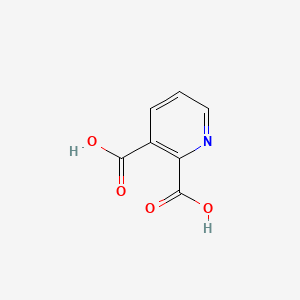
CAS 28605-84-7PubChem CID 1066
Quinolinic Acid
Quinolinic acid is a pyridinedicarboxylic acid that is pyridine substituted by carboxy groups at positions 2 and 3. It is a metabolite of tryptophan. It has a role as a NMDA receptor agonist, a mouse metabolite, an Escherichia coli metabolite and a human metabolite. It is a conjugate acid of a quinolinate and a quinolinate(1-). — ChEBI
- IUPAC name
- pyridine-2,3-dicarboxylic acid
- Molecular formula
- C7H5NO4
- Molecular weight
- 167.12 g/mol
- Exact mass
- 167.02185764 Da
- XLogP3
- 0.2
- Topological polar surface area
- 87.5 Ų
- Hydrogen-bond donors
- 2
- Hydrogen-bond acceptors
- 5
- Covalent units
- 1
- Defined stereocentres
- 0
Also known as
2,3-pyridinedicarboxylic acid89-00-9quinolinatePyridine-2,3-dicarboxylateF6F0HK1URNNSC-13127CHEBI:16675RefChem:389256
16 more reported names
CHEBI:132942201-874-8Pyridin-2,3-dicarbonsaeureAI3-630172,3-pyridine dicarboxylic acidpyridinedicarboxylic acidTocris-0225pyridine-2,3-carboxylateBSPBio_003143KBioGR_000711NSC-188362,3-pyridinedicarboxylateSR-01000075472EINECS 201-874-8UNII-F6F0HK1URNNSC 13127
External database identifiers
- ChEBI:CHEBI:16675
- ChEMBL:CHEMBL286204
- EPA DTXSID:DTXSID8041327
- PubMed:31678113
- PubMed:30876764
- PubMed:30130594
- PubMed:29981346
- PubMed:29702159
- PubMed:28336214
- PubMed:24211709
- PubMed:22982145
- PubMed:22939820
- PubMed:22900642
- PubMed:22875055
- PubMed:22860181
Retrieved from NIH PubChem on 2026-08-31 by checksum-valid CAS matching. Chemical properties do not replace the regulatory decision on this page.