
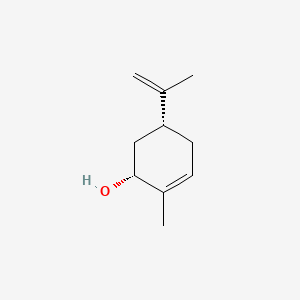
CAS 2102-59-2PubChem CID 330573
Carveol, cis-(-)-
(-)-cis-carveol is the (1R,5R)-stereoisomer of carveol. It is an enantiomer of a (+)-cis-carveol. — ChEBI
- IUPAC name
- (1R,5R)-2-methyl-5-prop-1-en-2-ylcyclohex-2-en-1-ol
- Molecular formula
- C10H16O
- Molecular weight
- 152.23 g/mol
- Exact mass
- 152.120115130 Da
- XLogP3
- 2.1
- Topological polar surface area
- 20.2 Ų
- Hydrogen-bond donors
- 1
- Hydrogen-bond acceptors
- 1
- Covalent units
- 1
- Defined stereocentres
- 2
Also known as
(-)-cis-Carveolcis-(-)-Carveol(1R)-cis-CarveolL-cis-Carveol(1R,5R)-(-)-cis-CarveolOOZ105PLI9(1R,5R)-2-methyl-5-(prop-1-en-2-yl)cyclohex-2-en-1-olcis-p-mentha-6,8-dien-2-ol
16 more reported names
(-)-(4R,6R)-cis-carveolCARVEOL, L-CIS-(4R,6R)-p-mentha-1,8-dien-6-ol(1R-cis)-2-Methyl-5-isopropenyl-2-cyclohexen-1-olCHEBI:227(1R-cis)-2-Methyl-5-(1-methylvinyl)cyclohex-2-en-1-olEINECS 218-270-5FEMA NO. 2247, CIS-(-)-2-Cyclohexen-1-ol, 2-methyl-5-(1-methylethenyl)-, (1R,5R)-p-Mentha-6,8-dien-2-ol, (2R,4R)-(-)-2-Cyclohexen-1-ol, 2-methyl-5-(1-methylethenyl)-, (1R-cis)-RefChem:5747481197-06-4Carveol, cis-(+/-)-cis-Carveol(4R,6R)-cis-Carveol
External database identifiers
- ChEBI:CHEBI:227
- EPA DTXSID:DTXSID60317646
- EPA DTXSID:DTXSID701036409
Retrieved from NIH PubChem on 2026-08-31 by checksum-valid CAS matching. Chemical properties do not replace the regulatory decision on this page.