
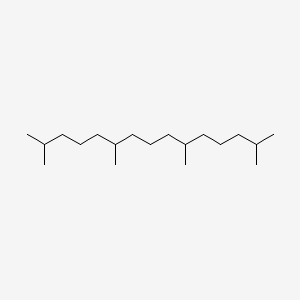
CAS 1921-70-6PubChem CID 15979
Pristane
Pristane is a norterpene that is an acyclic saturated hydrocarbon derived from phytane by loss of its C-16 terminal methyl group. It has a role as an immunological adjuvant and a biomarker. It is a norterpene and a long-chain alkane. — ChEBI
- IUPAC name
- 2,6,10,14-tetramethylpentadecane
- Molecular formula
- C19H40
- Molecular weight
- 268.5 g/mol
- Exact mass
- 268.313001276 Da
- XLogP3
- 9.3
- Topological polar surface area
- 0.0 Ų
- Hydrogen-bond donors
- 0
- Hydrogen-bond acceptors
- 0
- Covalent units
- 1
- Defined stereocentres
- 0
Also known as
NorphytaneNorphytanPentadecane, 2,6,10,14-tetramethyl-PristanNSC 11485226HZV48DT1NSC-114852CHEBI:53181
16 more reported names
RefChem:46199217-650-8tetramethylpentadecanemeso-Pristane2,6,10,10-TetramethylpentadecaneEINECS 217-650-82,6,10,14-tetramethyl-pentadecaneBRN 1720538UNII-26HZV48DT1Meso-formNorphytane;TMPDNorphytane, robuoyPRISTANE [MI]3-01-00-00570 (Beilstein Handbook Reference)2,10,14-TetramethylpentadecaneHSDB 8345
External database identifiers
Retrieved from NIH PubChem on 2026-08-31 by checksum-valid CAS matching. Chemical properties do not replace the regulatory decision on this page.