
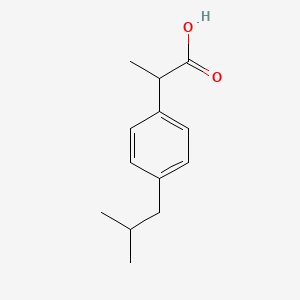
CAS 15687-27-1PubChem CID 3672
Ibuprofen, (+-)-
Ibuprofen is a monocarboxylic acid that is propionic acid in which one of the hydrogens at position 2 is substituted by a 4-(2-methylpropyl)phenyl group. It has a role as a geroprotector, a non-steroidal anti-inflammatory drug, a non-narcotic analgesic, an antipyretic, a xenobiotic, a radical scavenger, a cyclooxygenase 2 inhibitor, a cyclooxygenase 1 inhibitor, an environmental contaminant and a drug allergen. It is functionally related to a propionic acid. It is a conjugate acid of an ibuprofen(1-). — ChEBI
- IUPAC name
- 2-[4-(2-methylpropyl)phenyl]propanoic acid
- Molecular formula
- C13H18O2
- Molecular weight
- 206.28 g/mol
- Exact mass
- 206.130679813 Da
- XLogP3
- 3.5
- Topological polar surface area
- 37.3 Ų
- Hydrogen-bond donors
- 1
- Hydrogen-bond acceptors
- 2
- Covalent units
- 1
- Defined stereocentres
- 0
Also known as
RefChem:6648ibuprofen2-(4-Isobutylphenyl)propanoic acidBrufenMotrinAdvilMediprenNurofen
16 more reported names
LiptanNuprinAnflagenBuburoneButyleninIbuprocinAndranDolgitEbufacLamidonMynosedinEpobronHaltranIbumetinRoideninTrendar
External database identifiers
Retrieved from NIH PubChem on 2026-08-31 by checksum-valid CAS matching. Chemical properties do not replace the regulatory decision on this page.