
CAS 15356-70-4PubChem CID 1254
Menthol
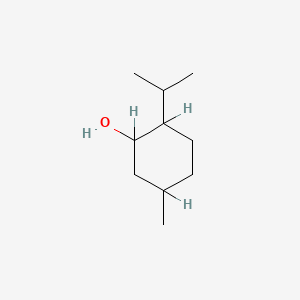
P-menthan-3-ol is any secondary alcohol that is one of the eight possible diastereoisomers of 5-methyl-2-(propan-2-yl)cyclohexan-1-ol. It has a role as a volatile oil component. It is a p-menthane monoterpenoid and a secondary alcohol. — ChEBI
- IUPAC name
- 5-methyl-2-propan-2-ylcyclohexan-1-ol
- Molecular formula
- C10H20O
- Molecular weight
- 156.26 g/mol
- Exact mass
- 156.151415257 Da
- XLogP3
- 3.0
- Topological polar surface area
- 20.2 Ų
- Hydrogen-bond donors
- 1
- Hydrogen-bond acceptors
- 1
- Covalent units
- 1
- Defined stereocentres
- 0
Also known as
1490-04-62-Isopropyl-5-methylcyclohexanolMenthyl alcoholMentholumCaswell No. 540Mineral ice5-Methyl-2-(1-methylethyl)cyclohexanol3-Hydroxy-p-menthane
16 more reported names
2-Isopropyl-5-methylcyclohexan-1-olCCRIS 9231EINECS 216-074-4EPA Pesticide Chemical Code 051601HSDB 593AI3-08161Therapeutic mineral iceMENTHOL, UNSPECIFIED FORMEC 216-074-41-Methyl-4-isopropyl-3-cyclohexanolFisherman's friend lozengesUNII-L7T10EIP3ABOHENAORefChem:6462MENTHOL (II)MENTHOL (MART.)
External database identifiers
- ChEBI:CHEBI:25187
- ChEMBL:CHEMBL256087
- EPA DTXSID:DTXSID8029650
- PubMed:22953891
- PubMed:22944434
- PubMed:22878261
- PubMed:22649749
- PubMed:22064618
- PubMed:21964764
- PubMed:21754537
- PubMed:21754488
- PubMed:21720039
- PubMed:21665944
- PubMed:21624153
- PubMed:21615034
Retrieved from NIH PubChem on 2026-08-31 by checksum-valid CAS matching. Chemical properties do not replace the regulatory decision on this page.