
CAS 15347-57-6PubChem CID 9317
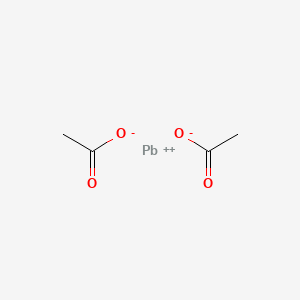
Lead diacetate
Lead acetate is a chemical compound made by treating lead(II) oxide with acetic acid. Due to its sweet taste, it was used as a sweetner before its toxicity was recognized. Today it can be found in low concentrations in some hair dyes. Lead is a heavy metal and stable element with the symbol Pb and the atomic number 82, existing in metallic, organic, and inorganic forms. It is mainly found in nature as the mineral galena (PbS), cerussite (PbCO3) or anglesite (PbSO4), usually in ore with zinc, silver, or copper. (L21, L405) — Toxin and Toxin Target Database (T3DB)
- IUPAC name
- lead(2+) diacetate
- Molecular formula
- C4H6O4Pb
- Molecular weight
- 325 g/mol
- Exact mass
- 326.00326 Da
- Topological polar surface area
- 80.3 Ų
- Hydrogen-bond donors
- 0
- Hydrogen-bond acceptors
- 4
- Covalent units
- 3
- Defined stereocentres
- 0
Also known as
301-04-2Lead(II) acetateLead di(acetate)Acetate de plombAcetic acid lead(2+) saltAcetic acid, lead(2 +) saltPb(CH3COO)2RefChem:55457
16 more reported names
CHEBI:31767Plumbous acetateSalt of saturnSugar of leadAcetic acid, lead saltNormal lead acetateDibasic lead acetateLead dibasic acetateLead(2+) acetatelead(2+);diacetateLead acetate (Pb(Ac)2)Acetic acid, lead(2+) saltLead acetate anhydrousLead acetate (Pb(O2C2H3)2)Lead(II) Acetate [for Perovskite precursor]KL498O6790
External database identifiers
Retrieved from NIH PubChem on 2026-08-31 by checksum-valid CAS matching. Chemical properties do not replace the regulatory decision on this page.