
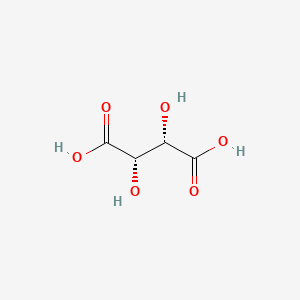
CAS 147-71-7PubChem CID 439655
D-Tartaric acid
D-tartaric acid is the D-enantiomer of tartaric acid. It has a role as an Escherichia coli metabolite. It is a conjugate acid of a D-tartrate(1-). It is an enantiomer of a L-tartaric acid. — ChEBI
- IUPAC name
- (2S,3S)-2,3-dihydroxybutanedioic acid
- Molecular formula
- C4H6O6
- Molecular weight
- 150.09 g/mol
- Exact mass
- 150.01643791 Da
- XLogP3
- -1.9
- Topological polar surface area
- 115.0 Ų
- Hydrogen-bond donors
- 4
- Hydrogen-bond acceptors
- 6
- Covalent units
- 1
- Defined stereocentres
- 2
Also known as
D-(-)-Tartaric acid(-)-Tartaric acidD-threaric acid(-)-D-Tartaric acid(S,S)-Tartaric acid(2S,3S)-(-)-Tartaric acid(2S,3S)-Tartaric acid(-)-(S,S)-Tartaric acid
16 more reported names
(S,S)-(-)-Tartaric acidunusual tartaric acidRRX6A4PL3CTARTARIC ACID, D-UNNATURAL TARTARIC ACIDCHEBI:15672RefChem:130683GlyTouCan:G95238FE205-695-6(2S,3S)-2,3-Dihydroxysuccinic acidD(-)-TARTARIC ACIDButanedioic acid, 2,3-dihydroxy-, (2S,3S)-133-37-9C4H6O6S-Bacampicillinlevo-Tartaric acid
External database identifiers
- ChEBI:CHEBI:15672
- ChEMBL:CHEMBL1200861
- EPA DTXSID:DTXSID4043775
- EPA DTXSID:DTXSID5046986
- PubMed:22983504
- PubMed:22287180
- PubMed:22267127
- PubMed:22192415
- PubMed:21876672
- PubMed:21739986
- PubMed:21582633
- PubMed:21580069
- PubMed:21522796
- PubMed:21202277
- PubMed:21151879
- PubMed:20882599
Retrieved from NIH PubChem on 2026-08-31 by checksum-valid CAS matching. Chemical properties do not replace the regulatory decision on this page.