
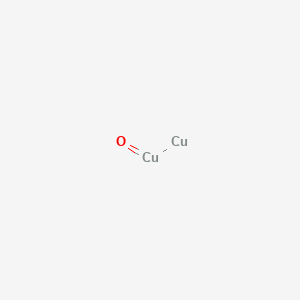
Copper oxide (Cu2O)
Copper(I) oxide is an oxide of copper. It is found naturally as the mineral cuprite and is formed by the slow oxidation of copper when exposed to oxygen. Copper(I) oxide is commonly used as a pigment, a fungicide, and an antifouling agent for marine paints. It is also a semiconductor. Copper is a chemical element with the symbol Cu and atomic number 29. Copper is an essential elements in plants and animals as it is required for the normal functioning of more than 30 enzymes. It occurs naturally throughout the environment in rocks, soil, water, and air. (L277, L278, L288) — Toxin and Toxin Target Database (T3DB)
- IUPAC name
- copper;oxocopper
- Molecular formula
- Cu2O
- Molecular weight
- 143.09 g/mol
- Exact mass
- 141.854109 Da
- Topological polar surface area
- 17.1 Ų
- Hydrogen-bond donors
- 0
- Hydrogen-bond acceptors
- 1
- Covalent units
- 2
- Defined stereocentres
- 0
Also known as
16 more reported names
Retrieved from NIH PubChem on 2026-08-31 by checksum-valid CAS matching. Chemical properties do not replace the regulatory decision on this page.