
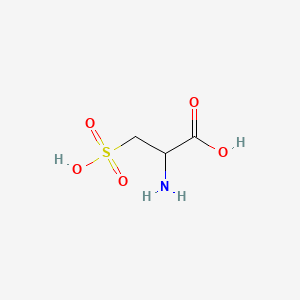
DL-Cysteic acid
Cysteic acid is an amino sulfonic acid that is the sulfonic acid analogue of cysteine. It has a role as an animal metabolite. It is an alanine derivative, a cysteine derivative, an amino sulfonic acid, a carboxyalkanesulfonic acid and a non-proteinogenic alpha-amino acid. — ChEBI
- IUPAC name
- 2-amino-3-sulfopropanoic acid
- Molecular formula
- C3H7NO5S
- Molecular weight
- 169.16 g/mol
- Exact mass
- 169.00449350 Da
- XLogP3
- -4.5
- Topological polar surface area
- 126.0 Ų
- Hydrogen-bond donors
- 3
- Hydrogen-bond acceptors
- 6
- Covalent units
- 1
- Defined stereocentres
- 0
Also known as
16 more reported names
External database identifiers
- ChEBI:CHEBI:21260
- ChEMBL:CHEMBL1171434
- EPA DTXSID:DTXSID40862048
- PubMed:23107541
- PubMed:23044173
- PubMed:22864822
- PubMed:22815635
- PubMed:22689630
- PubMed:22685715
- PubMed:22487448
- PubMed:22331997
- PubMed:22264203
- PubMed:22146536
- PubMed:21977904
- PubMed:21953265
Evidence from additional scientific databases
NIH PubChem PUG-View
Attributed physical-property, hazard, environmental and use annotations.
- Physical Description: Solid; [Merck Index] Source: Haz-Map, Information on Hazardous Chemicals and Occupational Diseases
- Physical Description: Solid Source: Human Metabolome Database (HMDB)
- Signal: Warning Source: European Chemicals Agency (ECHA)
- GHS Hazard Statements: H315 (100%): Causes skin irritation [Warning Skin corrosion/irritation]; H319 (100%): Causes serious eye irritation [Warning Serious eye damage/eye irritation]; H335 (100%): May cause respiratory irritation [Warning Specific target organ toxicity, single exposure; Respiratory tract irritation] Source: European Chemicals Agency (ECHA)
- Precautionary Statement Codes: P261, P264, P264+P265, P271, P280, P302+P352, P304+P340, P305+P351+P338, P319, P321, P332+P317, P337+P317, P362+P364, P403+P233, P405, and P501 (click each P-code to see the statement) Source: European Chemicals Agency (ECHA)
- ECHA C&L Notifications Summary: The GHS information provided by 1 company from 1 notification to the ECHA C&L Inventory. Source: European Chemicals Agency (ECHA)
- Sources/Uses: An amino acid with a C-terminal sulfonic acid group which has been isolated from human hair oxidized with permanganate. It occurs normally in the outer part of the sheep's fleece, where the wool is exposed to light and weather. [ChemIDplus] Source: Haz-Map, Information on Hazardous Chemicals and Occupational Diseases
Mapped by: Existing checksum-valid CAS to unique PubChem CID match. Retrieved: 2026-08-31. Open source record
Scientific classifications and hazard annotations provide context and do not replace the market-specific regulatory decision shown above.
Additional source coverage and match status
| Source | Result | Checked |
|---|---|---|
| NIH PubChem PUG-View | Exact match | 2026-08-31 |
A recorded no-match is useful evidence that the source was checked; it is not a claim that the substance does not exist elsewhere.
Retrieved from NIH PubChem on 2026-08-31 by checksum-valid CAS matching. Chemical properties do not replace the regulatory decision on this page.